Arriving earlier used to mean capturing exceptional prices, with returns high enough to justify virtually any level of investment. Today, this logic is no longer absolute, because those who arrive first are no longer alone. The issue is no longer how much we produce: the challenge lies in the value we are able to generate from those volumes.
The Chilean cherry industry is entering a new phase. This is not a crisis in the classic sense, but rather a turning point that requires a profound rethinking of the productive, commercial and strategic model. It is precisely in this context that early cherries have changed their role.
Where they once represented an opportunity, today they are becoming a discipline. It is no longer enough to “arrive first”: now it is necessary to do so at exactly the right moment, with the right condition and with a clear commercial strategy.
In this new scenario, early production therefore ceases to be a refuge for high prices and becomes one of the most demanding segments of the business. The reason is simple: it concentrates the highest level of uncertainty and, at the same time, has the greatest impact on the market signal.
The early window, between weeks 41 and 43, has become extremely sensitive. Small variations in volume, quality or timing generate disproportionate effects on prices. In practice, this means that success no longer depends solely on the productive potential of the orchard, but on the ability to execute with agronomic and logistical precision.
Concept of competitiveness
Today, a competitive early cherry project is not simply one that manages to produce earlier, but one capable of meeting three critical conditions simultaneously:
- real earliness, measured in actual days of arrival on the market;
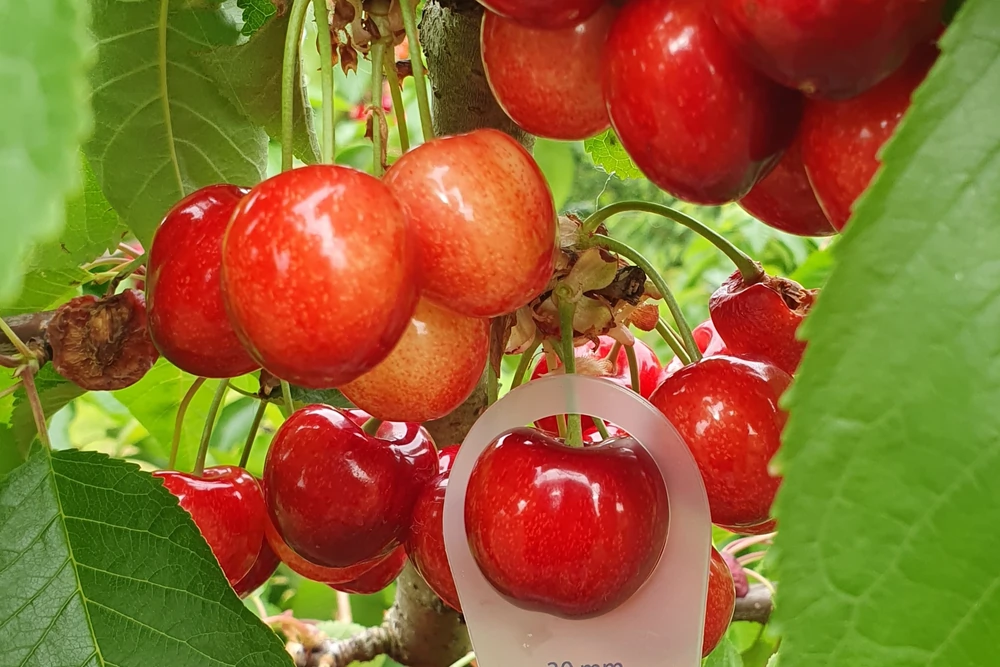
- consistent fruit condition, especially in terms of firmness, size and soluble solids;
- productive stability, avoiding high levels of variability from one season to the next.
According to this logic, early cherries are positioned as a high-standard technical system, in which agronomy, technology and climate management cease to be complementary tools and become structural elements of the production model.
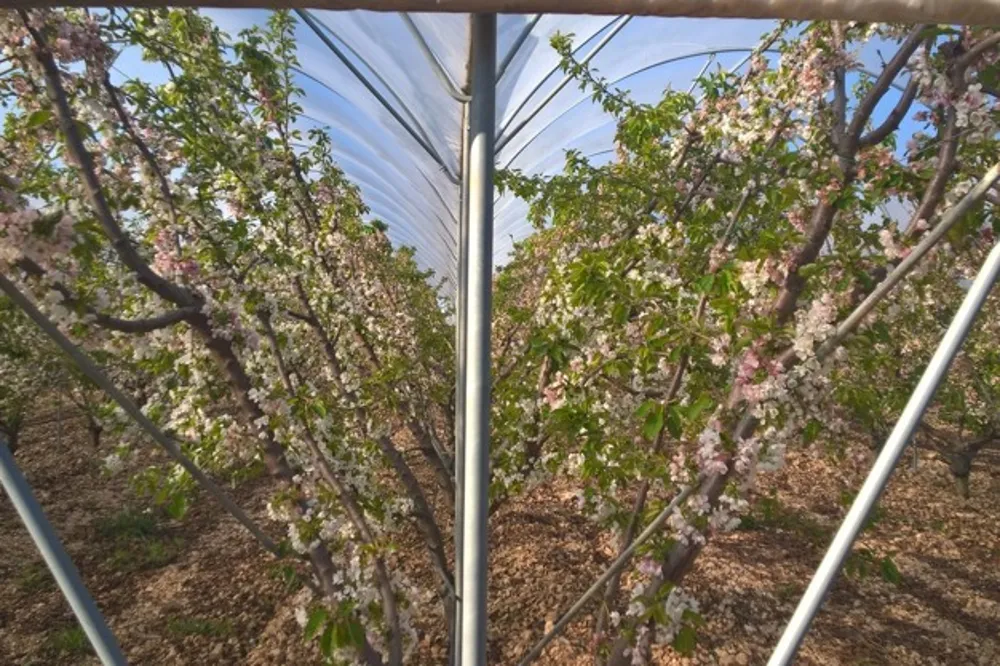
The use of covers, radiation management, dormancy induction and breaking strategies, together with accurate climate interpretation, are no longer differentiating factors, but necessary conditions for competing.
In this context, early production also takes on a new role within the industry: it becomes a strategic laboratory.
What happens at this stage does not only anticipate prices, but also provides signals on consumer behavior, quality tolerance and the market’s absorption capacity. In other words, early cherries generate not only economic returns, but also essential information for making decisions throughout the rest of the season. For this reason, their future development will not be determined exclusively by the expansion of planted areas, but by the ability to build more sophisticated, controlled production systems that are less dependent on chance.
Early cherries, therefore, do not disappear as a competitive advantage, but profoundly change their nature: from an opportunity linked to timing, they become a precision business.
THE NATIONAL CONTEXT: THE TURNING POINT
As recently highlighted, the change in perspective regarding early cherries is taking place in the middle of a new cycle for the industry.
In less than a decade, Chile has gone from being a relevant player to becoming the world’s leading exporter, with an area exceeding 77,000 hectares and volumes surpassing 120 million boxes. This growth has not only transformed the scale of the business, but also its nature.
For years, the market accompanied this expansion. China absorbed the growth, validated the model and supported prices that made it possible to justify aggressive investments. But when volumes reach a certain scale, the market stops behaving like a niche.
Cherries have ceased to be an exclusively premium product and have become a fruit consumed regularly during the Chinese winter. This change completely redefines the level of demand: greater consistency, higher quality and less tolerance for error.
In this way, Chile is not only facing a decline in prices, but the natural adjustment of an industry that has grown faster than its ability to organize supply.
REDUCING PLANTED AREAS? A NECESSARY BUT INCOMPLETE DEBATE
Everything that has emerged recently has strongly brought the issue of reducing planted areas back to the center of the debate, with the idea of removing between 20,000 and 30,000 hectares as a direct way to rebalance supply. However, framing the matter in these terms excessively simplifies a structural problem.
Chilean fruit growing has already undergone major adjustment processes, as in the case of table grapes or apples. Cherries, however, present a fundamental difference: the market still exists, continues to grow and remains attractive.
The problem is not a lack of demand, but the way in which supply reaches the market. For this reason, the most likely adjustment will not be a massive and coordinated removal of orchards, but a more selective process:
- exit of less competitive orchards;
- conversion of marginal projects;
- varietal adjustments;
- productive reorganization.
We can therefore speak of an economic adjustment driven by profitability. From this point of view, the case of kiwifruit is particularly significant. The industry did not only reduce planted areas, but also developed quality and maturity assurance programs, establishing minimum standards for export.
The removal of hectares can certainly happen, but it will not be the core of the adjustment. The real lesson lies in organizing supply not only in terms of quantity, but also quality.
THE REAL CHANGE: FROM VOLUME TO VALUE
If there is one central idea in this new scenario, it is that the focus must change. The issue is no longer how much we produce: the challenge lies in the value we are able to generate from those volumes. And this implies profound transformations.
First, a real segmentation of supply. Not all fruit can be destined for the same market or follow the same commercial logic. Second, it is necessary to understand that quality has ceased to be a distinguishing element: today it is a minimum condition for competing. In saturated markets, fruit that arrives in poor condition does not only lose value, but also damages the perception of the entire product.
Third, progress must be made in diversification. Dependence on China, while it has been a strength, also represents a structural risk. Finally, the production calendar needs to be organized. Avoiding extreme concentrations of fruit in limited periods is essential to support prices and stability.
The rule, therefore, is clear: the future of the business does not lie in producing more fruit, but in producing the right fruit, at the right time and for the most suitable market.
But focus is not the only element changing. The economic scenario of the business has also changed significantly. For years, margins made it possible to absorb mistakes, inefficiencies and even poor decisions. Today, the reality is different. Production costs are in ranges close to 1.8-2.2 dollars/kg (around 1.66-2.02 euros/kg), while in moments of strong supply pressure, prices have fallen to levels of 3-3.5 dollars/kg (around 2.76-3.22 euros/kg). This reduces margins and completely changes the logic of the system.
When the business loses room for maneuver, it stops being expansive and becomes selective. Not all orchards are sustainable, not all projects can withstand the pressure and not all production areas have the same outlook. This process, however demanding, is necessary, because it allows the industry to be refined and prepared for a more mature phase.
Jorge Astudillo Gálvez
Agricultural Engineer, consultant and early cherry producer
Image source: Stefano Lugli
Cherry Times - All rights reserved