The Italian season of 2026 sweet cherries confirms a trend that is now clear across the entire stone fruit sector: producing high-quality fruit is increasingly linked to the ability to coexist with an unpredictable climate. Rain, hailstorms, spring frosts, fruit cracking and price pressure continue to challenge growers.
Yet in the Euganean Hills, and particularly in the Vò area, in the province of Padua, the sweet cherry remains much more than a crop. It is a sign of belonging, a family farming memory and a product that speaks directly to consumers. EastFruit collected the testimony of Laura Ambrosi, representative of a family-run business that has been growing cherries for generations in this part of Veneto.
A short-season, fragile fruit with a strong identity
In Italy, the sweet cherry is never just a summer fruit. Its season is short, harvesting requires a great deal of manual labour, and every result depends on a delicate balance between size, flavour, freshness and weather conditions.
In Vò, among vineyards, olive groves and orchards, many growers have maintained a model far removed from long supply chains and large-scale retail. Sales are based above all on freshness, direct relationships and trust.
Laura Ambrosi explains that the farm’s cherries are sold directly on site, from the orchard. According to her, this area is one of the most important sweet cherry production zones in the Euganean Hills. For many local families, the sweet cherry is part of the area’s agricultural tradition.
Around 300 trees and production focused on the fresh market
The Ambrosi family farm has around 300 cherry trees. At the time of the visit, part of the harvest had already been completed, while the last fruits still remained on the trees.
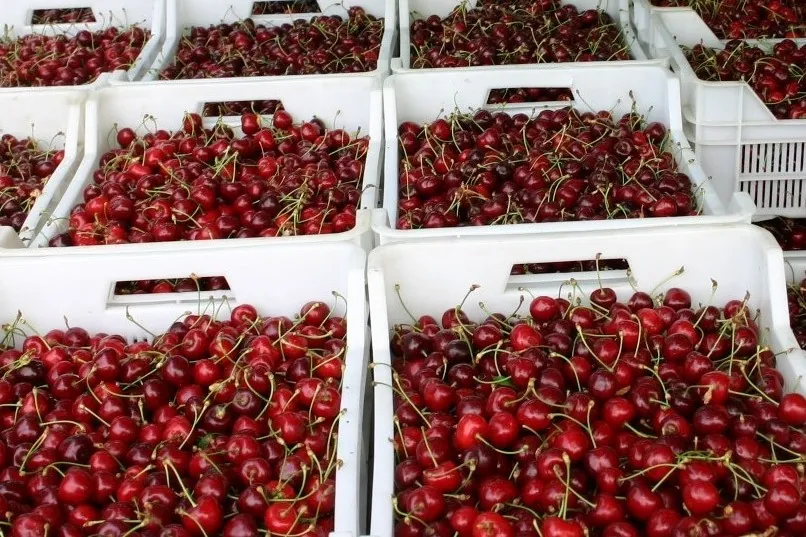
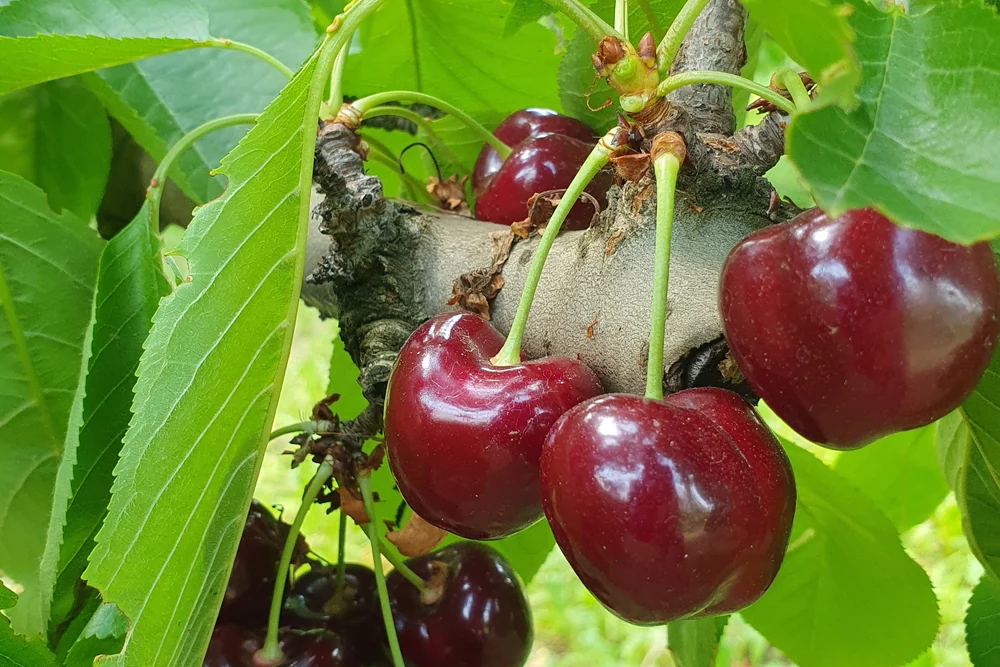
Among the varieties shown by Laura is Ferrovia, one of the most recognisable Italian sweet cherries, also appreciated for its heart shape and long stem. For the fresh market, these characteristics are crucial: consumers look at taste, colour, shape, size and the freshness of the stem.
In 2026, the farm’s fruit reached significant sizes, up to 30 mm. Laura emphasises that production was high: such an abundant harvest had not been seen for five or six years.
For buyers, the sweet cherry is often the first pleasure of summer. For those who grow it, however, it is the result of months of waiting, work and risk.
Lower cherry trees, larger fruit
Sweet cherry cultivation has changed significantly in recent decades. Laura recalls that in the past, trees were very tall, could live for a long time and required ladders for harvesting, making the work harder and riskier for operators.
Today, new orchards are designed with smaller trees that are easier to manage and capable of entering production quickly. While in the past a cherry tree could grow for 20 or 30 years, today trees begin producing after just two or three years. They live shorter lives, but allow for a faster return on investment and fruit of larger size.
Kateryna Zvierieva, head of the international EastFruit platform and an agrimarketing specialist, interprets this evolution as part of a broader transformation in modern horticulture: greater work safety, more efficient orchard management, product quality and faster economic valorisation.
After difficult years, a positive season
For the Ambrosi family, 2026 was a good year, especially compared with previous seasons. Laura recalls that last year and the year before, the harvest had been weak due to April frosts, cold damage and rains that had compromised production.
According to Kateryna Zvierieva, this is a common situation for many European sweet cherry growers. Spring frosts, persistent rain before harvest, hail and sudden temperature fluctuations are now among the main risk factors for stone fruit.
The sweet cherry is particularly vulnerable in the weeks leading up to harvest. A single intense rainfall event can cause cracking in the fruit, reduce marketability, worsen shelf life and severely limit sales opportunities. For those working in the fresh market, this means losing not only volume, but also value.
“Every year is a lottery”
When asked about the impact of climate risks in the Euganean Hills, Laura has no doubts: in recent years, the change has become evident. She recalls a recent hailstorm accompanied by heavy rain: damage on her farm was limited, but in other areas the situation was much more serious.
For growers, the climate is no longer an abstract issue. In Vò, two years ago, a flood caused a drainage canal to overflow, destroying numerous agricultural crops. This leads to the most effective summary of the current situation: climate change exists and, for those who grow fruit, every season increasingly feels like a lottery.
Grapes also show the shift in the agricultural calendar
In the Euganean Hills, vines are another clear indicator of the seasonal shift. Laura says that when she was a child, the grape harvest began at the start of September, in the first week of the month. Today, however, the grape harvest can begin as early as 10 to 13 August.
In less than 20 years, the calendar has shifted by almost a month. Laura’s mother recalled that, in the past, school in Veneto started in October precisely because many families were busy with the grape harvest throughout September. Today, by October, the first wine has practically already been produced, because harvesting ends at the beginning of September.
This change does not concern wine alone. It affects the entire agricultural organisation: flowering, harvesting, labour availability, commercial planning and the communication of seasonal products.
The value of direct sales
For Kateryna Zvierieva, the story of the cherries from Vò shows how a local product can become a competitive advantage when supported by quality, trust, a short supply chain and identity of origin.
Direct sales from the orchard are particularly interesting for delicate and perishable fruits such as sweet cherries. The grower retains more value, the consumer receives an extremely fresh product, and the territory preserves a recognisable connection with its agriculture.
The Euganean Hills, together with the thermal spa area of Abano and Montegrotto, are also a tourist destination visited by people from several countries. This offers further opportunities for local producers, especially when the agricultural product becomes part of the experience of the territory.
Zvierieva notes that this lesson is also useful for Eastern Europe, including Ukraine, where local fruit is often assessed mainly in terms of tonnes, yields and prices. The market, however, is increasingly looking at origin, the grower’s story, trust, taste and sustainability.
From anonymous fruit to a product with a story
The experience of the Ambrosi family shows that even a small grower can create value when the product is not perceived as an anonymous commodity. The cherries from Vò are fruits harvested in a specific place, by a specific family, within a recognisable agricultural tradition.
For the consumer, this means freshness and trust. For the farmer, it means reducing exclusive dependence on the wholesale market and on price fluctuations. For the territory, it means defending a productive identity.
This model does not eliminate climate risks, but it helps retain more value along the supply chain. This is especially important when dealing with premium sizes, recognisable varieties, direct communication and seasonal agritourism.
The sweet cherry as a new language of agrimarketing
The story of Laura Ambrosi and the family orchard in Vò reflects a broader transformation in European agricultural marketing. Today, producing good fruit is no longer enough: growers must explain why it is special, where it comes from, who harvests it, how the climate affected the season and why quality, taste and freshness have a price.
The sweet cherries of the Euganean Hills are a short-season product, highly sensitive to weather and strongly connected to the territory. This is precisely why they need professional communication capable of linking product, place, people and market.
In 2026, for the Ambrosi farm, the season brought a finally positive harvest after several complicated years. But the message coming from Vò goes beyond a single year: today, the sweet cherry is not measured only in kilograms. Its value also depends on the grower’s ability to preserve quality, trust and a connection with the territory, in a context where the climate makes every season increasingly less predictable.
Source: EastFruit
Image source: Stefano Lugli
Cherry Times - All rights reserved