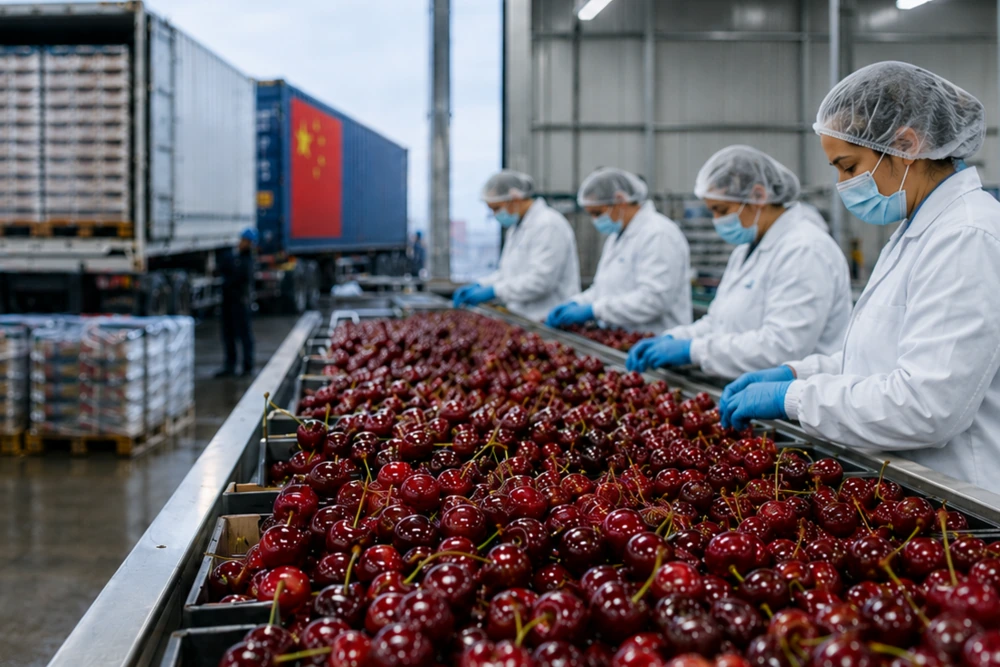
In Ukraine, cherry orchards intended for industrial production continue to attract growers’ attention. Interest is being driven by rising demand, the opportunities offered by processing and, above all, the possibility of reducing costs through mechanized harvesting.
Before establishing new orchards, however, operators are closely monitoring prices, regional competition and the technical characteristics needed to make orchards more efficient.
According to Taras Bashtannyk, president of the Ukrainian Fruit and Vegetable Association, demand for cherries is increasing and a growing number of producers are considering investments in new plantations.
The trend, therefore, is not linked only to seasonal price fluctuations, but is part of a broader discussion about the future of processing, available technologies and orchard design.
Stable production, but prices enter the seasonal decline phase
This year’s cherry harvest is not lower than last year’s and, in some regions, volumes are even higher.
At the same time, the market has already entered the traditional phase of seasonal price decline. For farms, this means that profitability will not depend exclusively on production yields.
Other key factors will include cost control, the ability to work with processing companies and the capacity to harvest the fruit at the right time.
Competition from Poland and Serbia influences the market
The international market also affects Ukrainian cherry prices. Prices are influenced by production volumes from Poland, Serbia and other supplying countries in the region.
When harvests in neighboring countries are abundant, Ukrainian growers can face greater price pressure even when domestic demand remains stable. Conversely, tighter fruit availability can increase competition between processing companies and fresh-market buyers.
For those considering new investments, the ability to operate across different sales channels therefore becomes a central element of planning.
Mechanized harvesting changes the production model
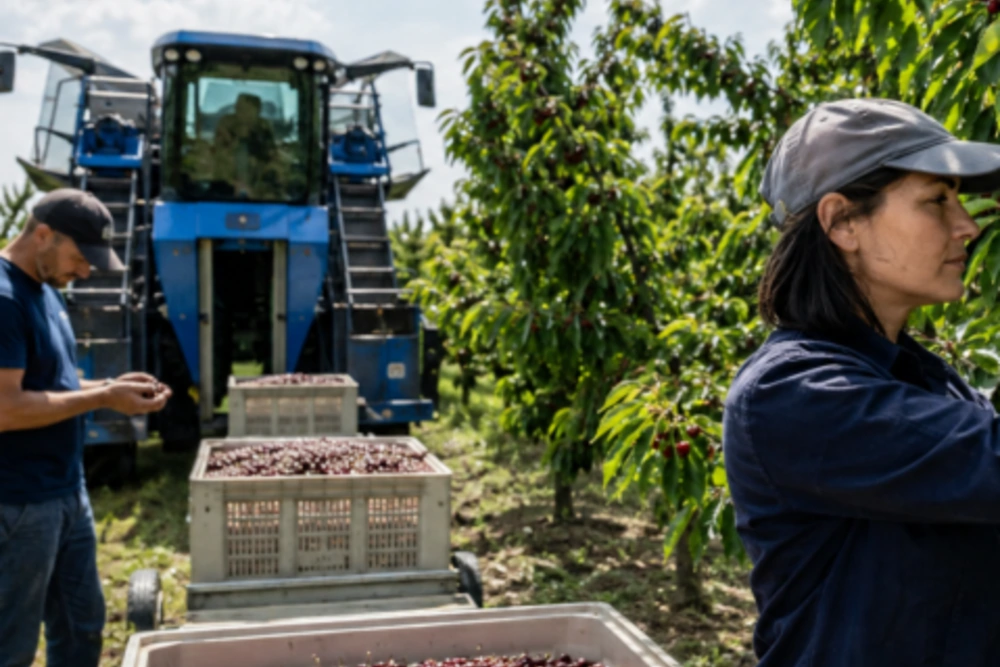
One of the most significant technological developments concerns the mechanization of harvesting. Ukraine already has at least five specialized machines for cherry harvesting, although the actual number may be higher.
For cherries intended for processing, the use of machinery can contribute significantly to reducing production costs. This is a particularly important advantage for farms supplying juice, frozen products, fillings and other industrial outlets rather than relying exclusively on fresh-market sales.
Mechanization can therefore become one of the key factors in making large-scale orchards dedicated to industrial production economically sustainable.
New cherry orchards must be designed with machinery in mind
The introduction of mechanized harvesting, however, cannot automatically be applied to every existing orchard.
Achieving good levels of efficiency requires a suitable planting system, varieties and rootstocks compatible with the production model, as well as an appropriate tree training system. Some older orchards may therefore be poorly suited to modern harvesting equipment.
New projects, on the other hand, can be designed from the outset around the needs of industrial production, integrating mechanized harvesting, cold storage and structured relationships with processing companies.
An opportunity linked to the design of the entire supply chain
Interest in industrial cherry orchards in Ukraine therefore appears likely to focus increasingly on projects built around a clearly defined production model.
For investors, the potential lies not only in developing new orchard areas, but also in designing orchards compatible with mechanization, connected to processing and organized to ensure operational continuity and cost control.
In this scenario, technology and orchard design could become just as decisive as production itself in determining the future competitiveness of Ukraine’s industrial cherry sector.
Text and image source: good-time-invest.com
Cherry Times - All rights reserved