An independent study conducted by a prestigious Italian institution confirms the benefits of Europollen-assisted pollination on cherry and kiwi crops, with a significant increase in yield observed in the latter.
In a major milestone for agrotechnology applied to fruit growing, the University of Bologna (Alma Mater Studiorum), through its Department of Agricultural and Food Sciences, has published the results of an independent scientific trial validating the effectiveness of assisted pollination using Europollen technology, developed by Zimex.
The study, led by Professor Brunella Morandi and completed in May 2025, was carried out in commercial orchards in the Emilia-Romagna region during the 2025 growing season. The findings provide a solid scientific basis for adopting assisted pollination as a complementary tool in Europe to address structural productivity challenges in high-value commercial crops such as Kordia cherries and Dori kiwifruit.
This work is also part of the technical collaboration between Zimex and the North American company Antles Pollen, which brings 95 years of experience in assisted pollination. Its historical expertise in pollen management, storage, and application is key to the development and international deployment of Europollen technology.
Experimental design
The sweet cherry trial was conducted in a Kordia cultivar orchard grafted onto Gisela 6, located in Bomporto (Modena, Italy), where severe pollination issues had been reported. The grower had historically observed low productivity due to poor pollination of the cultivar, despite the regular introduction of bumblebees into the orchard during the flowering period. Kordia is known as a “self-incompatible” cultivar, with significant pollination challenges if not planted near other varieties that bloom simultaneously, as was the case in the commercial orchard under study.
The orchard, trained in a V-system, was covered with a single-row white multifunctional net (rain and insect protection), which remained closed during pollination. The orchard was planted in 2021 with a north-south orientation. Tree spacing was 1.5 m within rows and 3.5 m between rows, resulting in a density of 1,905 trees/ha. Two main areas were selected within the orchard and kept separated by opening a single-row net in the middle. Two treatments were established at opposite ends of the orchard, each involving 16 trees:
- Control: trees located as far as possible from pollen-enriched hives
- Artificial pollination: trees located near pollen-enriched hives.
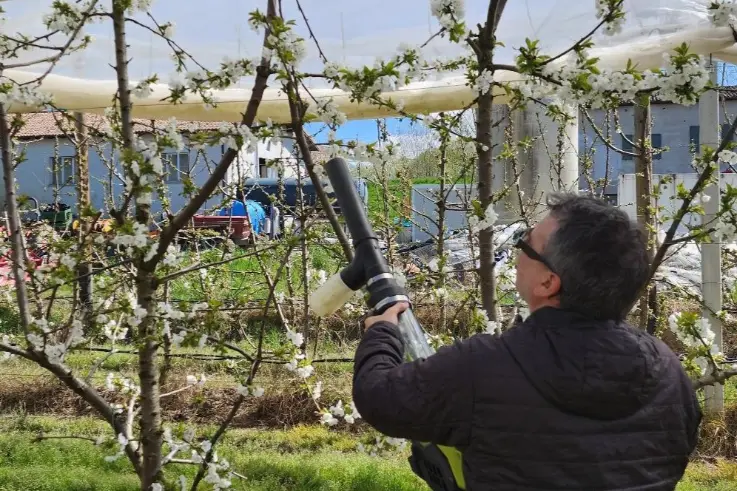
Hives were introduced, with half placed on one side of the orchard and the other half on the opposite side. Hives for each treatment were kept separate, at a distance of 80 m (0.08 km). Artificial pollen, shipped frozen from the producing company in Chile, was regularly distributed at the entrance of the hive groups closest to the treated trees.
The applied pollen corresponded to the Skeena and Rainier varieties. It was distributed early in the morning during the Kordia flowering period. Full bloom occurred on March 31, while harvest took place on June 27. During full bloom (April 4), some precipitation events occurred, with a peak of less than 10 mm in May. No frost events were recorded during this period.
Assessments and methodology
Fruit set evaluation The fruit set percentage was estimated on 4 branches per tree, evenly distributed across the canopy (north/south directions), with a total of 64 branches per treatment evaluated. The number of flowers per branch was counted just before bloom, while the number of set fruits was assessed at 87 DAFB on the selected branches. In the sweet cherry orchard, flower counts were conducted on April 4, and fruit set was measured on both April 30 and May 27, 2025, corresponding to approximately 20 and 50 days after full bloom (DAFB). At the same time, the diameter of each selected shoot was measured using a digital caliper.
Yield and fruit quality evaluation On June 26, 2025, for both treatments, fruit yield per selected tree was measured at harvest using a scale, while the equatorial diameter of a total of 100 fruits per selected tree was measured with a digital caliper. The following parameters were then averaged per treatment, and standard error was calculated:
- Shoot equatorial diameter
- Number of flowers per shoot
- Number of set fruits per shoot
- % fruit set
- % fruit drop
- Yield (kg/tree)
- Fruit equatorial diameter For each parameter, treatments were compared using a Student’s t-test.
Trunk diameter evaluation On November 21, for both treatments, trunk diameter was measured on each selected tree at 50 cm above the grafting point. Measurements were taken using a digital caliper. Statistical analysis A t-test in Excel was used to compare mean values between the two treatments for each parameter. For non-parametric data, a Wilcoxon test was performed.
Results
The results obtained for each of the parameters listed above are reported in Table 1:
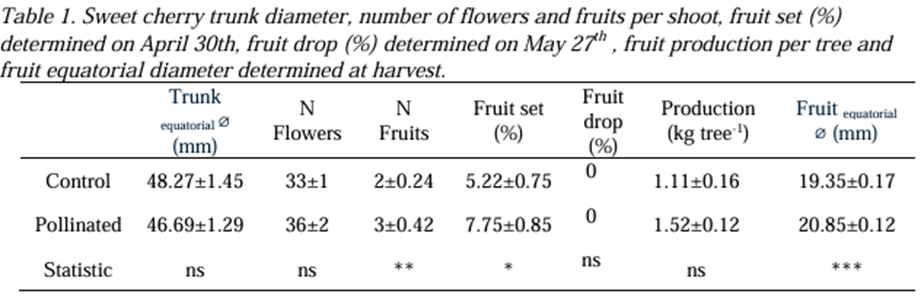 Table 1. Sweet cherry trunk diameter, number of flowers and fruits per shoot, fruit set percentage (%) measured on April 30, fruit drop percentage (%) measured on May 27, fruit yield per tree, and fruit equatorial diameter measured at harvest.
In the sweet cherry experimental trial, significant differences between the two treatments were observed across several morphological and reproductive parameters. Although the number of flowers per shoot was slightly higher in the pollen-treated group, this difference was not statistically significant. A significantly higher number of set fruits was observed in the pollinated treatment, averaging 3 fruits per shoot compared to 2 in the control (P < 0.01).
However, the fruit set percentage was similar between treatments, although slightly higher in the pollinated group, possibly due to shoot diameter. At harvest, the average fruit diameter was significantly greater in the pollinated treatment, reaching 20.85±0.12 mm compared to 19.35±0.17 mm (P < 0.001).
The lack of differences in both fruit set percentage and yield between treatments may be attributed to low pollen viability or to the strong foraging capacity of bees, which can travel long distances and visit a high number of flowers.
The open separation between the two treatments may therefore have been ineffective. In any case, the grower confirmed that this season was characterized by a significantly higher pollination rate compared to previous years, which may have been due to favorable seasonal conditions, the presence of honeybees instead of bumblebees, or the application of an external pollen source.
Conclusions
The results of these experiments indicate a positive effect of assisted pollination using an external pollen source on fruit set percentage and fruit quality in Kordia sweet cherries.
Source: Europollen, Zimex, University of Bologna
Image source: Andres Bastos
Cherry Times - All rights reserved