The recent cases of sudden death confirm that Pseudomonas syringae and wood diseases will continue to pose a challenge for the cherry industry. The combination of applied research, diagnostics, integrated management and timely field decisions will be essential to support healthy crop development.
Bacterial canker, caused by Pseudomonas syringae, has been present in Chilean fruit growing for decades. However, its recent behaviour has raised alarm signals across the sector, particularly in young Santina orchards. The speed of disease progression, the aggressiveness of symptoms and the increasing number of cases have taken technicians and growers by surprise, reopening a debate once thought to be closed: do we really understand the current dynamics of this disease?
What was once addressed as a localised and seasonal problem now appears as a far more complex phenomenon, in which pathogen, climate and physiological stress interact, generating highly severe scenarios. Field evidence collected by Abud & Cía. shows that during vegetative regrowth, apparently healthy trees can collapse within a few days, with buds failing to open, shoots becoming necrotic and complete loss of the aerial part. In the most severe cases, mortality can reach 10–30%, compromising orchard structure, early entry into production and long-term sustainability.
Although all
Although all cultivars can be affected by P. syringae pv. syringae, studies such as Vanneste (2017) indicate that Santina shows greater sensitivity, even when defence mechanisms are rapidly activated, compared to Bing. This condition is exacerbated in cold climates and low-vigour soils, where the most severe cases have been recorded over the past two seasons.
Wood diseases
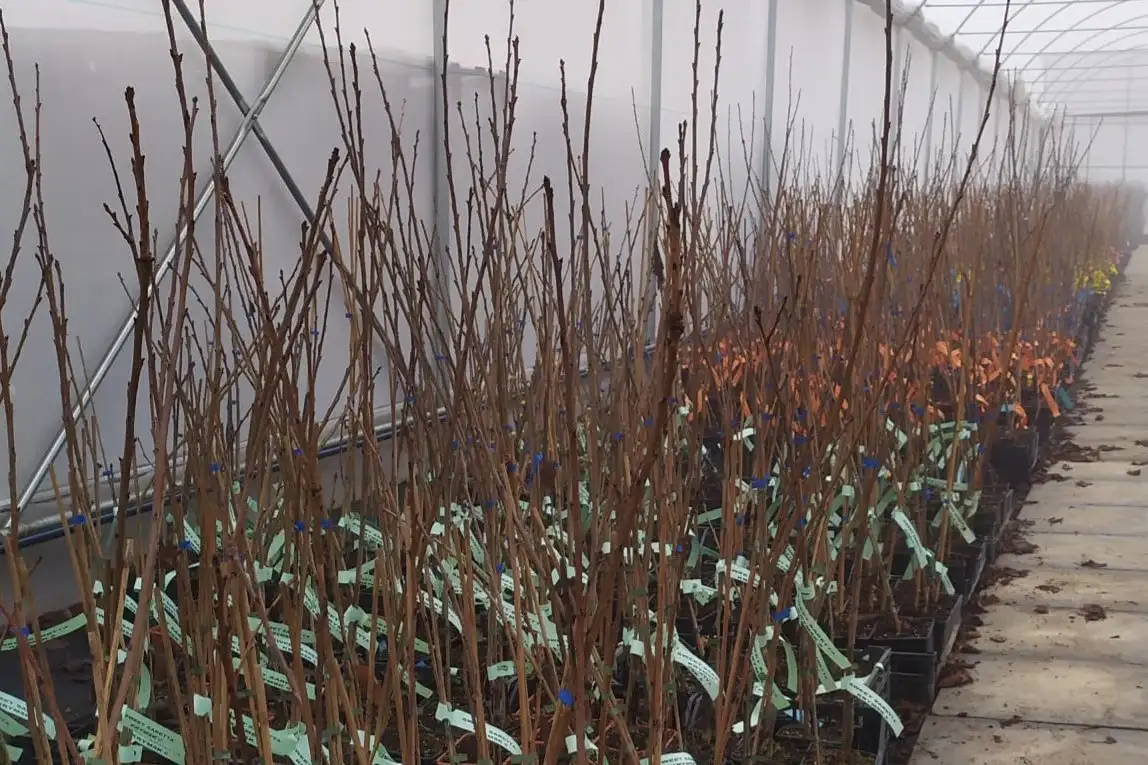
During this period, orchard collapse associated with wood diseases has also gained particular relevance, generally linked to infected nursery material. Among the most frequent causal agents are Cytospora, Chondrostereum purpureum (silver leaf) and Calosphaeria. In collapsed trees, it is common to detect more than one of these pathogens, often in association with bacterial canker, due to their opportunistic nature. For this reason, it is essential to analyse not only already compromised plants, but also those that appear healthy or are beginning to show early symptoms.
When the fungus originates from nursery material, cross-sections must be taken in the grafting area, where necrotic patterns are frequently observed and should be sent to the laboratory. In cases of non-severe infection, it is possible to coexist with the pathogen, provided that a management programme is implemented to limit its progression. Strategies include the use of foliar elicitors during the season, potassium phosphite via irrigation post-harvest, and broad-spectrum fungicides also applied through irrigation, in order to reach the affected xylem.
Distinguishing between canker
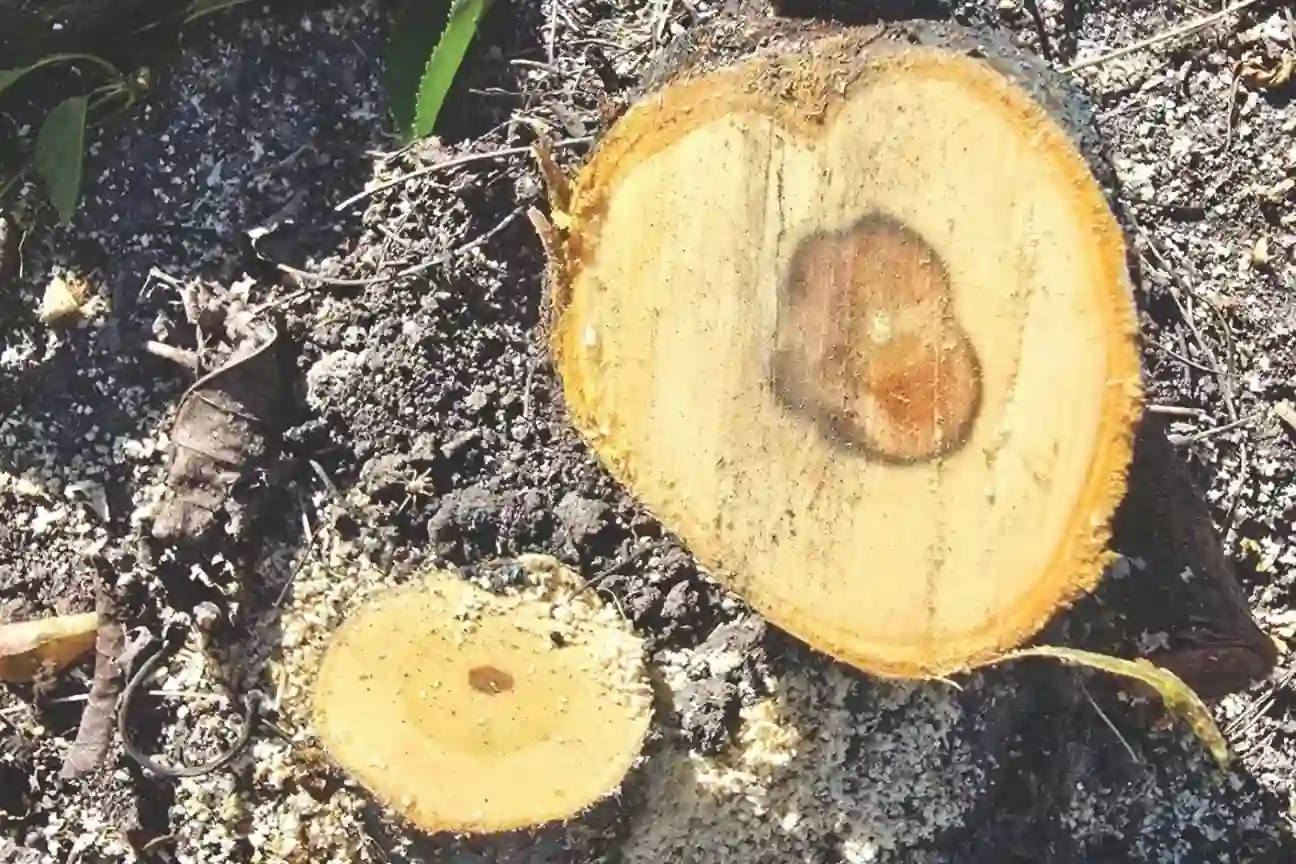
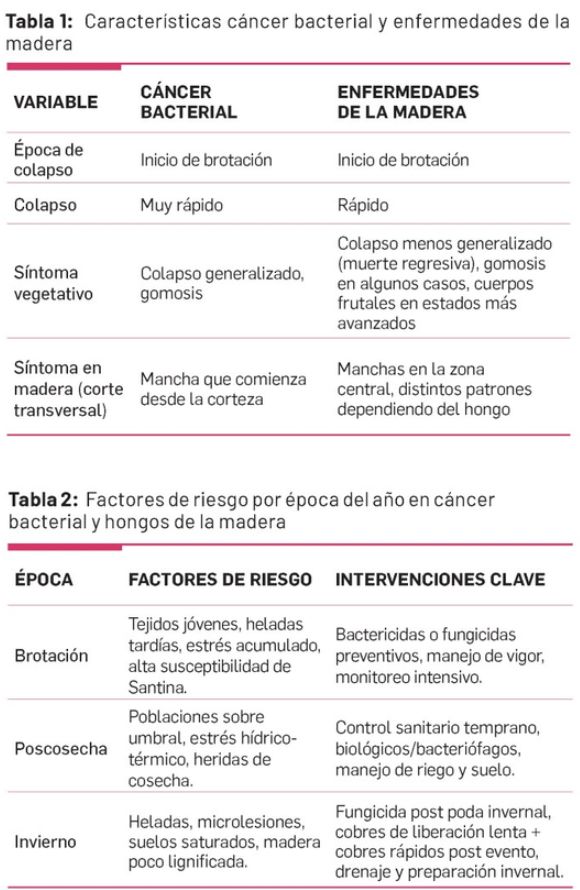
Distinguishing between bacterial canker and wood diseases is essential, even though both types of collapse tend to occur at the onset of vegetative regrowth. The speed of deterioration is a key factor: bacterial canker causes a very rapid and widespread collapse, characterised by gummosis; wood diseases also lead to relatively rapid collapse, but in a more localised manner, often manifesting as dieback. In advanced stages, fruiting bodies may be observed. On internal trunk analysis, bacterial canker appears as a lesion originating from the bark, whereas wood diseases leave alterations in the central area of the cross-section, with variable patterns depending on the fungus involved.
Post-harvest
One of the main new insights concerns the post-harvest period, historically underestimated. For years it was believed that summer heat reduced bacterial activity, but a recent study by the Centro de Innovación Montefrutal (CIM) together with Agroadvance, conducted on Santina grafted onto mahaleb in Pichingal (Molina), has challenged this assumption. Monitoring during the 2023–2024 season detected bacterial populations above the risk threshold (1,000 CFU/g) from the very first assessment, even in midsummer.
The trial compared an untreated control with no sanitary applications from December, against a management strategy involving a biological bactericide based on Bacillus and bacteriophages applied in January and again at leaf fall. The January application kept bacterial populations below critical levels throughout the summer, while the control showed accelerated growth. Although the autumn intervention significantly reduced bacterial load, it was not sufficient to bring it below the risk threshold, reinforcing the importance of reaching leaf fall with already contained populations.
Frost and micro-injuries
A further factor aggravating the problem is represented by severe frosts. P. syringae possesses ice-nucleating proteins that promote ice crystal formation even close to 0 °C, causing micro-injuries that act as entry points for infection (Lindow, 1983). In young trees, with poorly lignified wood and under stress, these micro-fractures can trigger significant damage.
Over the past two years, winter frosts have proven to be a major triggering factor for cases of sudden death, particularly in Santina grafted onto medium-to-low vigour rootstocks and in soils with drainage issues or low fertility. In response to this scenario, several technicians have adjusted their strategies, prioritising the reduction of Pseudomonas populations before frosts using slow-release copper, followed by fast-acting copper when temperatures exceed 10 °C.
Towards management
Structural stress within the orchard emerges as a condition favouring pathogen progression. Gravelly areas, pedological variability, compaction, shallow water tables or poorly managed irrigation progressively weaken trees, increasing their susceptibility. It is no coincidence that the first symptoms appear in specific orchard zones already characterised by vigour or development issues.
In this context, integrated management plays a central role. Multispectral mapping technologies allow early identification of stressed areas and help guide targeted interventions. The use of cover crops and the living soil approach contribute to improving orchard resilience.
The recent cases of sudden death confirm that Pseudomonas syringae and wood diseases will continue to pose a challenge for the cherry industry. The combination of applied research, diagnostics and integrated management will be decisive in supporting healthy crop growth and future competitiveness.
Text and images source: mundoagro.io
Patricio Murúa
Senior Advisor e Luis Ahumada, Responsabile Innovazione e Sostenibilità di Abud & Cía
Cherry Times - All rights reserved