For decades, the global fresh fruit industry has built its growth on a winning idea: producing where we are best positioned to do so and selling where consumers are willing to pay more. This model has led to extraordinary success stories, including that of Chilean cherries in China, probably one of the most successful examples of modern agricultural exports.
But the world is changing. Logistics have become more expensive, consumers are more price-sensitive, markets are more volatile, and geopolitical conflicts remind us of the importance of fuels, fertilizers and petroleum-based products throughout the entire food supply chain. Added to all this are increasingly frequent climate events, which require business decisions to be made further in advance and with a reduced margin for error.
Distance takes on strategic importance
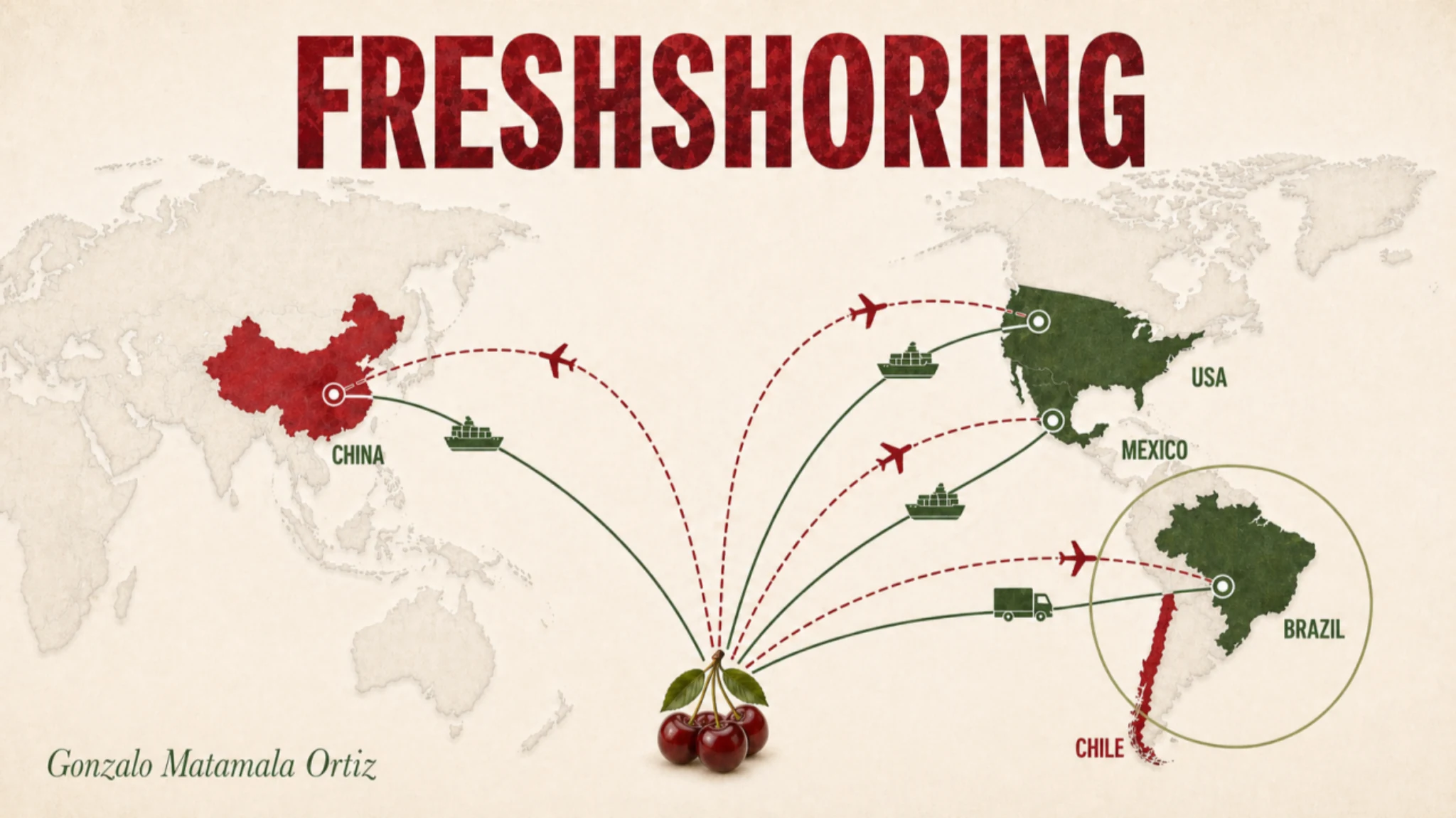
I call this trend Freshshoring: a strategy aimed at bringing fresh and highly perishable products closer to nearby, strategic or regionally connected consumer markets, with the goal of reducing logistical risk, preserving product integrity upon arrival, accelerating turnover and maintaining margins that allow for a more stable medium- and long-term outlook.
It is not about abandoning large distant markets. It is about building a more balanced commercial structure, better suited to the modern world. Diversifying does not mean forgetting what has already been built; it means placing the right product in the right market, reducing dependence on exceptional circumstances that do not always repeat themselves.
United States: proximity, speed and commercial response
In the United States, the relationship with Mexico is one of the clearest examples of fresh fruit production relocation. Mexico does not compete only on price or availability, but also on geographical proximity, speed of response and the ability to adapt programs to changes in North American retail demand.
This does not exclude the role of other origins such as Peru, Chile or other suppliers in the Southern Hemisphere. However, when the product is perishable, proximity offers concrete advantages: fewer days in transit, lower exposure to risk, greater flexibility and better responsiveness. In scenarios of rising fuel costs or increased logistical pressure, this advantage can become even more relevant.
Europe: the Mediterranean corridor and the value of proximity
Europe is also showing clear signs of this trend. The Morocco-Spain-Europe axis has become a key corridor for fresh fruit and vegetables, combining geographical proximity, complementary production and redistribution capacity across different European markets.
The lesson is important: proximity does not completely replace global sourcing, but it becomes a competitive advantage when the product requires freshness, speed and consistency. In Europe, this logic has allowed some regional origins to gain relevance not only because of costs, but also because of continuity, speed and lower delivery risk.
Asia: Freshshoring and the idea of feeding Asia
In Asia, the concept of Freshshoring is directly linked to an idea I am developing: Asia feeding Asia. The growth of the Asian middle class, the professionalization of retail, the improvement of logistics infrastructure and the emergence of new production areas are creating a different dynamic: Asia is no longer merely importing fruit from the Southern Hemisphere; Asia is also beginning to supply Asia.
This is evident across several categories. China has made progress in the production, consumption and sophistication of higher-value fruit; Southeast Asia is consolidating its position as a natural platform for tropical fruit and new production opportunities; India is beginning to gain relevance as a market and, in some categories, as an emerging source; and several countries in the region are exploring regional sourcing models.
For Southern Hemisphere exporters, this trend should not be seen simply as a threat, but rather as a strategic signal. The opportunity no longer lies solely in reaching Asia, but in understanding how Asia is sourcing its supply and in which segments imported fruit must defend a leading, off-season, differentiated and high-quality role.
Chilean cherries: Brazil as a Freshshoring case study
Chilean cherries are probably one of the clearest examples of how this logic can be applied. China will remain the central market and must continue to do so. The story built in that country is too important for Chilean agricultural exports. However, excessive concentration on a single destination, within a narrow commercial window and under high volume pressure, increases the vulnerability of the entire sector.
In this context, Brazil should not be considered a secondary market. It should be understood as part of a new commercial architecture for Chilean cherries. It is a large and nearby market, with shorter transit times, lower logistical risks and significant growth potential if approached correctly: quality, size, branding, consumer experience, retail, e-commerce and consumer education.
The example of Chilean wine in Brazil offers an interesting lesson. When a category is developed with consistency, positioning and a strong commercial presence, it can become a significant market and bring greater balance to a sector. In the case of cherries, the challenge is not simply to ship fruit; it is about building a category, educating the consumer and developing a value proposition that is not based exclusively on price.
The question is not whether Brazil can replace China. The answer is no. The right question is whether Brazil can help protect the value of the Chilean industry by reducing pressure on China, absorbing part of the volumes and enabling a more balanced commercial strategy. In this case, the answer is clearly yes.
Freshshoring does not mean selling closer: it means making our sales more profitable
Freshshoring does not mean choosing nearby markets out of convenience. Rather, it means developing a strategy in which proximity becomes a competitive advantage, allowing companies to recover profitability in a context where transport, energy and logistics risks increasingly affect the final result. For fresh produce products – cherries, berries, grapes, avocados or tropical fruit – distance has a direct impact on quality, costs, speed of sale and overall business performance.
The Chilean cherry industry must not reject its history in China. On the contrary, it must protect it. And to protect China, it must prevent all the volume, all the pressure and all the risk from being concentrated in the same destination, at the same time and under the same commercial conditions.
Freshshoring can be a tool for this new phase: Brazil and Latin America for Chilean cherries; Mexico for the United States; the Mediterranean and North Africa for Europe; and an Asia increasingly integrated into the logic of Asia feeding Asia.
The future of fresh fruit will be global, regional and strategic at the same time. In this new scenario, proximity will cease to be a limitation and will become an advantage.
Freshshoring means bringing fresh fruit to the right consumer at the right time, better managing risk and making sales more profitable.
Image source: Gonzalo Matamala Ortiz, Global Agribusiness & Asia Market Strategy
Gonzalo Matamala Ortiz
Global Agribusiness & Asia Market Strategy
Cherry Times - All rights reserved