The increasing frequency and intensity of heat waves represent a growing challenge for sweet cherry cultivation in warm-climate regions. A recent study conducted in China provided a comprehensive field-based evaluation of heat tolerance in five sweet cherry rootstocks: Gisela 6, Gisela 12, Krymsk 5, Colt, and Lanting, by integrating morphological, anatomical, physiological, and biochemical parameters.
The objective was to identify the most suitable materials for subtropical conditions, an increasingly important trait in light of climate change and the ongoing climatic evolution of temperate cherry-growing regions.
The trial was carried out in Zhejiang Province during the summer of 2024, characterized by particularly high average temperatures and numerous days with maximum temperatures above 35 °C. Under these conditions, researchers analyzed several indicators of heat-stress response, including leaf integrity and anatomy, antioxidant enzyme activity, plant hormone content, osmoregulatory compounds, and vegetative growth parameters. The data were subsequently processed using multivariate statistical models, including PCA and Entropy Weight-TOPSIS, to obtain an overall ranking of rootstock resilience.
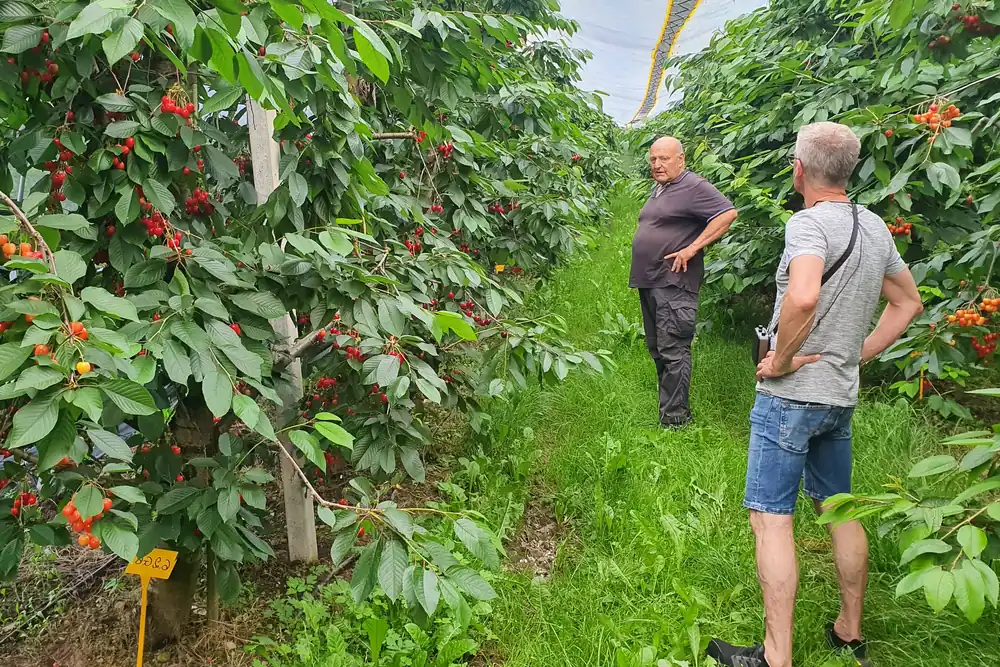
The results revealed marked variability in heat response among the tested genotypes. Lanting and Colt emerged as the most heat-tolerant rootstocks, whereas Gisela 6 showed the greatest sensitivity. In particular, Lanting maintained good canopy integrity, with reduced leaf drop and a lower incidence of necrosis and heat-induced lesions. From an anatomical perspective, this rootstock exhibited thicker leaves and more developed epidermal tissues, characteristics that appear to promote heat dissipation and photosynthetic stability under extreme conditions.
Physiological response
Regarding the role of the antioxidant system, high temperatures induce the production of reactive oxygen species (ROS), molecules capable of damaging cell membranes and the photosynthetic apparatus. The most resilient rootstocks displayed greater coordinated activity of the enzymes SOD, CAT, and POD, all involved in ROS detoxification. Lanting, for example, showed very high SOD activity and a soluble protein content approximately six times greater than that observed in Gisela 6, suggesting a superior cellular protection capacity.
With respect to hormones, the more sensitive genotypes accumulated high concentrations of abscisic acid (ABA), typically associated with severe stress conditions and prolonged stomatal closure, resulting in reduced carbon assimilation. In contrast, Colt and Lanting maintained moderate ABA levels, indicating better physiological homeostasis. At the same time, jasmonic acid (JA) was positively correlated with proline accumulation and negatively correlated with oxidative damage, confirming its role in regulating adaptive responses to heat stress.
The study also highlighted the importance of osmoprotective compounds, such as soluble sugars, proline, and soluble proteins, in maintaining cellular balance during prolonged periods of high temperature. In the most tolerant rootstocks, these metabolites appear to contribute to membrane stabilization and protection of cellular proteins.
Integrated model
Overall, the research proposes an integrated model of heat tolerance based on four major components: structural resilience of leaves, efficiency of the antioxidant system, hormonal balance, and metabolic flexibility. This approach goes beyond traditional evaluations based on single physiological parameters and provides a more realistic framework for understanding rootstock adaptive capacity under field conditions.
In conclusion, the identification of rootstocks such as Lanting and Colt, capable of maintaining physiological functionality and vegetative integrity under prolonged heat stress, offers valuable insights both for breeding programs and for the design of new orchards in regions increasingly exposed to hotter summers.
Source: Luo, H., Liu, H., Pei, J., Ruan, R., Zhang, C., Xi, D., Li, Y., & Huang, K. (2026). Field-Based Evaluation of Heat Tolerance in Sweet Cherry Rootstocks Reveals Integrated Morphological and Physiological Adaptation Mechanisms. Horticulturae, 12(2), 240. https://doi.org/10.3390/horticulturae12020240
Image source: Stefano Lugli
Andrea Giovannini
PhD in Agricultural, Environmental and Food Science and Technology - Arboriculture and Fruitculture, University of Bologna, IT
Cherry Times - All rights reserved