The study of root architecture in fruit trees is both challenging and essential. Roots play a fundamental role in water and nutrient management, plant health, and the overall resilience of production systems.
A recent study conducted by researchers from the Michigan State University has introduced a new non-invasive approach to reconstruct the spatial distribution of tart cherry roots, integrating geophysics, computer vision, and predictive modelling.
Innovative techniques and radar use
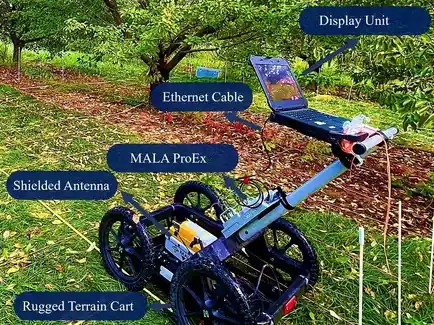
Using ground-penetrating radar (GPR) with an 800 MHz antenna, roots were mapped in two di6erent areas of Michigan, the main cherry-growing region in the United States, generating three-dimensional soil volumes from which reflection patterns associated with root presence were extracted.
The radiograms, initially processed using standard procedures, were later analyzed with a convolutional neural network model that made it possible to isolate root structures more precisely, reducing the background noise typical of GPR signals.
The system’s ability to detect roots as small as 4.3 cm in diameter was validated through a controlled experiment involving the burial of “root proxies”, small branches of known diameter arranged radially at varying depths.
This validation revealed high consistency between real and reconstructed positions, with an average error of only ±3 cm, confirming the method’s reliability in sandy-loam soils, provided that soil moisture is not excessive.
Moisture levels and integration with drones
Results indeed show that GPR performs best under “moderate” moisture conditions, whereas soils that are too dry or too wet significantly reduce the dielectric contrast needed to distinguish roots from the surrounding soil matrix.
Furthermore, GPR data were integrated with drone surveys to estimate canopy dimensions and verify allometric relationships between below-ground and above-ground development.
It emerged that the lateral extension of coarse roots exceeded the projected canopy area, with a root-to-canopy ratio of 1.22 at the Traverse City site and 1.24 at the Clarksville site.
This information could be useful for defining the effective water-nutrient uptake area, designing targeted irrigation systems, or assessing potential conflicts with nearby structures or infrastructures.
Machine learning and biomass estimation
Finally, a machine learning model was developed to estimate root biomass based on geometric measurements, trained using di6erent types of regressors on a dataset of over one hundred wood samples.
The Random Forest model showed the best performance, with an average error of 5%, suggesting potential future applications for automatically converting GPR data into quantitative estimates of biomass and, consequently, carbon stored in the soil.
Conclusions and future applications
In conclusion, the study demonstrates how an integrated approach based on ground-penetrating radar, neural network models, and remote sensing techniques represents a practical and scalable solution for studying plant root architecture in the field, avoiding destructive methods and enabling repeated analyses over time.
The application on tart cherry also highlights the potential of these tools for improving orchard management, understanding tree development dynamics, and contributing to the quantification of carbon stored in roots within the soil.
Source: Salako, J., Millar, N., Kendall, A., & Basso, B. (2025). Assessing tree root distributions using ground-penetrating radar and machine learning algorithms. Agrosystems, Geosciences & Environment, 8(4), e70217. https://doi.org/10.1002/agg2.70217
Image source: Salako et al 2025
Andrea Giovannini
University of Bologna (IT)
Cherry Times - All rights reserved