A nationwide spring frost slashed Michigan's crop to 50 million pounds (22.7 million kg) from the typical 200 million (90.7 million kg). Processors are fearing permanent market loss.
- A catastrophic nationwide frost has decimated the 2026 U.S. tart cherry crop across all major regions.
- It is the worst disaster in tart cherry history because it comes when reserve inventories are near historic lows.
- The severe shortage threatens permanent market loss.
Grower impact
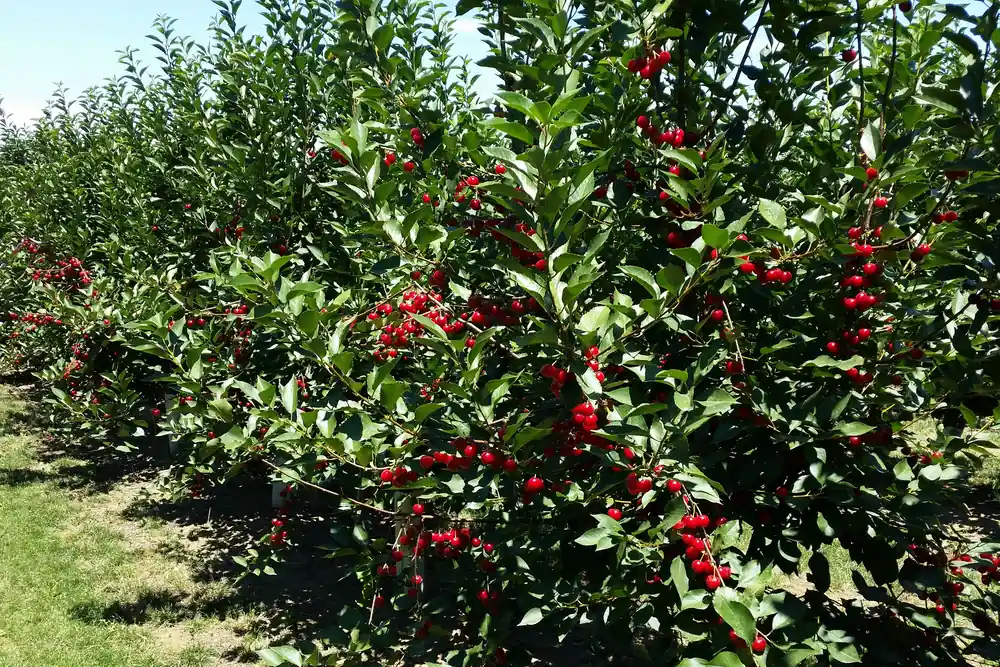
Dorance Amos has spent decades growing tart cherries on more than 200 acres (80.9 ha) of Michigan farmland. This year, he'll be lucky to harvest 50,000 pounds (22,680 kg) — a fraction of his typical million-pound crop (453,592 kg).
Unfortunately, he’s not alone.
The American tart cherry industry is navigating a critical period after a nationwide frost that has decimated the 2026 crop across all major growing regions. Industry veterans are calling this the worst disaster in tart cherry history because it comes when reserves — tart cherries in deep freeze — are almost nonexistent.
“I'd say we have 10% to 15% of a crop on our farms; that's what I'm looking at,” Amos said, with his voice heavy with resignation. He farms 1,400 acres (566.6 ha) in northwest Michigan’s Elk Township, including 200 acres (80.9 ha) of tart cherries, as well as plums, pears, apples, soybeans, wheat and hay.
Industry pressures
The double whammy of frost with virtually no reserves threatens to permanently dismantle an industry already weakened by years of regulatory pressures, pest infestations, diseases, lack of labor, decline in processors, imports and a complicated marketing order that can restrict domestic production in good years without factoring in foreign imports.
Scope of the damage
Michigan, the nation's leading tart cherry producer — with 70% of the U.S. total — may harvest less than 50 million pounds (22.7 million kg) this year, down from the typical 170 million to 200 million pounds (77.1 million to 90.7 million kg). The U.S. tart cherry market has fluctuated over the past decade with annual production ranging from 150 million to 300 million pounds (68.0 million to 136.1 million kg).
The frost damage has been comprehensive and unforgiving across all regions:
Utah, the second-largest-producing state with about 8% of the country's production, is “essentially zero,” according to Tom Facer, a New York agent with Farm Fresh First who has been in the cherry business since 1983.
New York, with 5% of the country's production, will have less than half its normal crop of 5 million to 7 million pounds (2.3 million to 3.2 million kg), Facer predicts.
Regional losses
- Wisconsin is looking at a 40% to 50% loss.
- Pennsylvania will have a pittance of its usual crop.
- Washington, mostly known for its sweet cherry crop, will “have a decent tart cherry crop, but they only grow about 20 million pounds (9.1 million kg),” Facer said.
- “All regions are smoked from frost,” Amos said. “We are in deep, deep trouble. The cherry industry is about one blink away from going away altogether.”
Orchard variability
Doug DeBadts, based in Sodus, N.Y., in Wayne County, has downsized his tart cherry acres from 150 to 80 acres (60.7 to 32.4 ha) in recent years. He’s expecting only 20% to 40% of his normal crop.
“We have one big orchard that's almost right on the shore of Lake Ontario, and our furthest inland orchard is like 3 miles (4.8 km) from the lake. The one closest to the Lake Ontario blooms about a week and a half later than the rest of them, and I think that helped,” he said, noting that processing and fresh apples are their biggest crop.
“We’ve taken cherry trees out and replaced with apples, but they have suffered as well. Some places and some varieties are OK, but other ones don't look too special right now for the same reasons as the cherry crop, as well as poor weather during pollination.”
But not all growers were hit as severely. Nikki Rothwell, Michigan State University Extension specialist and Northwest Michigan Horticulture Research Center coordinator located in Traverse City, said Michigan’s Northport region and areas closer to East Bay had damage, but they were not wiped out.
Crop estimates
“The crop is variable across northwest Michigan, and it all depended on the stage of tree development when we had the cold weather,” she added.
Rothwell reported that the Michigan Cherry Committee estimates northwest Michigan will have 40 million pounds (18.1 million kg), west-central areas 4 million pounds (1.8 million kg) and southwest Michigan 1.5 million pounds (680,389 kg). Last year it was 33, 59 and 15 pounds (15, 26.8 and 6.8 kg), respectively.
Facer, whose company typically handles about 10 million pounds (4.5 million kg) of tart cherries from growers in New York, Michigan and, occasionally, Wisconsin, confirmed the grim outlook.
“The 2026 crop is extremely short, and with little inventory, the available supply is not going to meet demand,” he said. “For the industry, I think this is worse than the disaster of 2012, because the carry-in inventory from prior years is significantly below average, and significantly below where it was in 2012.”
Inventory crisis
Michigan growers have experienced reduced volumes three times in five years. Last year’s crop also suffered frost damage, with growers harvesting just 101 million pounds (45.8 million kg).
Tim Brian, 20-year president of Smeltzer Orchards, whose family farm grows about 45 acres (18.2 ha) of cherries, emphasized the severity.
“The inventory levels have been depleted over time,” he said. “As of the end of April, tart cherries in storage were within 4 million pounds (1.8 million kg) of the all-time low recorded in 1977.”
Perfect storm
Michigan’s 2026 spring has been mixed. The southern half of the state warmed ahead of seasonal growing degree day averages, causing not only early bloom, but also sharp temperature swings that damaged some blossoms, Rothwell said.
Northern Michigan experienced prolonged cold, with nighttime lows below freezing, delaying dormancy and increasing the risk of additional frost damage. “As a result, many growers face variable crop loads across their orchards,” she said.
“If you determine a block is not worthwhile to harvest, you can’t just ‘walk away’ for the season, but rather minimally manage the block with fewer inputs.”
DeBadts agreed. “Looking at the trees, you know that you need to take care of them the way you would if there was a full crop, because what you do this year also affects next year's crop — it can be a double-edged sword,” he said.
Cherry prices soar
Low supplies will drive prices higher — a boost for those who have cherries to sell — but it could have a devastating, long-term impact on the industry. Grower prices are expected to reach $1 per pound (€1.91/kg), up from about 25 to 50 cents (€0.22 to €0.43) in recent years.
Wholesale pricing of dried cherries may exceed $8 per pound (€15.30/kg), with retail prices surpassing $10 per pound (€19.13/kg) — more than double the $4.50 per pound (€8.61/kg) from just two years ago.
Restaurants and food service operations face similar pressures. Brian added, “You got a lot of restaurants that put dried cherries in a salad. Are you going to spend $10 per pound (€19.13/kg) on cherries in a salad? Or, are you going to buy cranberries that are probably 25% of the cost at $3 or $4 a pound (€5.74 or €7.65/kg)?”
Cranberries, with their ample supply, are positioned to capture significant market share from cherries. “We can't do anything about it, because we don't have the fruit,” Amos said.
Processing woes
As farmers sell off property or convert it to other crops, the tart cherry business is contracting and concentrating, as is processing. Michigan's processing infrastructure is down to six major processors — Peterson Farms, Cherry Central Co., Smeltzer Orchard Co., Great Lakes Packing, Burnett Foods, and Honey Bear — from 13 in Grand Traverse County alone in previous years. Conagra exited Michigan last year entirely.
“Our processors are scared we're going to lose this market next year because we cannot begin to fill all of the orders,” Amos said.
Facer, who supplies processors serving large consumer product manufacturers, warned of the long-term implications. “If they don't have cherries for a year, and they just came off a year where the prices were abnormally high, there'll be a rationalization done of whether they continue to carry that product or have cherries in their product line,” he said.
Product substitution
The danger extends beyond simple substitution. “Once that decision's made, it's tough to change it,” Facer explained.
“You can't tell consumers, ‘Sorry, we don't have cherries this year, but come back next year, and we'll be back again.’ Once processors have to use something different, whether it's a different red fruit or a different colored fruit, they have to be convinced to come back.”
The import paradox
In a stunning reversal, industry leaders who have historically opposed imports are now advocating for foreign cherries to fill the gap — not to compete, but simply to keep cherry products on store shelves.
“Typically, I would criticize imported cherries coming in because they take away markets from us, but in this case this year, I actually would support imported cherries,” Brian admitted. “There's huge danger in losing products in the marketplace with such a severe shortage.”
Facer echoed this sentiment. “We're going to tell our processors we will buy all that we can physically purchase, and hopefully, for the industry's sake, there are imports available to bring in,” he said.
“Otherwise there's going to be customers that won't have cherries, which is horrendous, long-term, for the industry.”
Worldwide shortage
However, the international supply situation offers little relief. Europe, particularly Poland and Turkey — the two other major tart cherry-producing regions — also experienced short crops last year, creating a worldwide shortage. While Turkey is expected to have a better crop this year, prices for imported frozen cherries are projected to exceed $2 per pound delivered (€3.83/kg delivered).
Limited protection for growers
Crop insurance, while helpful, provides limited protection. “In our world, we have a 35% deductible,” Amos explained. “We don't have that kind of margin.”
The insurance is also based on historical averages, which have declined due to consecutive short crops, further reducing potential payouts.
Facer, who has worked with some Michigan growers for 20 to 30 years, was recently in the Traverse City area assessing damage and maturity levels of what remained. “It's still a little unknown in the North because they have the youngest cherries, but it's far, far, far from a full crop,” he said.
Future risks
Even if weather cooperates in 2026, the damage may already be done. “We've always had that volatility, but this is … we're really ramping it up another notch this year,” Brian said. “We'll handle it, but it's not going be easy.”
Regarding this own family’s operation, he said, “We've struggled on the farm the last few years, but this is obviously a huge blow — we might be buying out finally this year.”
Industry meetings and next steps
The industry is gathering to assess the damage and chart a path forward. Two key meetings are scheduled:
June 16. This will be an industry meeting with format to be determined.
June 25. This Zoom meeting will feature an analytical company that will profile worldwide crops and inventory situations.
These meetings will provide more concrete data on international supply and help processors and growers make critical decisions about the remainder of the season.
Jennifer Kiel
Editor of Michigan Farmer and Ohio Farmer
Source: Farm Progress
Image source: Stefano Lugli
Cherry Times - All rights reseved