The future of Iberian cherry production depends on protecting biodiversity, technological innovation and the adoption of sustainable agricultural practices. This is the vision behind IBERIAN CHERRY, a cross-border project developed under the Interreg VI-A Spain–Portugal (POCTEP) 2021–2027 programme.
The initiative involves two key cherry-producing regions: the Jerte Valley in Extremadura (Spain) and Cova da Beira in central Portugal. Its objective is to strengthen the resilience of agricultural businesses to climate change by enhancing natural resources and promoting the use of digital technologies.
IBERIAN CHERRY: the project in numbers
36 months
Planned duration
Climate change and cherry production: the main threats
Cherry production is an economic activity of primary importance to both regions. However, increasing climate instability and the deterioration of natural resources make it necessary to change the way cherry orchards are managed.
IBERIAN CHERRY aims to address these challenges through strategies combining regenerative agriculture, biodiversity conservation and digital innovation, with the goal of improving the sustainability and competitiveness of local production.
Three risk factors for cherry orchards
🌡️
Climate change
Rising temperatures, irregular rainfall patterns and late frosts can compromise fruit set and the consistency of cherry yields.
🐛
Emerging pests
High temperatures and periods of drought can favour the spread of new pests and diseases, making crop protection increasingly challenging.
💧
Soil and water resources
Soil degradation and increasing pressure on water availability threaten the long-term sustainability of cherry production systems.
Spain and Portugal: two regions united by cherry production
The project brings together two major production areas of the Iberian Peninsula, both characterised by a strong agricultural tradition and cherry supply chains deeply rooted in their local economies.
🇪🇸
SPAIN · CÁCERES
Jerte Valley
Located in northern Extremadura, the Jerte Valley is one of Spain's most representative cherry-growing areas.
The area is known for its Cereza del Jerte PDO cherries and its spectacular spring cherry blossoms.
Its agricultural heritage includes more than 1.5 million cherry trees, a central feature of the local landscape and economy.
🇵🇹
PORTUGAL · CENTRAL REGION
Cova da Beira
Cova da Beira is an important fruit-growing area in central Portugal, where cherry production has a long tradition.
Among its best-known products is the Cereja do Fundão, which is particularly appreciated on the domestic market.
The presence of a well-established agricultural cooperative network represents an important resource for spreading innovation among growers.
Cooperation between the two regions will enable the sharing of expertise, trials and sustainable management tools, creating new opportunities for the cross-border cherry supply chain.
IBERIAN CHERRY objectives: biodiversity and competitiveness
The project aims to develop and implement innovative solutions for biodiversity conservation in cherry-growing ecosystems.
A central aspect involves enhancing local resources and transferring scientific knowledge to agricultural businesses. Research must translate into tools that growers can use directly, helping to improve the efficiency of cherry orchard management.
Three pillars of innovation in cherry production
🌱
Nature-based solutions
Promoting regenerative agriculture and enhancing ecosystem services.
📡
Technological innovation
Using sensors, digital monitoring and Big Data to support agricultural management.
🤝
Knowledge transfer
Cooperation between research centres and growers to encourage the adoption of innovations in cherry orchards.
The project's five main activities
The work programme is structured around five complementary areas. The approach includes analysing production conditions, implementing regenerative practices, introducing technological tools and directly involving agricultural stakeholders.
01 · ASSESSMENT
🔍 Environmental analysis and assessment
The first phase involves identifying the main threats to biodiversity and studying soil conditions and water resources in the cherry-producing areas of the Jerte Valley and Cova da Beira.
02 · NATURE-BASED SOLUTIONS
🌱 Regenerative agriculture and agroecological management
Activities include implementing regenerative agricultural practices to restore soil functions and strengthen ecosystem services.
Solutions under consideration include cover crops, the protection of functional biodiversity, agroecological cherry orchard management and soil restoration measures.
These practices aim to make agroecosystems more resilient to climate-related stresses.
03 · AGRITECH
📡 Digital monitoring and Big Data
Another area of intervention concerns the development and implementation of digital tools for cherry orchard management.
The use of sensors, monitoring systems and data analytics will help support more efficient crop management and smart pest control on pilot farms.
04 · TECHNOLOGY TRANSFER
🤝 Collaboration between research and agricultural businesses
The project promotes the creation of cooperation networks between scientific institutions and growers, with the aim of encouraging the practical adoption of research findings and new technologies.
05 · DISSEMINATION
📢 Communication and awareness-raising
Communication initiatives will target both agri-food supply chain stakeholders and consumers, promoting greater awareness of the role of biodiversity in sustainable agricultural production.
Four expected outcomes for the cherry supply chain
Implementing the planned activities is expected to deliver environmental and production benefits, contributing to the modernisation of cherry growing in the two participating regions.
OUTCOME 01
🌿
Improved biodiversity
Strengthening the resilience of cherry-growing agroecosystems to pests and the effects of climate change.
OUTCOME 02
📡
Digital transformation
Introducing new technologies on at least 50 pilot farms to improve production management and plant health protection.
OUTCOME 03
🤝
Strengthening the sector
Developing a shared cross-border strategy for sustainable cherry production, designed to benefit hundreds of growers in the La Raya region.
OUTCOME 04
📑
Long-term sustainability
Producing best practice manuals and operational protocols that can also be applied to other characteristic crops of the Euroregion.
The consortium: eight organisations from Spain and Portugal
IBERIAN CHERRY is coordinated by the University of Extremadura (UEx) and brings together eight organisations, including universities, research centres, public administrations, agricultural cooperatives and agri-industrial associations.
⭐
LEAD PARTNER
Universidad de Extremadura (UEx)
Consortium coordination · Spain 🇪🇸
🇪🇸 Spanish partners
- CICYTEX – Extremadura Centre for Scientific and Technological Research.
- Diputación de Cáceres – Provincial Government of Cáceres.
- Agrupación de Cooperativas del Valle del Jerte – Organisation representing local cherry growers.
🇵🇹 Portuguese partners
- Instituto Politécnico de Castelo Branco (IPCB).
- CATAA – Centro de Apoio Tecnológico Agro-Alimentar de Castelo Branco.
- InovCluster – Associação do Cluster Agro-Industrial do Centro.
- CAFCOB – Cooperativa Agrícola de Fruticultores da Cova da Beira.
The consortium brings together scientific expertise and the needs of agricultural businesses, promoting an integrated approach to sustainable cherry production.
Opportunities for cherry growers
The project plans to involve at least 50 pilot farms in testing digital technologies, regenerative agricultural practices and sustainable management tools.
The Cáceres Chamber of Commerce, although not one of the consortium's eight direct partners, supports small and medium-sized agri-food businesses in Extremadura interested in the initiative's results.
In particular, growers and cooperatives in the Jerte Valley can contact the Chamber of Commerce for information about participation opportunities and technology transfer activities.
Through cooperation between Spain and Portugal, IBERIAN CHERRY aims to promote a model of cherry production that is more resilient, innovative and biodiversity-friendly, capable of addressing climate and environmental challenges while maintaining strong ties to local agricultural economies.
Source: Cáceres Chamber of Commerce – IBERIAN CHERRY Project
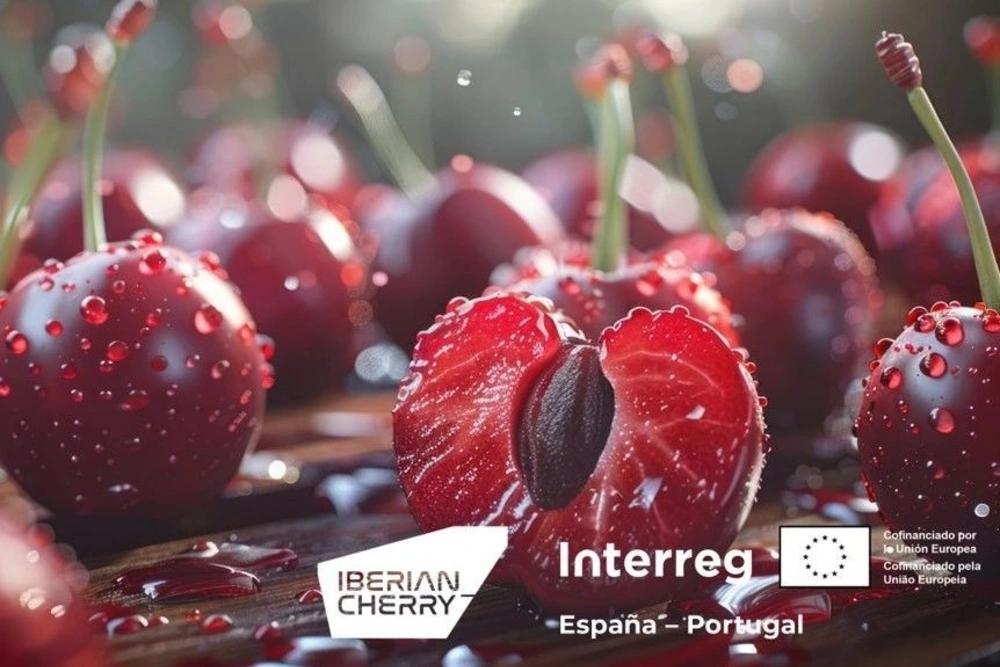
Image source: INTERREG
Cherry Times - All rights reserved