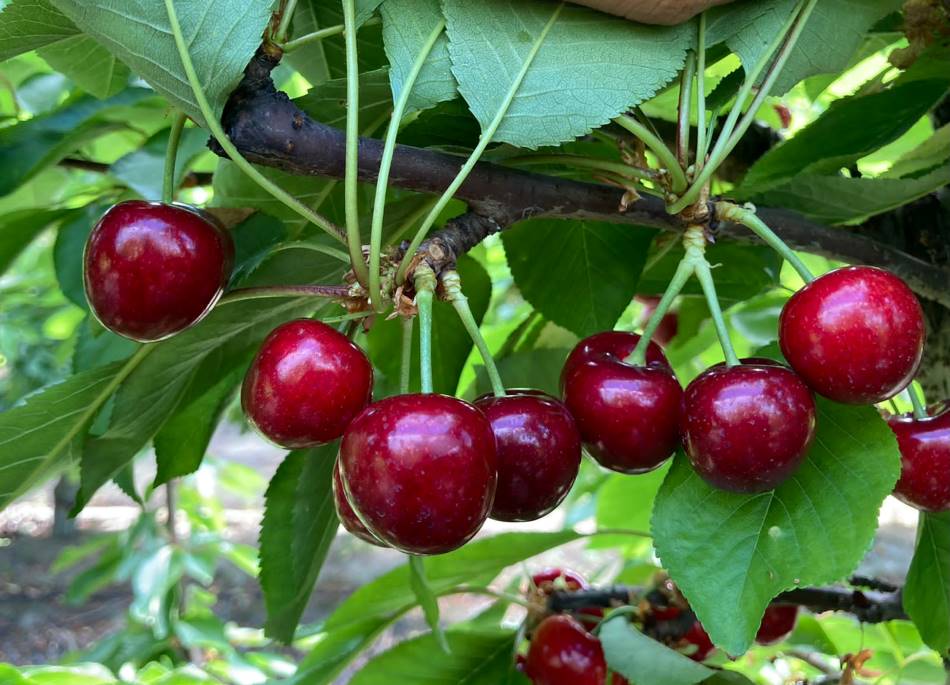
Heat, mild winters and late frosts are putting this fruit species under increasing pressure. Shade nets help reduce water stress and heat damage, but their effectiveness depends on rootstock, vigour, training system and cherry orchard management.

Climate context
The climate crisis is affecting sweet cherry (Prunus avium) through high temperatures, intense solar radiation and, although it may seem counterintuitive, cold snaps that influence productive seasons.
In cherry growing, the mitigating effect of multifunctional nets against heat, through the creation of shade, is now widely recognised. Despite their extensive use, it is important to understand how shading works, what it affects and how the plant responds to cover systems in order to avoid mistakes that could prove decisive for cherry production.
AgroNotizie®, in collaboration with the Italian Society for Horticultural Science, interviewed Brunella Morandi, associate professor of General Arboriculture and Tree Crops at the Department of Agricultural and Food Sciences of the University of Bologna, to explore the role of shade nets and their correct use in effectively defending orchards against increasingly unpredictable weather.
The Italian Society for Horticultural Science works to develop scientific and technical cooperation between the research world, entrepreneurs and professionals in the horticultural sector. Through its actions and activities, it covers a broad area of agriculture: from fruit and timber tree crops to vegetable, flower and ornamental plants, as well as nursery production, turfgrass, landscape management and the protection of green spaces. Its goal is to support the progress and dissemination of the sector.
Sweet cherry: less cold, more problems
Heat creates three main challenges for Prunus, as outlined below.
The first challenge is increased transpiration and, consequently, a possible rise in the tree's water requirements. If these requirements are not adequately met, the tree responds physiologically by adopting water-saving mechanisms. Transpiration refers to the amount of water lost from leaves in the form of water vapour. A transpiring leaf draws water and nutrients from the soil through the trunk and roots. When irrigation does not compensate for transpiration, the plant switches to water-saving mode through stomatal closure, which in turn reduces photosynthesis and therefore the synthesis of carbohydrates needed for fruit growth.
The period most sensitive to water stress is the post-harvest phase, not the pre-harvest phase as one might think: "Before harvest, there are no particular periods of water shortage because cherry production occurs fairly early in the season, and also because the tree relies heavily on the reserves accumulated the previous year," explains Brunella Morandi. "The problem arises when water shortage occurs after harvest. The symptoms are not immediately visible, but emerge in the following season, since reduced photosynthesis limits the production of reserves."
Differentiation and quality
The second challenge concerns flower differentiation. It is still unclear how and to what extent temperatures and the possible shading effect of cover systems influence this aspect, although in other species, such as Actinidia, excessive shading has been shown to reduce flowering intensity the following year.
The third challenge concerns cherry quality: "The production of double fruits is often observed, caused by heat waves that occurred the previous year, at the time when buds were differentiating. In addition, if drupe respiration is excessive, the fruit tends to accumulate less sugar in its tissues."
Therefore, all three issues are interconnected and, if not properly managed, lead not only to low yields but above all to a product that is less attractive and less sweet. "The only characteristic that is not affected is colour, because cherries are genetically well pigmented, unlike apples," Morandi continues.
Cold and late frosts
When discussing high temperatures, however, one should not think only of the summer period. In fact, the climate crisis is causing milder winters, a condition that, for some varieties, prevents the natural chilling requirement from being met.
This problem mainly affects Southern Italy, while in North-Eastern Italy chilling hours are still being met. However, another challenge is emerging there: late frosts.
"Physiologically, the sweet cherry tree must overcome endodormancy and ecodormancy. The first is overcome with a certain number of chilling hours, while the second requires a certain amount of heat hours. In northern regions, by February the tree has usually already overcome endodormancy, and high temperatures during this month accelerate the release from ecodormancy, leading to excessively early flowering that is then affected by cold snaps and by the increasingly high risk of late frosts."
Nets, in this sense too, if opened, could help contain damage because during the night they reduce heat loss through radiation. The result is a 1-2°C increase in orchard temperature, protecting plants from the thermal shock caused by frost. However, during the flowering period, nets are generally kept closed to encourage pollination.
"Some cherry growers open the net specifically in anticipation of a frost event. However, the decision whether or not to open them depends on the number of hectares and the availability of labour, because it represents a significant cost," Morandi specifies.
How nets protect sweet cherry trees
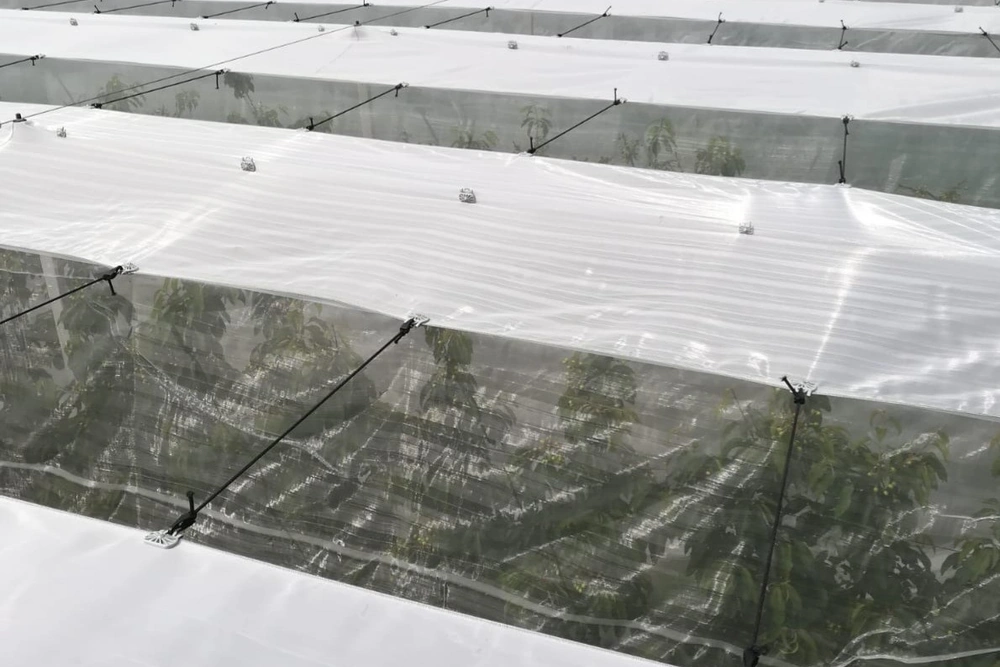
To reduce the temperature of the cherry orchard by 2-3°C, growers use cover systems that may be single-block or single-row, depending on the needs of the farm.
The material plays an important role: net-based covers allow the orchard to be ventilated and shaded, lowering the temperature by a few degrees. Plastic covers, on the other hand, tend to create greenhouse-effect conditions, increasing the temperature, and are therefore not highly recommended.
Then, as mentioned above, the timing of opening also makes a difference: "Usually, multifunctional covers are opened around veraison to protect production from Drosophila suzukii and hail, and are closed after harvest. However, the recommendation is to provide shading also during the post-harvest phase, in order to reduce water stress and support the accumulation of reserves needed for the following season."
Microclimate under cover
In practice, shade has an effect on the Vapour Pressure Deficit (VPD), a parameter used to measure the plant's transpiration rate. Morandi explains: "The more shade is provided, the more VPD tends to decrease: orchard temperature drops and relative humidity increases. We know this thanks to field trials in which different shading percentages, from 20% to 40%, were tested."
Although the trials went up to 40%, the optimal percentage for sweet cherry is 20-30% shade, in order to avoid negatively affecting photosynthesis.
Since the microclimate under the cover is more humid, growers must be careful not to create an environment favourable to fungal pathogens, such as brown rot and powdery mildew. The choice of material can make a difference: "I recommend choosing rain covers that are ventilated, rather than plastic sheets that are completely impermeable. This choice must be carefully assessed based on the growing latitude."
Finally, in cherry orchards, white nets are often used rather than black ones because they disperse photons more effectively in multiple directions. White creates a high amount of diffuse light, which reaches the innermost parts of the canopy and promotes the development of young shoots.
Shade and vigour: how the effect changes in each orchard
"In cherry orchards, there is still great variability in vigour and planting density. We range from super-intensive systems with 6,000 plants per hectare grafted onto Gisela to orchards with 400-500 plants per hectare grafted onto Colt. The vigour of these two rootstocks is different, so the plant's response will not be the same," says Morandi.
In simple terms: cherry trees with different vegetative development will require different percentages of shade. "In high-density orchards with Gisela, which is known to be a dwarfing rootstock, shading helps a great deal because the canopy is sparse and diffuse light reaches all its parts: in this way, the microclimate improves. By contrast, in low-density orchards with more vigorous rootstocks such as Colt, the canopy is very voluminous and creates self-shading in the innermost parts. In this case, adding further shade with a net is not physiologically advantageous, as photosynthesis slows down and fruit growth becomes more difficult."
Depending on the vegetative drive, different training systems will then be used. Traditionally, vigorous rootstocks are associated with volume-based training systems that tend more towards self-shading, while less vigorous rootstocks are associated with wall-trained systems that leave the canopy very open.
Training systems
"Wall-trained systems, such as multi-axis, candelabrum or Bibaum®, for example, can be associated with slightly more vigorous rootstocks, while still maintaining well-ventilated canopies organised as walls that intercept the diffuse light produced by the cover system very effectively," Morandi concludes.
Shade covers providing 20-30% shading are very well suited to this type of cherry orchard.
Shading, therefore, cannot be standardised across all orchards. To be truly effective in mitigating the effects of climate change, many agronomic and environmental aspects must be assessed.
Source: agronotizie.imagelinenetwork.com
Image source: Stefano Lugli
Chiara Gallo
AgroNotizie
Cherry Times - All rights reserved