A few years ago, artificial intelligence (AI) was the exclusive preserve of large industries, which had the resources needed to integrate it into their operations. This situation, however, has gradually changed, and AI has begun to enter one of Chile’s main economic sectors: agriculture.
Thanks to the introduction of various tools, farmers can make decisions based on more information and carry out operations with greater precision.
Jorge Álamos, general manager of Dronespray, explained to [Portalfruticola.com]([http://portalfruticola.com/](http://portalfruticola.com/)) that this change is affecting the entire sector across the board. “Artificial intelligence is having an impact on practically every process,” he said, from planning and preliminary studies through to the execution of operations and post-harvest activities.
The executive explained that the company uses images captured by drones to identify differences within crops and detect, for example, areas affected by weeds. The information can then be transformed into instructions for ground or aerial machinery, allowing products to be applied exclusively where they are needed.
)
From data to decisions
According to the company’s general manager, the main transformation concerns the ability to convert large amounts of information into concrete decisions.
The data may also include variables relating to soil, climate, irrigation and production history. In this way, the farmer can move from uniform application to differentiated management, based on the specific needs of each area. “Our goal is to apply what is needed, where it is needed,” Álamos said.
In this process, specialized platforms make it possible to process images and transform maps into instructions that can be carried out directly by agricultural drones and other machinery. Artificial intelligence begins…
Artificial intelligence in cherry cultivation
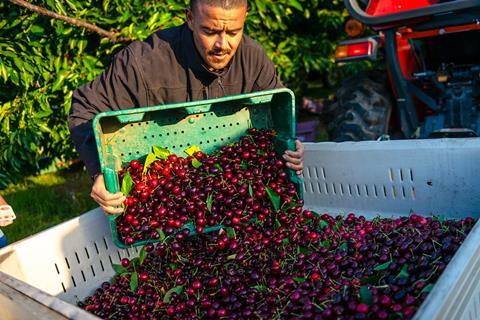
The Chilean cherry industry is one of the sectors with the greatest potential for the introduction of these technologies, thanks to the crop’s high economic value and the importance of variables such as size, firmness, quality conditions and harvest timing.
Alonso Bravo, agronomist and Head of Research and Development at Dronespray, told [Portalfruticola.com]([http://portalfruticola.com/](http://portalfruticola.com/)) that the results obtained from a two-season study in a young cherry orchard of the Santina variety, located in Retiro, in the Maule Region, were positive.
The trial compared phytosanitary treatments carried out with a DJI Agras T-50 drone with those performed using a conventional sprayer, on land characterized by slopes ranging from 30% to 44%.
“The area treated with the drone recorded an estimated yield 38.5% higher, fruit firmness 6.36% greater and better physiological indicators, detected through multispectral imaging,” Bravo said.
Operational results and integration
He also added that, from an operational point of view, the system made it possible to reduce the time required for application by around 72% and water consumption per hectare by 90%, without causing soil compaction in the treated area.
According to Bravo, these results show that true technological progress does not consist of replacing a tractor with a drone, but of integrating different tools.
“The interesting aspect is the integration of sensors, drones, multispectral images, artificial intelligence, data analysis and machinery capable of putting decisions into practice,” he emphasized.
A tool to address climate change
In relation to climate change, the use of drones offers the possibility of carrying out operations at times when conventional machinery cannot enter orchards.
[Portalfruticola.com]([http://portalfruticola.com/](http://portalfruticola.com/)) interviewed Francisco García, agricultural technician and manager of the cherry-growing company Don Emeterio, who said: “With the drone we can carry out applications at the right time: it provides greater savings, lower water consumption and greater speed.”
García pointed out that, in cherry cultivation, this possibility is particularly relevant because the time windows available for treatments can be very narrow. “After rain, for example, the time available to enter the orchard and carry out a treatment may be limited, especially when working on large areas,” he explained.
Based on his own experience, he therefore recommended not being afraid of these technologies: “They are efficient, fast and easy to use.”
The challenges
Despite the introduction of artificial intelligence into Chilean agriculture, some obstacles still remain. According to Álamos, one of the main ones is limited knowledge of the technology, accompanied by the fear that it could ultimately replace people.
The experience of Dronespray, however, points in a different direction: AI does not eliminate agronomic judgment, but provides new tools to support it.
In this regard, Álamos highlighted the growing adoption of artificial intelligence by new generations of growers.
According to the executive, training is a determining factor in bringing these technologies closer to the sector, starting with technical education. “This allows future agricultural professionals to enter the workforce with knowledge that in the past was not part of their training.”
The prospects for automation
According to specialists, technological evolution will lead toward an agriculture in which different systems are interconnected. Drones, satellite and multispectral imagery, soil sensors, weather stations, historical data, agricultural machinery and artificial intelligence platforms will be able to share information to produce diagnoses, forecasts and actions.
Bravo explained that, in the case of the cherry tree, the next step consists of developing systems capable of integrating information relating to climate, fruit development and production history, with the aim of estimating crop load, yield, size and degree of ripeness.
These tools will also be able to identify in advance any anomalies or areas that require greater attention.
Added to this is the use of increasingly autonomous machinery. New agricultural drones integrate technologies such as radar and vision systems, which make it possible to recognize the surrounding environment in three dimensions, detect obstacles and adapt navigation during operations.
Integrated processes and supervision
Álamos explained that the future objective is to equip farms with complete processes based on the connection between different tools. For example, “a sensor detects a certain condition, AI analyzes the data, software generates a prescription and, subsequently, a drone or machine carries out the operation, always under human supervision.”
“Artificial intelligence is already present on Chilean farms. The real question is how quickly we will be able to integrate it into the agronomic system, ensure that it is understood and used by farmers, and transform it into concrete production decisions.”
Macarena Bravo
Portal Fruiticola
Image source: Portal Fruticola / Dronespray
Cherry Times - All rights reserved