Successful flower fertilization depends closely on pollen quality, flowering synchronization, and environmental conditions. In particular, the ability of pollen to germinate and rapidly develop a pollen tube is a fundamental parameter for evaluating the efficiency of a genotype as a pollinizer, with implications for both orchard productivity and breeding programs.
The study, conducted at the experimental station of the University of Belgrade (Serbia), investigated the influence of genotype, environment, and incubation temperature on in vitro pollen germination and pollen tube growth in sour cherry over three consecutive years, from 2022 to 2024. In parallel, flowering phenology was monitored to assess the temporal variability among genotypes and the potential relationship between environmental conditions and reproductive behavior.
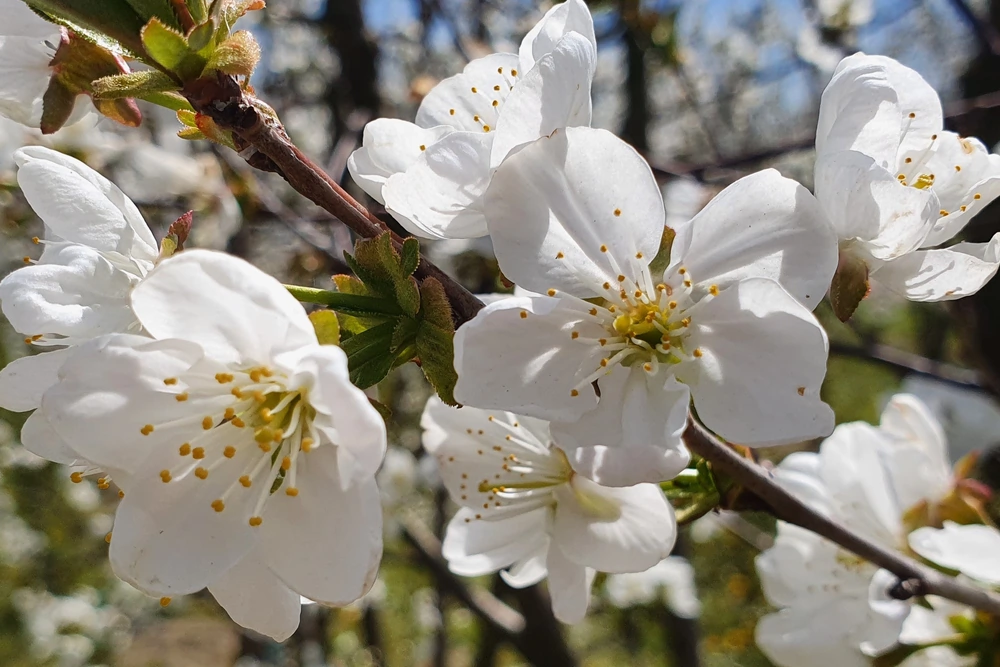
Six genotypes with different genetic origins were examined: the Serbian cultivars ‘Sofija’ and ‘Šumadinka’, the introduced cultivar ‘Érdi Bötermö’, the native cultivar ‘Feketićka’, and the two promising genotypes ‘GV-6’ and ‘GV-10’. Flowering was described according to three phenological stages: beginning, full bloom, and end of flowering.
Flowering phenology and pollen fertility
To evaluate pollen fertility, pollen was collected and placed in Petri dishes containing an agarose–sucrose nutrient medium, then incubated for 24 hours at 17 °C and 20 °C. At the end of the incubation period, pollen germination percentage and pollen tube length were determined.
The results revealed marked genetic and environmental variability. In vitro germination ranged from 3.16% to 53.75%, while pollen tube length varied from 225.6 to 960.2 μm. Differences among most genotypes were statistically significant for both traits, confirming that the reproductive potential of pollen is strongly influenced by genetic background.
The year effect was also significant. Flowering date and duration varied between 2022 and 2024, highlighting the sensitivity of flowering phenology to annual weather conditions. Similarly, pollen performance changed significantly among years.
In contrast, the two incubation temperatures tested, 17 °C and 20 °C, did not result in statistically significant differences in the traits analyzed. Particularly noteworthy was the result of the analysis of variance, which revealed numerous significant genotype × environment interactions.
Genotype × environment interactions
This indicates that different genotypes do not respond in the same way to changes in environmental conditions and that their phenotypic stability may therefore differ considerably. Overall, the study demonstrates that the combined assessment of pollen germination, pollen tube growth, and flowering phenology provides an effective tool for identifying genotypes with high and stable pollination capacity.
This information is particularly valuable for the design of new commercial orchards, where temporal compatibility among cultivars is essential, especially in the context of climate change.
Source: Klijavost polena i dužina polenove cevčice kao pokazatelji uticaja temperature na genotipove višnje
Image source: Stefano Lugli
Melissa Venturi
Ph.D. in Agricultural, Environmental, and Food Sciences and Technologies – Fruit Tree Physiology and Cultivation - Bologna, Italy
Cherry Times – All rights reserved