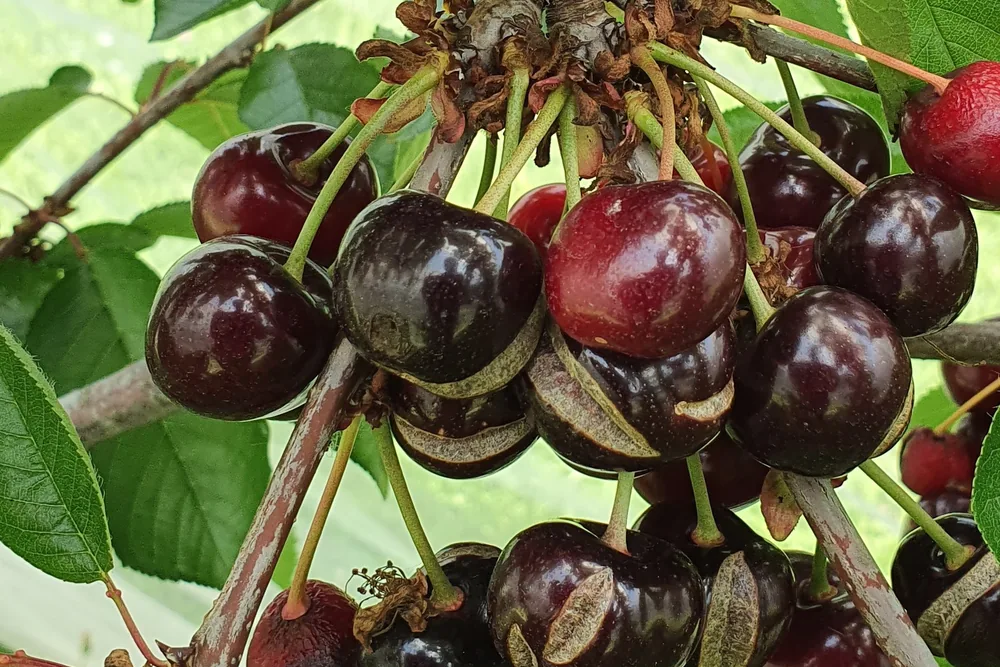
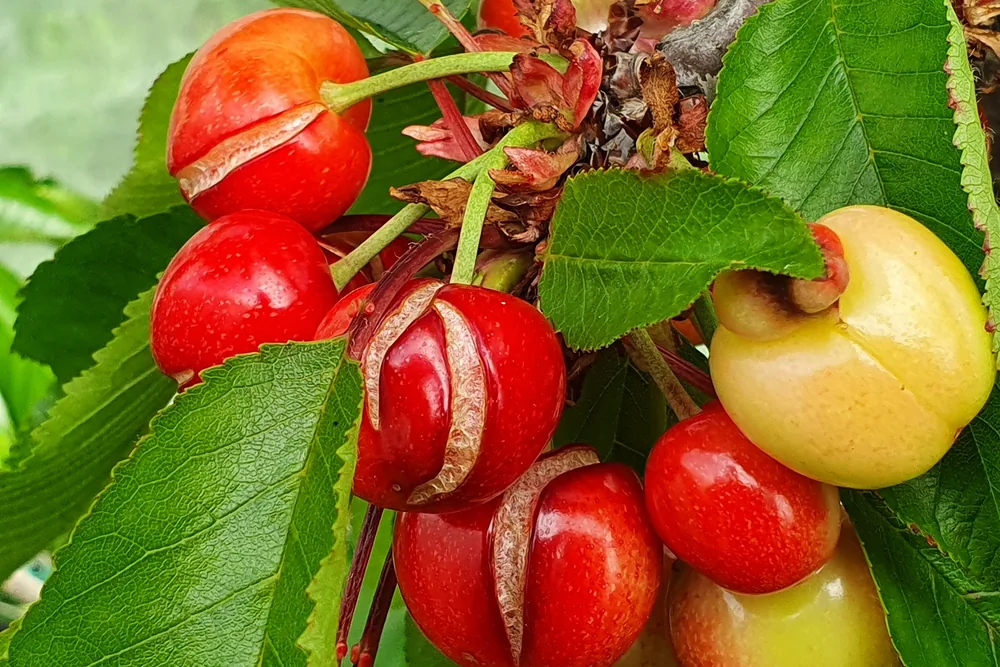
The agroclimatic conditions in northern Mendoza make it possible to obtain one of the Southern Hemisphere’s earliest harvests. Since 70–80% of production is destined for the domestic market, INTA is evaluating varieties, consumer preferences and technologies to preserve fruit quality. The findings will be presented at INTA Open Doors 2026, with two tastings open to the public.
Cherry production in Mendoza is preparing to begin its early harvest in the first week of November, one week later than in the previous season. The agroclimatic conditions of the Northern Oasis allow one of the earliest harvests in the Southern Hemisphere, a feature that supports the marketing of fresh cherries both domestically and abroad.
In Argentina, cherry cultivation covers around 2,200 hectares, and Mendoza leads the country’s production. Between 70% and 80% of Mendoza’s cherries are marketed domestically, while exports mainly go to Europe, Southeast Asia, China, the United Arab Emirates and Saudi Arabia.
Where Mendoza’s cherries are marketed
Production destinations. The export share is calculated as the remaining proportion of the total.
Domestic market70–80%
70%Reported range: 70–80%80%
Exports, remaining share20–30%
20%Remaining share of the total30%
The bars show the midpoint of each range; the values are those reported in the text.
To support the sector’s development, INTA Mendoza has a collection of 50 varieties from Canada, France, the United States and Japan. Those suited to local conditions include Brooks, Bing, Lapins, Sweet Heart, Royal Dawn, Symphony and Santina. Assessing quality and consumer preferences is essential to guiding production.
At INTA Open Doors 2026, scheduled for 6 and 7 November, two tastings will be held again, featuring the same varieties evaluated in 2025. The aim is to determine how the weather conditions in each season affect the varieties’ quality parameters and find out which ones the public prefers.
“We will organize a panel of non-expert consumers because we want to find out which varieties they prefer. We want to make this information available to those who produce mainly for the domestic market,” explained Javier Chaar, a researcher at INTA Mendoza.
The initiative builds on the tastings held during the previous edition. According to Chaar, “The results made it possible to identify the preferred varieties in detail, generating information of interest to small cherry growers supplying nearby markets.”
At the same time, INTA is conducting trials to assess yields and how they relate to fruit quality. One study focuses on three commercially important cultivars for Mendoza’s Northern Oasis: Bing, Lapins and Brooks.
According to Facundo Quirós, director of the Mendoza Cherry Chamber, “The seasonal challenge for this year’s early harvest, in 2026, will be to start in the first week of November, about two weeks later than in the previous season.” The organization represents 85% of the province’s growers, who together account for around 600 of Mendoza’s 700 hectares of cherry orchards.
Quirós added: “This year we have faced a series of adverse events—Zonda winds, hail, frosts and rainfall—that have exceeded the highest levels recorded in previous seasons, due to the effects of Super El Niño. Those who have been unable to actively protect their crops have suffered greater losses. Those who were able to access an appropriate technology package will have a heavier crop load and better quality; we nevertheless estimate a volume similar to the 2025 season.”

Research to preserve quality
Alongside varietal selection, preserving quality is a central focus of INTA’s research. The Agri-Food Laboratory at the Mendoza Agricultural Experimental Station studies harvesting, pre-cooling, packing and cold storage.
In this regard, María Isabel Quiroga Martín, a researcher at INTA Mendoza, warned that mechanical damage to cherries cannot be repaired; it can only be prevented. “Protecting fruit quality is not the responsibility of just one link in the supply chain: it requires the commitment of the picker in the orchard, the operator at the packing shed and the transport logistics team. Taking care at every stage of the chain is the only way to preserve the value of our production and gain access to the world’s most demanding markets.”
The main types of mechanical damage include depressions in the fruit skin, known as pitting, bruising and microcracking. These injuries can occur during handling and compromise the fruit’s commercial quality.
According to Quiroga Martín, “Mechanical damage is a very serious yet often overlooked problem, since cherries are a high-value product for which appearance and firmness are everything. A slight impact during harvesting or packing may seem insignificant at the time, but when a container is opened at its destination 30 days later, the result can be soft fruit with small dark indentations—one of the main causes of commercial devaluation.”
To understand how these injuries occur, the INTA team assessed the interaction between three factors: pulp temperature at the moment of impact, drop height and the material of the impact surface. The studies showed that cherries stored at 0 °C are firmer, but also more fragile when struck. By contrast, at temperatures of 22–24 °C, the fruit is softer and more prone to bruising, especially when dropped from greater heights.
Handling and risk of damage
Qualitative summary of the results described by INTA; this is not a quantitative scale of damage.
Conditions associated with more injuries
- Fruit at 0 °C
- Rubber impact surface
- Drop from 30 cm
This combination produced the highest levels of injury.
Practices that reduce damage
- Cushioning materials: polyester or EVA foam
- Maximum drop height: 10 cm
These measures reduced damage to minimal levels.
Pulp temperature: at 0 °C, cherries are firmer but more fragile when struck; at 22–24 °C, they are softer and more susceptible to bruising, especially when dropped from greater heights.
Based on these results, the researchers identified practices that can reduce damage during packing. The combination of fruit at 0 °C, high-impact surfaces such as rubber and drops from 30 centimetres causes the highest levels of injury. By contrast, using cushioning materials such as polyester or EVA foam, and limiting drop heights to a maximum of 10 centimetres, can reduce damage to a minimum. These findings provide practical information for improving cherry handling and storage.
The research also highlights the importance of integrating pre-harvest management with post-harvest care. Since cherries are highly perishable, preserving their physical and sanitary characteristics requires coordinated work between the fruit-growing and post-harvest teams.
Source: intainforma.inta.gob.ar
Image source: INTA
Cherry Times - All rights reserved