"Cracking" is a problem for sweet cherry production wherever the high-value crop is grown. However, despite considerable research, the reason that this phenomenon occurs has not been clear. In a new study, researchers reveal their discovery of what makes sweet cherries crack.
HANNOVER, GERMANY — "Cracking" is a problem for sweet cherry production wherever the high-value crop is grown. However, despite considerable research, the reason that this phenomenon occurs has not been clear.
In a new study, Andreas Winkler, Max Ossenbrink, and Moritz Knoche reveal their discovery of what makes sweet cherries crack.
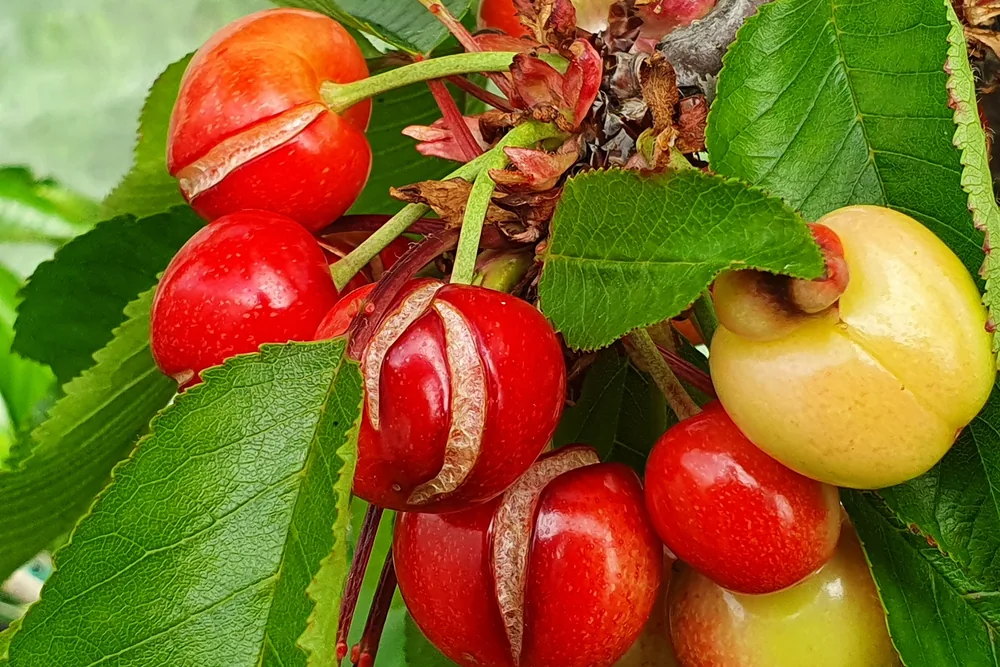
Sweet cherry cracking
Knoche, lead author of the study published in the Journal of the American Society for Horticultural Science, said the scientists from the Institute for Horticultural Production Systems at Leibniz University set out to investigate consequences of the leakage of cell contents into the fruit's apoplast.
"We observed a surprising and dramatic increase in cracking when sweet cherry fruit are brought into direct contact with the expressed juice of sweet cherries," Knoche said.
The scientists compared water uptake and fruit cracking in 'Sam' sweet cherries following incubation in polyethylene glycol (PEG) 6000, real sweet cherry juice extracted from the same batch of fruit using a spaghetti press, or in artificial juice comprising the five most abundant osmolytes of sweet cherries.
Fruit incubated in deionized water served as the control.
Malic acid and cracking
"Our results demonstrate that sweet cherry juice causes rapid fruit cracking for low amounts of water uptake. The effect of the juice on cracking can be reproduced using an artificial juice composed of the five most abundant osmolytes in real juice, which include malic acid.
It can also be reproduced using malic acid on its own," the authors explained. "We clearly identified malic acid as the major crack-promoting component in sweet cherry juice."
The researchers added that malic acid may be an "important link" in a reaction chain that begins with the bursting of individual epidermal cells and ends with the formation of macroscopic skin cracks. They noted that the same conditions may also occur in sweet cherry fruit in orchards.
Source: Manufactoring
Image source: Stefano Lugli
American Society For Horticultural Science
Cherry Times - Tutti i diritti riservati