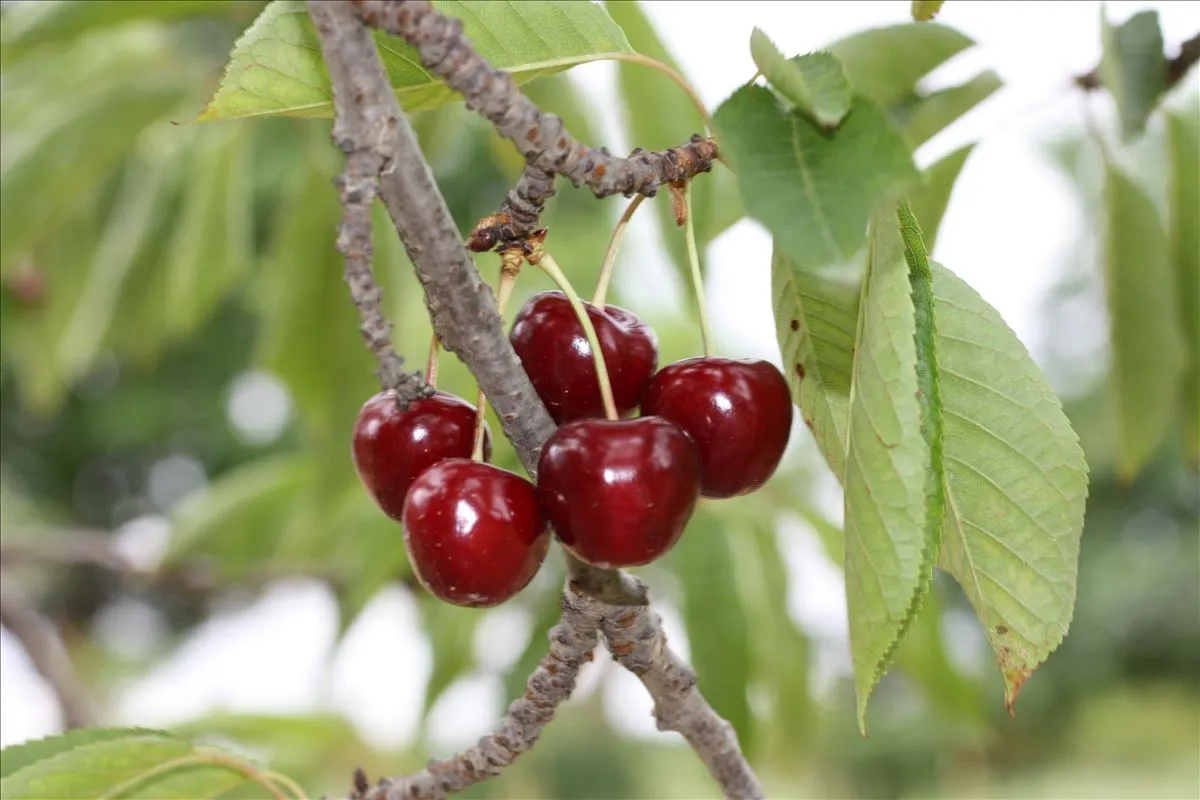
Mountain cherry trees grow under very particular conditions. Steep slopes, generally shallow and stony soils, and the risk of erosion and nutrient leaching make farming operations more difficult and can reduce fertilization efficiency.
At the same time, the altitude and climatic conditions typical of these areas make it possible to produce cherries of excellent quality, characterized by outstanding firmness, color and flavor.
These characteristics make it necessary to adopt a fertilization strategy suited to the soil. On a mountain farm, every operation involves a significant cost: access to the plots, working hours, fuel, and the use and wear of machinery.
For this reason, in addition to ensuring the proper nutrition of cherry trees, it is particularly important to improve the efficiency of each application and, whenever possible, reduce the number of required operations.
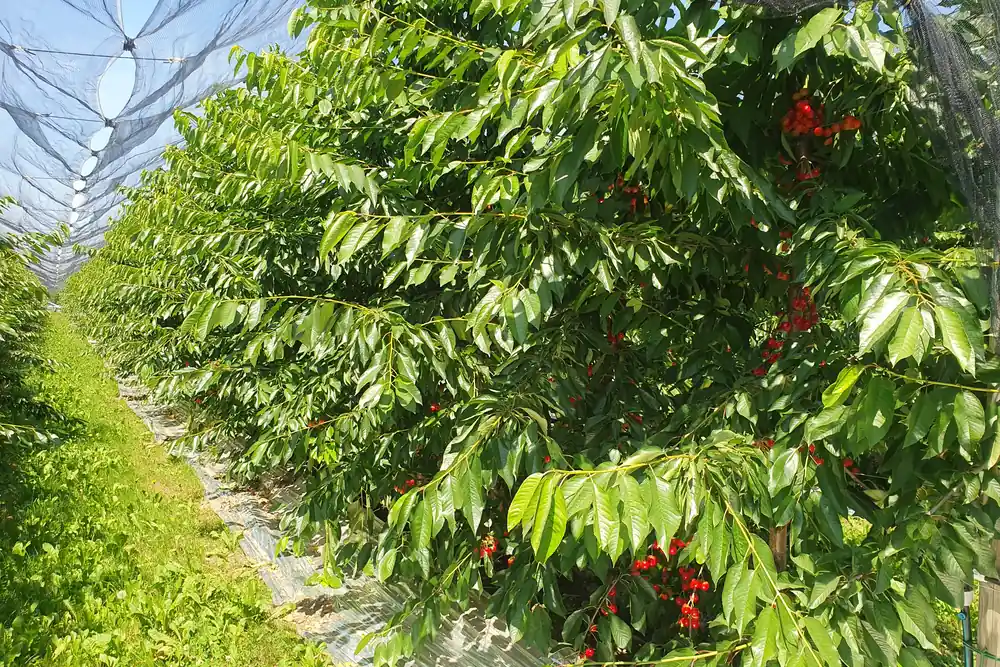
Soil, the foundation of production
Under these conditions, soil plays a fundamental role. Fertile soil acts as a reservoir of water and nutrients, supports the development of a healthy root system, promotes biological activity and improves fertilizer use.
The objective should be to keep the cherry tree balanced, avoiding excessive vigor, which can lead to excessive wood production, reduced exposure of the fruit to sunlight, poorer color and firmness, and greater pruning and management requirements.
Excessively dense vegetation can also hinder air circulation and the penetration of crop protection treatments.
Keeping trees balanced, therefore, does not only affect the quality of the harvest. It can also help reduce pruning, management and treatment costs, increasing the farm’s overall profitability.
The post-harvest phase
The post-harvest phase also plays an important role. After harvesting, the cherry tree remains active, developing its roots and accumulating carbohydrates and nutrients that will provide reserves for bud break and flowering in the following season.
Proper nutritional management must therefore consider the tree’s entire cycle, rather than focusing solely on the period of fruit development.
Why use organo-mineral fertilizers?
Organo-mineral fertilizers combine organic matter and mineral nutrients in a single formulation, making it possible to act simultaneously on crop nutrition and soil fertility.
This combination can promote greater retention and availability of nutrients, a more gradual release and a reduction in certain losses caused by leaching.
The objective is not simply to supply a greater quantity of nutrients, but to ensure that a higher percentage of those applied remains available and can be used by the cherry tree.
Greater nutrient-use efficiency also provides an economic advantage. Every unit of fertilizer that is lost represents a cost that does not translate into production. Improving fertilizer use therefore means achieving a greater agronomic return on the investment made in fertilization.
Two operations with a single application
One of the main practical advantages of organo-mineral fertilizers is the possibility of applying organic matter and mineral fertilizer at the same time.
Instead of applying an organic soil amendment followed by a separate application of mineral fertilizer, both inputs can be supplied in a single operation.
This aspect is particularly important in mountain cherry growing, where access to and work in certain plots can be more complex and expensive.
Reducing the number of passes provides direct savings in fuel, tractor operating hours, labor and machinery wear, while also limiting travel between plots and simplifying work organization.
It also provides a wider application window
It also provides a wider application window. When weather conditions or the condition of the soil limit the number of days available for field operations, being able to perform two functions in a single operation greatly simplifies management.
The cost of fertilization, therefore, should not be assessed solely by comparing the price per ton of fertilizers. The overall cost of the operation must be considered: product, transportation, machinery, fuel, working time and the number of required applications.
An investment in the orchard’s future
Cherry tree fertilization must be planned with both the current harvest and the long-term maintenance of productivity in mind.
Gradually improving the soil promotes more active roots, better-balanced trees, more efficient use of water and nutrients, and more stable, higher-quality harvests.
Furthermore, a farm that can use nutrients more effectively, reduce losses and limit certain operations can produce more efficiently. The objective is not simply to spend less on fertilizers, but to reduce the actual cost of producing each kilogram of marketable cherries.
Ultimately, organo-mineral fertilization is a particularly valuable tool for mountain cherry growing, as it makes it possible to nourish the crop and improve the soil with a single application.
The combination of greater fertilization efficiency, fewer field operations and the gradual improvement of soil fertility can lead to lower management costs, more effective use of the investment allocated to fertilization and greater farm profitability.
Source: agricotec.es
Image source: Stefano Lugli
Cherry Times - All rights reserved