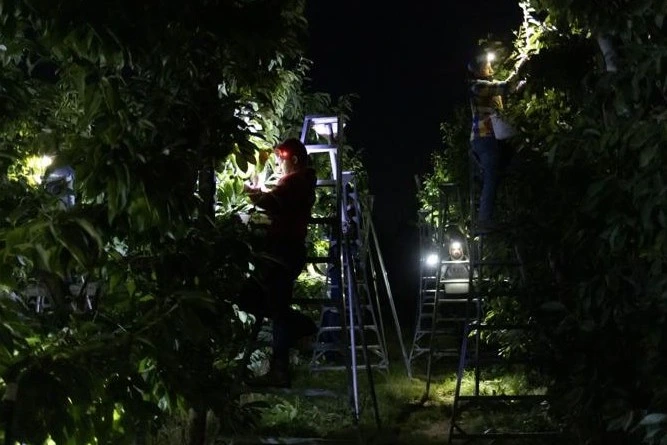
Together with consultant Sebastián Johnson, who has experience with this type of harvesting in the United States – where it is a common practice – we observed in the field the advantages, opportunities and challenges that this option could present, mainly to avoid the high daytime temperatures during summer, protect workers and also the fruit, improving its condition and postharvest life.
Night cherry harvesting: how close are we in Chile?
Is it possible to harvest cherries at night in Chile?
It is a challenge, but through planning and attention it is possible, just as has happened in other sectors of the country that have managed to operate 24 hours a day, 7 days a week.
This is according to Sebastián Johnson, consultant and general director of Proyectos Industriales Johnson, who has observed this type of harvesting in the United States and believes that the model could also be imported to Chile.
“We must stop seeing agriculture as if it were the third world,” he says, emphasizing that with planning and logistics it is absolutely feasible.
The reasons are far from superficial: the high temperatures recorded in summer, during the harvesting period that is mainly concentrated in December, affect both workers and fruit quality.
Cherries can in fact reach very high pulp temperatures at the moment of harvest, with a strong impact on quality and their postharvest life.
Johnson, in this trial carried out together with Redagrícola in the El Toro orchard, located in Bulnes (Ñuble region), argues that night harvesting would make it possible to stop using traditional tools that try to imitate the night, such as the wet sponges normally placed in the bins where freshly harvested cherries are deposited.
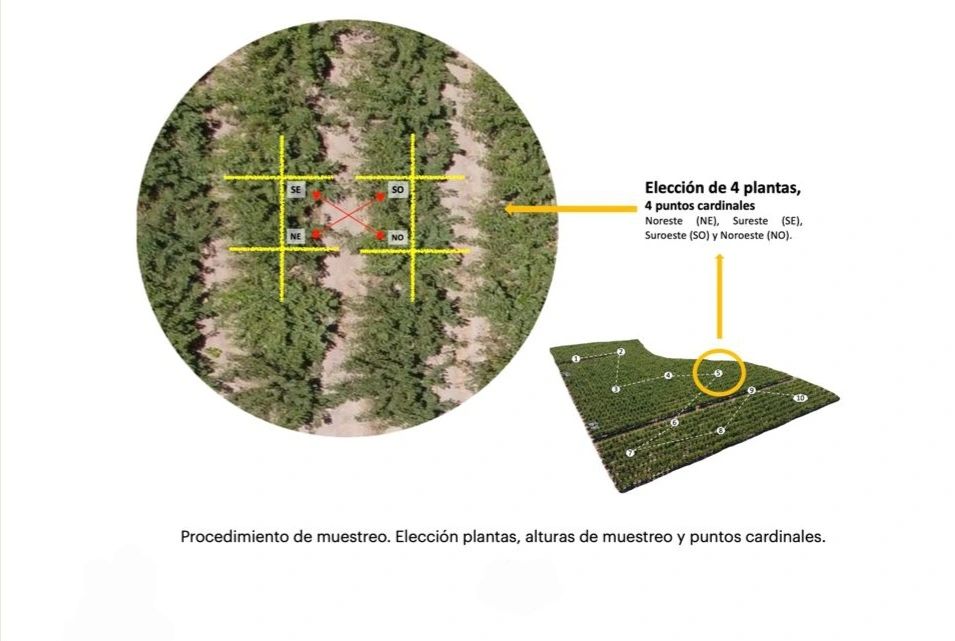
The inclusion of remote sensing as a variable has been decisive in the evaluation of product or management trials. The wealth of information available, scheduling and geostatistics make it possible to accurately assess the effectiveness of treatments and programmes.
It is important to note that ours is a mature industry,' says Claudia Soler, 'and Chile is the world's largest cherry exporter and leads the southern hemisphere's exports: more than 96% of the supply with over 400,000 tonnes of shipments in 2022-2023.
A study of greenhouse-grown Sunburst sweet cherries in Beijing, China, compares hand pollination, growth regulators and honey bees. Hand pollination raises fruit set to 71.68% while maintaining good fruit firmness. Costs and results across seasons still need assessment.
Cherry irrigation and fertilization: practical guidance on water, nutrients and root growth. Learn how irrigation frequency, calcium and nitrogen applications, soil inspections and compaction management can support fruit quality, healthy roots and productive orchards.