Born almost as a hobby, today it is a structured player in the Argentine cherry industry. In just over twenty years, Frutos del Valle Patagónico has grown from four experimental hectares in Chubut to 79 cultivated hectares between Chubut and Santa Cruz, with production approaching one million kilos per year and around 800 thousand kilos destined for export.
A growth path built on quality, technology and an international vision, within a global market dominated by Chile.

From the first trees to vertical integration
The company was founded in 2003 through the initiative of Viviana Bircher, a certified public accountant, and Omar Salinas, an employee of Banco Nación temporarily transferred to Trelew. The initial idea was to diversify income with a small cherry orchard in Chubut, supported by the dynamism the region was experiencing in the sector.
The first four hectares, managed with the support of agronomists, marked the beginning of an entrepreneurial journey that soon required a qualitative leap. When production began, a structural limitation in the area emerged: there were no packing facilities nearby, and outsourcing meant less control and reduced margins.
In 2010, the family opted for vertical integration by opening its own packing facility, initially in an artisanal way. A strategic decision that made it possible to manage the entire production chain, from harvest to air shipment.
Territorial development and international markets
Today the company operates 33 hectares in Chubut – in the chacras Cielos del Sur, Glyn and Las Santinas – and 46 hectares in Santa Cruz, in Los Antiguos at “Villa Favaloro”. The growth of the cherry sector in South America is closely linked to Chile’s expansion into China.
The Chilean market paved the way by capturing Chinese demand and building a solid reputation. Argentina, on the other hand, faced delays in opening phytosanitary protocols with Beijing, arriving late in a scenario where cherries are often perceived as a Chilean product.
Today the challenge is to establish Argentine origin in the eyes of international consumers, despite difficulties related to high tariffs and several markets still closed from a sanitary standpoint.
Exports and cultivated varieties
The company exports around 70% of its production to destinations reachable by air and with active protocols: China, the United States, the Middle East – particularly Dubai – and Singapore in Southeast Asia. This strategy is based on markets with active sanitary access.
Cherries are a delicate and highly technical fruit. The company grows seven varieties with different calendars and characteristics: Santina, an early variety and flagship, harvested between late November and mid-December; Lapins and Ping; Kordia and Regina, more exclusive varieties; Staccato and Sweet Heart, late-season varieties ideal for extending the production window.
Some cultivars are particularly sensitive to heat and require harvesting within precise temperature windows to avoid cracking.
From harvest to air shipment
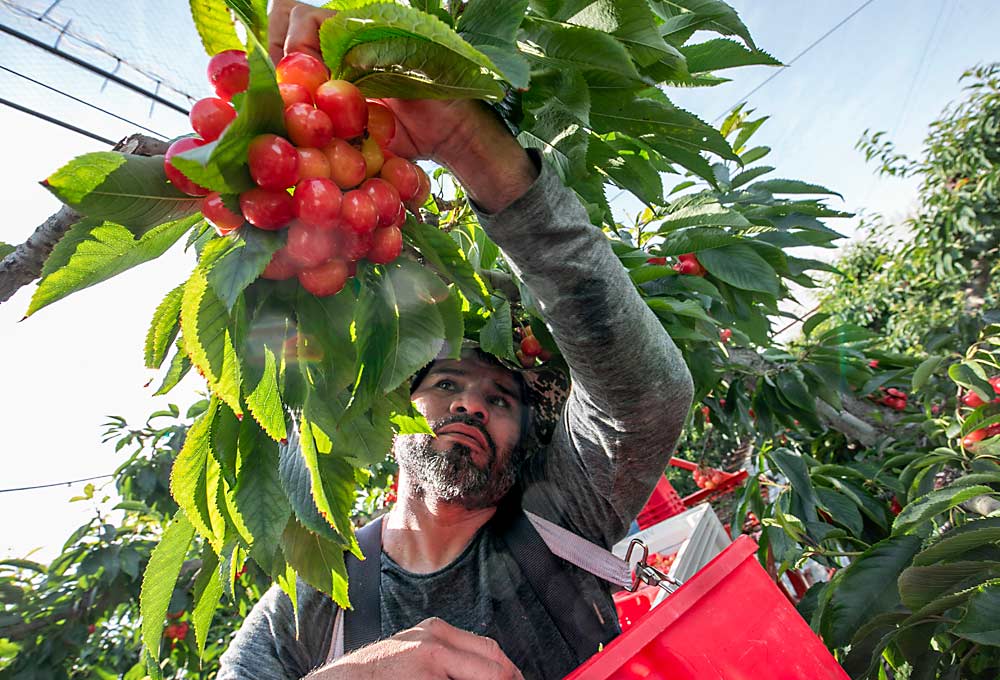
Harvesting takes place in four-kilo crates. To stop ripening and preserve firmness and quality, cherries are placed on carts covered with foam soaked in chlorinated water to lower temperature and maintain humidity.
Transport to the packing facility takes place in refrigerated trucks, where the product is quickly stabilized using hydrocoolers, with timing adjusted depending on the variety. After weighing and batch labeling, cherries enter cold storage at 4°C and subsequently the grading line, which sorts by quality and size.
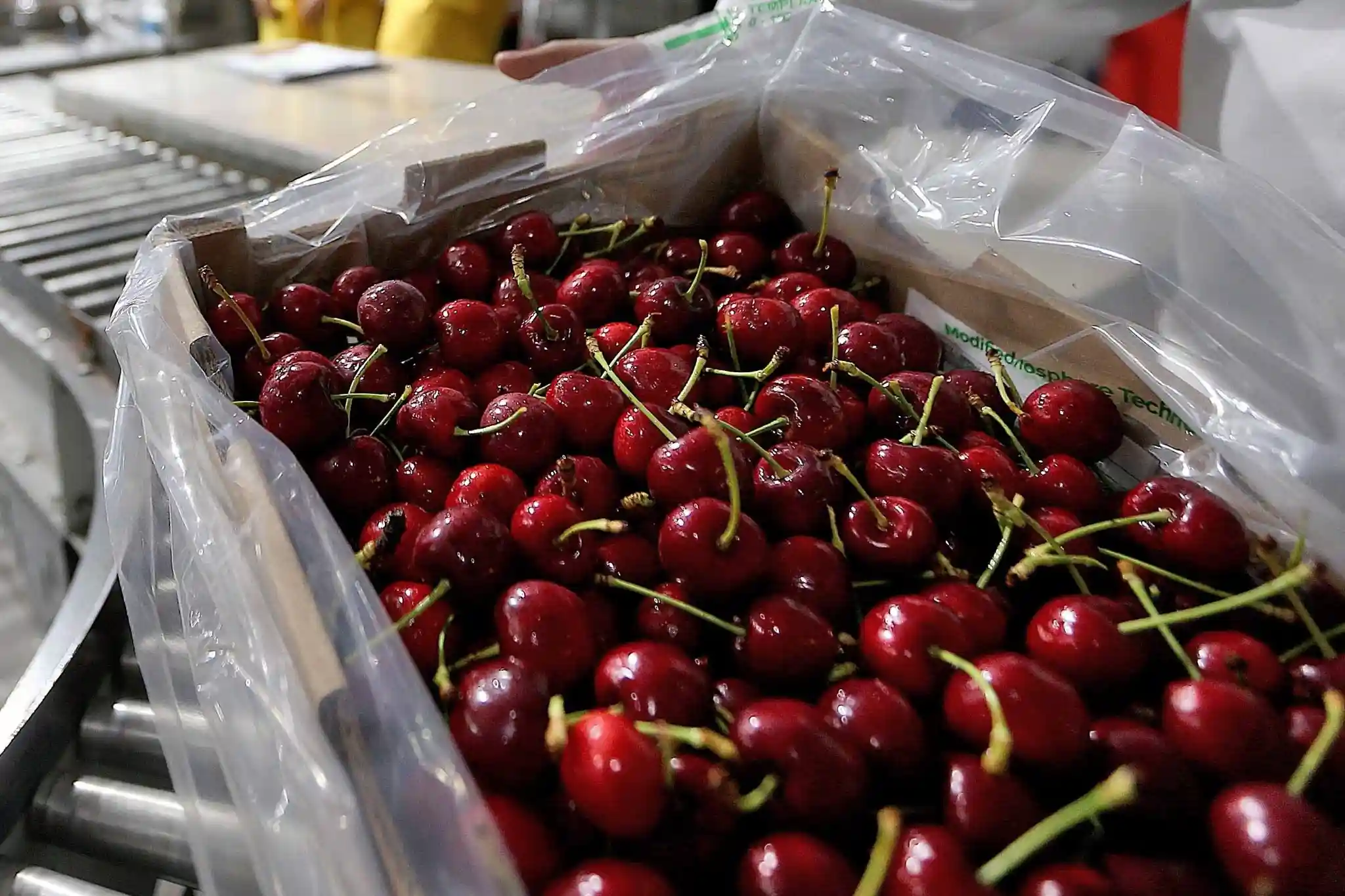
For export, modified atmosphere bags are used. Once packed, the fruit is palletized and cooled to 0°C, ready for air shipment from Ezeiza to the final customer.
Production, family and expansion
Production varies depending on climatic conditions but in recent years has ranged between 900 thousand and 1 million kilos annually, with 600–700 thousand kilos exported. During the season, the workforce reaches 220–240 employees.
A portion of production remains on the domestic market, which in the last two years has shown greater sustainability due to exchange rate differentials, whereas in the past prices did not even cover packaging costs. Management remains strongly family-oriented and involves the founders, their daughter Sofía, her brother Cristian, their uncle and Sofía’s partner.
Today the main bottleneck is the capacity of the packing facility and cold storage rooms, currently undersized compared to volumes. The objective is to invest in a new packing facility with greater storage and refrigeration capacity and with structural improvements in export packaging.
A niche space for Argentina
The company is awaiting the signing of a contract for a larger plot of land in the Trelew industrial park; alternatively, solutions in other areas of the province or other regions are being considered, or the outsourcing of services, a scenario that would have employment implications.
Argentina produces about 1% of Chile’s volumes and, in this context, the strategy cannot be based on volume competition but rather on the development of a premium niche built on quality, efficiency and commercial reliability.
For Frutos del Valle Patagónico, the key word is consistency: maintaining high standards, meeting programs and ensuring continuity for customers. In a delicatessen segment such as cherries, it is precisely credibility throughout the supply chain that makes the difference and supports future growth.
Source: www.clarin.com
Image source: Clarin
Magalí Sztejn
Clarin
Cherry Times - All rights reserved