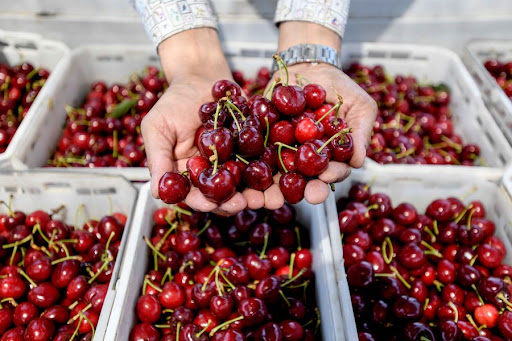
For more than a decade, Chilean cherries generated exceptional margins based on a fairly simple premise: reaching their destination before Chinese New Year. This strategy was enough for demand to absorb almost any volume. However, the 2024-25 season delivered less encouraging results, signalling a shift that the industry definitively confirmed in 2025-26.
Chile exported fewer cherries than in the previous season, yet prices failed to recover, with profitability lower than in recent years.
An overview of the 2025-26 season
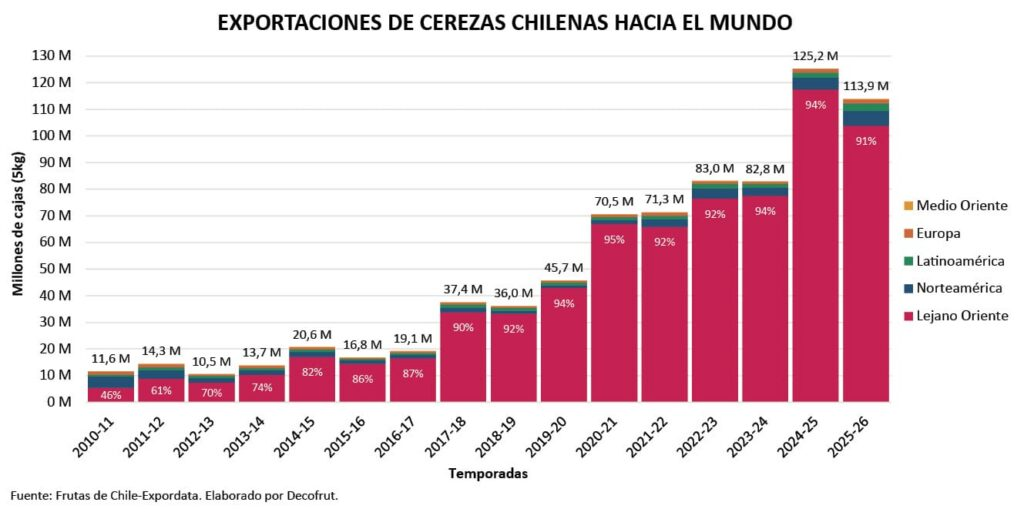
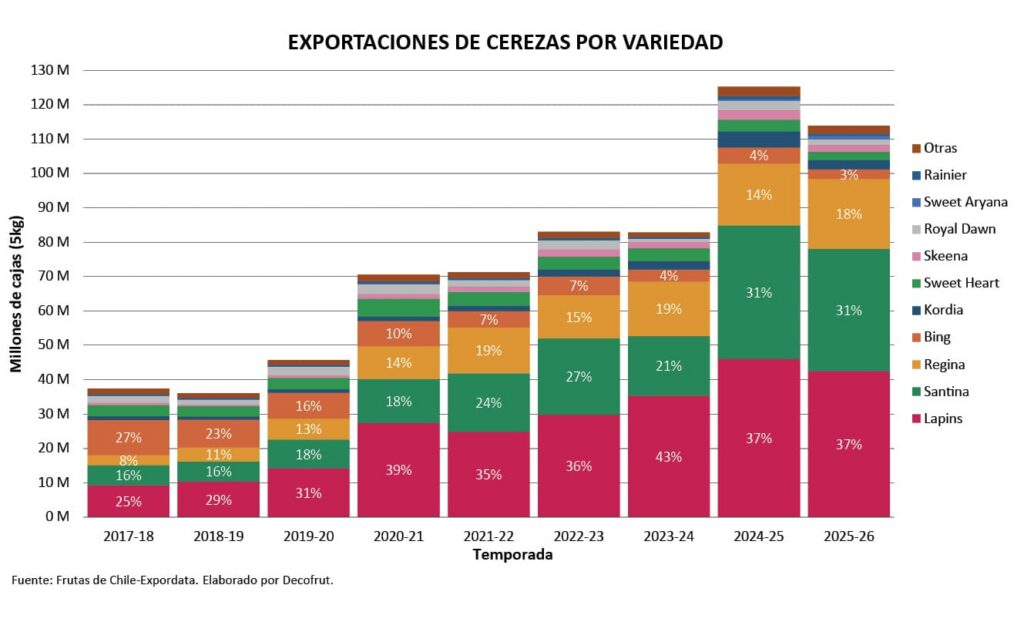
The Cherry Committee of Frutas de Chile expected exports to exceed 131 million boxes in 2025-26, maintaining the growth trend seen over the past decade. However, volumes totalled 113.9 million boxes (569,200 tonnes), 13% below forecasts and 9% below the 125.2 million boxes (626,000 tonnes) shipped in 2024-25.
A breakdown by destination shows that China-Hong Kong remained the main recipient, absorbing 98.9 million boxes. However, its historically dominant share declined from 91% to 86.9% of the total, reaching its lowest level since the 2017-18 season. The remaining volume was distributed among secondary but strategic markets.
The United States imported 5.1 million boxes (4% of the total), Taiwan received 2.1 million (2%) and South Korea 1.4 million (1%), alongside other destinations.
Market diversification progressed, albeit modestly. Exports to the United States increased by 27%, shipments to Latin America by 51%, those to Europe by 12% and those to Middle Eastern countries by 34%. Meanwhile, volumes destined for the Far East fell by 12% compared with 2024-25.
What happened during the season?
Despite lower export volumes, the 2025-26 season faced profitability challenges caused by a timing mismatch. Chile’s early harvest, combined with a late Chinese New Year in week 8, meant that the bulk of supply arrived far too early ahead of the festivities.
This scenario created an oversupply that, although partly absorbed by the market, exceeded demand at the expected price levels, eroding projected margins and, to some extent, forcing the industry to prioritise inventory turnover over price speculation.
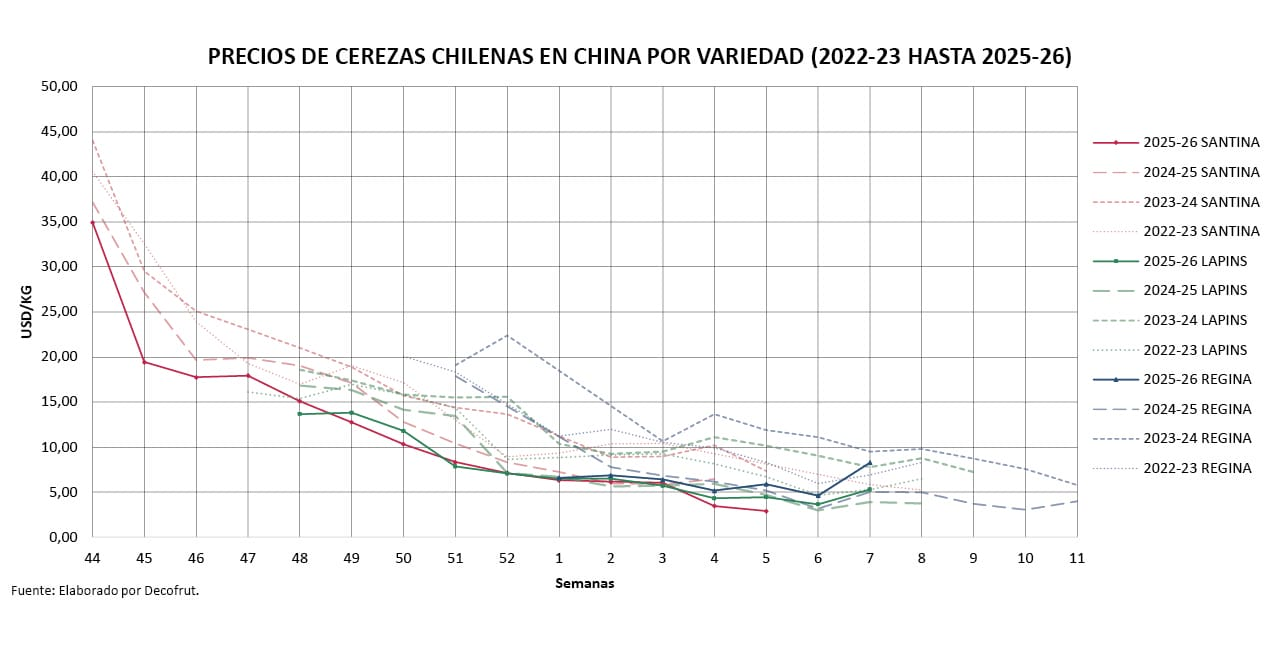
Faced with the persistent downward trend in prices that characterised the period between December and January, several importers shifted their commercial strategy towards holding cherries in storage. Expecting prices to recover in the run-up to Chinese New Year, they chose to store lots in excellent condition, postponing their immediate sale.
However, this tactic proved counterproductive. Rather than delivering higher margins, it led to a loss of value due to the natural deterioration of the fruit and market oversupply during the crucial weeks.
China remains the key market, but consumers have changed
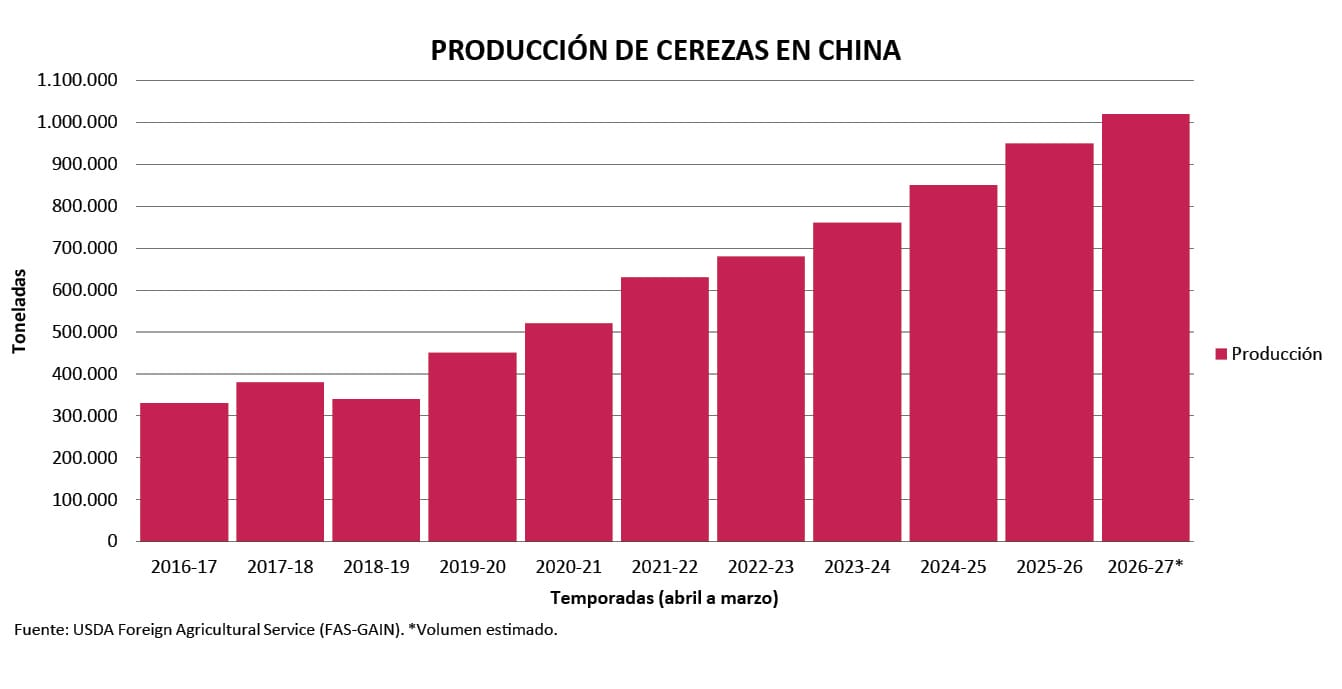
China remains the most important market for Chilean cherries, but its consumption habits have changed dramatically in recent years. Steady growth in Chinese domestic production, alongside an increase in more competitively priced imports, has broadened consumption to middle-income households. However, current economic uncertainty and weak domestic demand have made buyers particularly price-sensitive when purchasing non-essential goods.
Today’s consumers are far more demanding and selective, carefully comparing specific quality attributes such as size, crunchiness, sweetness, colour and presentation. In this context, growth opportunities are shifting towards smaller urban centres beyond Shanghai or Guangzhou, and towards digitalisation.
E-commerce and social media, through live streams, short videos and influencer partnerships, are driving fruit sales and introducing dynamics and formats that differ completely from those of the traditional wholesale channel.
Key factors for the new season
Quality emerges as the most frequently repeated word in industry analyses. A significant share of shipments during the 2025-26 season consisted of fruit in sizes L (22-24 mm) and XL (24-26 mm); however, some lots had serious condition issues, including internal browning, soft fruit, insufficient colour and poor firmness.
The industry’s assessment clearly indicates that the market penalises poor fruit quality and condition, particularly in smaller cherries, for which returns can no longer cover production costs. Marketing fruit of this kind not only jeopardises growers’ financial viability but also directly affects perceptions of the country’s brand.
Consequently, to maintain international competitiveness, the minimum standard for export fruit should be set at sizes J (26-28 mm) or 2J (28-30 mm).
Alongside increasing fruit size, it is essential to review the varieties being grown. Those presenting difficulties related to chilling requirements, fruit set, size and postharvest performance, or simply no longer meeting consumer expectations, should be urgently assessed, particularly where cherry orchards have ceased to be profitable.
Given the steady expansion of planted area in recent years, with a substantial proportion of hectares yet to reach full production, every change represents an opportunity. This is particularly relevant when considering operational factors already showing signs of reaching capacity, such as labour availability, packing facility capacity and logistics infrastructure, both at origin and destination.
From a climatic perspective, current signals are mixed. Winter rainfall is changing application schedules for growth regulators and other agricultural inputs, with potential implications for expected harvest dates.
Towards the end of the year, El Niño could intensify, bringing a wetter spring and a warmer-than-usual summer to central Chile. This temperature variability can alter dormancy release, interfere with flowering and budbreak, increase frost risk and raise pathogen levels on the fruit.
From a phytosanitary perspective, the Mediterranean fruit fly (Ceratitis capitata) currently represents one of the main risks to exports to China, with eradication campaigns active in the Atacama, Coquimbo, Valparaíso and Metropolitan regions. Unless controlled, new detections would trigger quarantine measures and cold treatments, once again complicating shipment logistics.
Other threats include the European grapevine moth (Lobesia botrana), subject to the strict zero-tolerance protocol of the Servicio Agrícola y Ganadero (SAG), and the spotted-wing drosophila (Drosophila suzukii), which directly affects fruit quality and condition in the orchard.
Finally, agroclimatic and market challenges are compounded by external factors that the industry cannot avoid and that increase pressure on the sector. On the one hand, crises in the Middle East, including tensions in the Strait of Hormuz and ongoing conflicts in the Red Sea, have forced shipping companies to divert their traditional routes, extending transit times and increasing freight rates worldwide.
On the other hand, the United States’ recent introduction of an additional 12.5% tariff on a broad range of Chilean products, including cherries, directly affects one of the key markets in the country’s commercial diversification strategy.
Outlook for 2026-27
Export potential for the coming season is projected at a minimum of more than 130 million boxes (650,000 tonnes) and, under the most optimistic scenarios, could even exceed 140 million boxes (700,000 tonnes). However, the industry’s challenge is no longer to maximise volumes, but to safeguard quality.
The 2025-26 season represented more than a decline in exports: it was the year in which the industry acknowledged something that had been highlighted for some time: the market for Chilean cherries in China will not return to what it once was. The question remains whether the production, logistics and quality conditions needed to maintain a competitive advantage are in place, or whether strategic adjustments are required.
The adjustment concerns the model, not the market. Chile must decide whether to manage growth, with everything that entails, or allow the market itself to do the job.
Kori Luengo and América Ramírez - Decofrut Information Department
Source: Vision Magazine
Cherry Times - All rights reserved