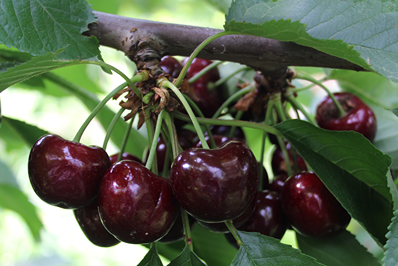
A scientific study conducted by Chilean researchers analyzed how mineral nutrition may be related to internal browning in cherries. A subsequent study on ‘Regina’ showed that specific foliar phosphorus applications reduced the incidence of this physiological disorder by 29%.
A cherry can leave the orchard looking apparently perfect and, several weeks later, reveal an internal problem capable of compromising its commercial value. Internal browning has become one of the main challenges facing cherry production for distant markets, particularly for varieties and growing areas where the fruit must maintain its quality throughout long periods of storage and transportation.
And part of the answer may be found long before the fruit enters the packing facility.
Tree nutrition, particularly the balance between nitrogen (N) and phosphorus (P), appears to be a factor capable of influencing firmness, antioxidant content, tissue stability and, ultimately, the ability of cherries to withstand the postharvest period.
Nutrition and research
This was one of the main hypotheses analyzed in the scientific paper “The Potential Roles of the N and P Supplies on the Internal Browning Incidence in Sweet Cherries in the Southern Chile”, authored by Cristóbal Palacios-Peralta, Marjorie Reyes-Díaz, Jorge González-Villagra and Alejandra Ribera-Fonseca and published in the journal Horticulturae.
The paper is a scientific review: the authors analyzed the available evidence to understand how nitrogen and phosphorus might be involved in the development of internal browning, emphasizing the need to subsequently validate these hypotheses under commercial growing conditions.
Dr. Ribera-Fonseca of the Universidad de La Frontera (UFRO) began her research through the PTEC Project on cherry postharvest management.
This last point is important for growers: the original study does not define a fertilization protocol for cherry trees, but identifies several physiological and agronomic processes that may help explain why certain fruits have a greater storage potential than others.
A disorder that develops from within
Internal browning is particularly complex because it is not necessarily visible at the time of harvest or packing.
From a physiological perspective, the phenomenon is associated with oxidative processes. Polyphenol oxidase enzymes, or PPOs, are involved in the oxidation of phenolic compounds, generating quinones that subsequently give rise to the characteristic brown pigments found in the affected tissues.
In other words, the fruit may retain an acceptable commercial appearance externally while showing changes in the flesh after several weeks of storage.
This physiological disorder is especially relevant to the Chilean industry, where a considerable proportion of production must travel through a long logistics chain before reaching consumers.
Storage and susceptibility
Postharvest research indicates that this deterioration increases as the storage period becomes longer and that varieties such as Regina and Skeena may be particularly susceptible under prolonged storage conditions.
To understand the connection with fertilization, it is necessary to observe what happens inside the fruit.
Cherries contain numerous antioxidant compounds, including phenols, anthocyanins and ascorbic acid, which help protect tissues against oxidative processes. The scientific review indicates that higher levels of these compounds may help reduce susceptibility to browning.
This raises an important agronomic question: can tree nutrition alter this antioxidant capacity and, consequently, the subsequent behavior of the fruit?
Nitrogen and phosphorus
The evidence analyzed by the researchers indicates the existence of a potential relationship, although not all nutrients act in the same way and their response is not linear. It is within this context that nitrogen and phosphorus come into play.
Nitrogen is essential for cherry tree growth. It is involved in the formation of proteins, enzymes and tissues and directly influences vegetative growth.
However, this does not mean that indefinitely increasing its availability will improve fruit quality.
The scientific review highlights that an excessive supply of nitrogen may negatively affect attributes related to the quality and storability of several fruit species. The reported effects include reduced firmness, changes in phenolic composition and a lower storage potential.
Nutritional balance
According to the authors, these findings justify the need to investigate this relationship specifically in cherries grown in southern Chile.
The recommendation is not to arbitrarily restrict nitrogen, but to avoid nutritional imbalances and adjust its supply to the actual requirements of the orchard.
An excessively vigorous tree does not necessarily produce fruit that is better prepared to withstand several weeks of postharvest storage.
Phosphorus presents a particularly interesting situation in southern Chile.
Volcanic soils
Much of the region’s volcanic soil has a high capacity to retain or adsorb phosphorus. This means that a soil may contain significant quantities of this element while, at the same time, having a relatively small fraction available for plant uptake.
Research conducted on Chilean Andisols has described precisely this high phosphorus-fixing capacity and the resulting reduction in its availability.
This characteristic is becoming increasingly relevant as cherry cultivation expands into southern regions and plastic covers are used for late-season varieties.
These systems make it possible to protect crops from events such as rainfall, but they also create a particular growing environment that may affect fruit quality characteristics and storability.
The 2022 hypothesis
The 2022 scientific study hypothesized that an adequate phosphorus supply could be involved in processes related to soluble solids, secondary metabolism, antioxidants and postharvest physiology.
At the time, however, the authors themselves emphasized the lack of field-based experimental evidence under southern Chilean conditions, which was necessary before this hypothesis could be turned into a recommendation for cherry cultivation.
Three years later, direct evidence emerged for ‘Regina’
It is precisely on this point that subsequent developments in the research become particularly interesting.
A study published in 2025 evaluated foliar phosphorus applications on cv. Regina cherries grown under plastic covers in southern Chile. The researchers compared an untreated control with treatments using 1.5 and 2.2 L ha⁻¹ of the product tested in the trial, evaluating the fruit both at harvest and after storage.
The results highlighted an aspect of particular importance to growers.
Commercial quality
The phosphorus applications did not produce significant differences in average fruit weight, average fruit size or soluble solids content. The effect, therefore, did not simply result in “more kilograms” or a “higher sugar content.”
Differences instead emerged in attributes directly related to commercial quality and storability.
The research recorded a higher percentage of fruit larger than 32 mm, a greater proportion of cherries in the Dark Mahogany color category and an increase in antioxidant compounds, such as total phenols and anthocyanins.
The most significant result, however, emerged after the storage period.
29% less internal browning
In the treatment using 2.2 L ha⁻¹ of the product specifically tested by the researchers, the incidence of several postharvest physiological disorders decreased compared with the control.
The study recorded reductions of 70% in pitting, 31% in dehydration, 56% in “orange peel”, also known as lizard skin, and 29% in internal browning.
The result provides experimental evidence supporting a hypothesis that, three years earlier, had been formulated primarily on the basis of a literature review: preharvest nutritional management may reveal its effects several weeks later, when the fruit is being stored or is about to reach the consumer.
However, it would be incorrect to interpret these results as a general recommendation to apply 2.2 L ha⁻¹ of phosphorus in every orchard.
Orchard application
This rate refers to the specific product, formulation, cultivar, environment and protocol used in the trial. Before applying it in a commercial orchard, it is necessary to consider soil and plant tissue analyses, initial phosphorus levels, variety, rootstock, crop load, vigor, irrigation management, previous fertilization and the specific characteristics of the product used.
This is one of the main messages emerging from this line of research: the nutrition of an orchard producing cherries for long-distance export should not be assessed solely in terms of growth and yield. Fruit quality upon arrival must also be included in the equation.
A sufficient supply of nitrogen to support production, but without excess; phosphorus availability suited to soil characteristics; balance with other nutrients; vigor control; an appropriate crop load; and the correct identification of the harvest timing are all part of the same system.
This is particularly relevant in the volcanic soils of the south, where considering only the total phosphorus content may be misleading because of the element’s high fixation capacity.
Nutritional diagnosis
For this reason, a diagnosis based on soil and plant tissue analyses, combined with the plot’s production history, is more valuable than the application of standard programs.
Postharvest begins before harvest
For years, many of the solutions adopted to extend the storability of cherries have understandably focused on refrigeration, modified atmospheres, packaging and postharvest management.
This research adds another dimension.
A fruit that has better physiological and biochemical conditions at harvest is in a stronger position to withstand the storage period. This condition is the combined result of decisions made over months of orchard management.
A complementary strategy
Centro Fruticultura Sur summarizes this line of research by emphasizing that balanced nutrition could become a complementary strategy for reducing internal browning and preserving fruit quality during long-distance exports.
However, further research is needed to develop specific recommendations according to the growing area and production system.
The term “complementary” is crucial: no fertilizer can replace harvesting at the correct stage of maturity, prompt cooling, an efficient cold chain or proper packing management.
However, the evidence is beginning to show that perfect postharvest management is not enough if the fruit arrives at the packing facility already weakened from a physiological perspective.
Quality over time
For Chilean growers, particularly those producing late-season cherries in southern regions, this research presents a concrete challenge: to start evaluating fertilization not only by asking how much the tree can produce, but also what level of fruit quality can still be maintained 30, 35 or more days after the fruit leaves the orchard.
This change in perspective may prove decisive in an industry where true quality is not only what is observed at harvest, but what the end customer ultimately receives.
Source: www.diariofruticola.cl
Image source: Stefano Lugli
Cherry Times - All rights reserved