Nitrogen management in fruit orchards requires an increasingly precise approach that considers not only the amount of the nutrient present in the soil, but also the chemical form in which it is available.
Nitrate (NO3−) and ammonium (NH4+), in fact, represent the main forms of mineral nitrogen present in the rhizosphere and are subject to transformation, uptake, and loss processes that are strongly influenced by environmental and biological conditions.
A recent study has shown that tree species may represent an additional factor contributing to the composition of mineral nitrogen.
The study in German orchards
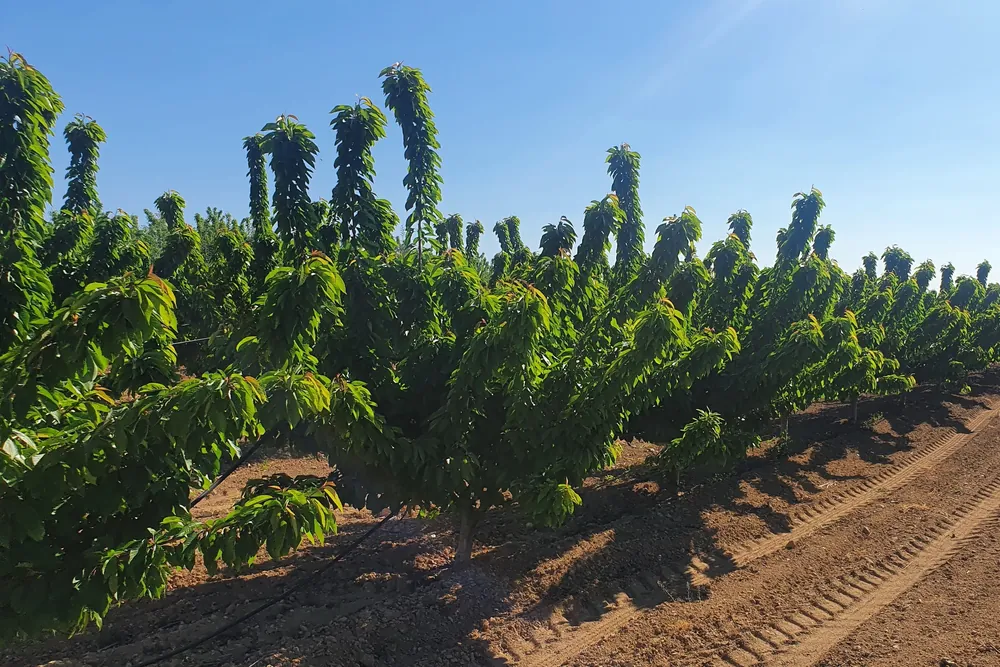
The study compared apple (Malus domestica) and sweet cherry (Prunus avium) orchards through a long-term experiment conducted at Klein-Altendorf, Germany, followed by a validation study in a commercial orchard in Beesenstedt.
At the first site, soils from orchards subjected to different fertilization strategies were analyzed, including an unfertilized control, liming, lime plus compost, and lime plus NPK fertilization, while in the commercial orchard the comparison was conducted under standard production conditions.
Soil sampling, carried out during the late winter–early spring period, focused on the 0–20 cm topsoil layer, corresponding to the main rooting zone of the rootstocks considered.
Differences between apple and sweet cherry orchards
The results revealed a marked difference in mineral nitrogen composition. In apple orchard soils, nitrate accounted on average for approximately 83% of mineral nitrogen, whereas in sweet cherry orchards the distribution was much more balanced, with approximately 42% nitrate and 58% ammonium.
This finding is particularly interesting because the different ratio between the two nitrogen forms remained consistent across different years, the two sites, and the different fertilization systems.
Over the long term, compost application increased the availability of both nitrate and ammonium compared with the other treatments, indicating enhanced mineralization of organic matter and a consequent release of mineral nitrogen.
The role of climatic conditions
Climatic conditions also affected the absolute levels of mineral nitrogen: in 2021, which was characterized by cooler and wetter conditions, the availability of both forms was lower than in 2020.
However, these factors were not sufficient to explain the different composition observed between apple and sweet cherry.
In the commercial orchard, moreover, the comparison between February and March showed an increase in NH4+ in sweet cherry soils during the transition from dormancy to bud break, whereas nitrate remained clearly predominant in apple soils.
Possible plant–soil interactions
According to the researchers, this phenomenon could be associated with species-specific differences in plant–soil interactions, potentially related to root activity, ammonium retention, or nitrification processes in the rhizosphere.
However, these remain hypotheses that require further investigation, as the study did not directly measure root system characteristics, microbial communities, or nitrification rates.
Overall, the most interesting finding was the species-related difference in soil mineral nitrogen composition observed between apple and sweet cherry orchards, beyond the effects of fertilization, site, and environmental conditions.
Implications for orchard fertilization
From a nutritional management perspective, these results suggest that crop-specific characteristics and plant–soil interactions should be taken into account when designing fertilization programs, with the aim of improving nitrogen use efficiency and reducing the risk of environmental losses.
Source: Schwitzky, E., Kalbitz, K., Blanke, M., & Siewert, C. (2026). Contrasting Nitrate and Ammonium Stocks in Soils of Sweet Cherry and Apple Orchards. Agronomy, 16(12), 1179. https://doi.org/10.3390/agronomy16121179
Image source: Stefano Lugli
Andrea Giovannini
PhD in Agricultural, Environmental and Food Science and Technology - Arboriculture and Fruitculture, University of Bologna, IT
Cherry Times - All rights reserved