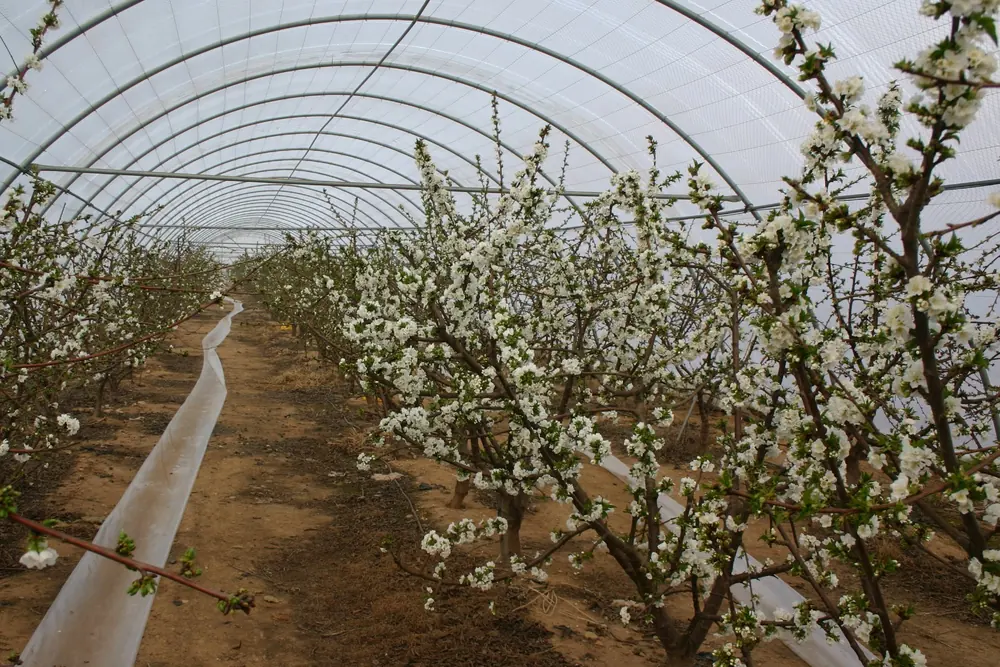
The cultivation of sweet cherry under greenhouse conditions has expanded rapidly. In these protected environments, achieving consistent fruit set remains a major challenge, as limited air circulation and specific microclimatic conditions can reduce the efficiency of pollination and fertilization.
Even self-compatible cultivars, although not entirely dependent on pollen from other varieties, may exhibit uneven fruit set when pollen dispersal is insufficient. To identify effective strategies, a recent study compared three techniques to improve fruit set in the self-compatible cultivar ‘Sunburst’: hand pollination, plant growth regulator treatment, and pollination by honey bees (Apis mellifera ligustica).
The experiment was conducted in 2025 in a solar greenhouse at the Tongzhou Cherry Base in Beijing, China, using eight-year-old trees grafted onto ‘Landing 2’ rootstock. The three treatments were compared with an untreated control. The results revealed differences in both fruit set percentage and several fruit quality parameters.
Hand pollination proved particularly effective, increasing fruit set to 71.68%, compared with 38.21% in the control. Plant growth regulator treatment also produced a positive response, achieving a fruit set rate of 66.05%. By contrast, introducing honey bees did not significantly improve fruit set, which reached 42.06%.
Fruit set and treatment results
This finding suggests that, under the specific conditions of the experiment, pollinator activity was insufficient to overcome limitations in pollen distribution and that, for a self-compatible cultivar such as ‘Sunburst’, the contribution of honey bees may be less decisive than that of other techniques.
The agronomic effectiveness of these treatments must nevertheless be assessed alongside fruit quality. Hand pollination produced firmer cherries than the control, with an average firmness of 86.50 g compared with 70.10 g, and increased raffinose content, a sugar involved in metabolism and osmotic regulation.
Furthermore, it did not affect fruit shape or average fruit weight, maintaining an overall balanced quality profile. Plant growth regulator treatment resulted in the highest fruit firmness, at 97.00 g, but also increased pedicel length to 3.43 cm, compared with 2.81 cm in the control.
In biochemical terms, this treatment increased gluconic acid content to 3.44 mg/g fresh weight while reducing ascorbic acid content to 0.23 mg/g, compared with 0.34 mg/g in the control. These changes highlight how the use of growth-regulating substances can influence not only fruit set but also organic acid metabolism and certain fruit quality traits.
Fruit quality and biochemical changes
Bee pollination, in turn, resulted in the highest total soluble solids content, at 16.68%, and the highest total phenolic content, at 1.93 mg/g, together with higher sucrose and sorbitol concentrations.
Overall, the study identifies hand pollination as a valid strategy for increasing fruit set under protected cultivation without the use of exogenous plant growth regulators, while maintaining good fruit firmness and a balanced sugar–acid profile. Its practical application must nevertheless be evaluated in relation to labour costs and orchard size.
It is also important to note that the study involved only one cultivar, a single growing season, and a limited sample size. Multi-year trials involving different cultivars and growing environments will therefore be essential to determine whether these findings can be generalised and to establish reliable practical protocols.
Source: Chuanbao Wu et al. (2026). Effects of Different Fruit Set Enhancement Treatments on Fruit Set Rate and Fruit Quality of the Self-Compatible Sweet Cherry Cultivar ‘Sunburst’ Under Protected Cultivation. Horticulturae, 12(9), 1094. https://doi.org/10.3390/horticulturae12091094
Image source: Stefano Lugli
Andrea Giovannini
PhD in Agricultural, Environmental and Food Sciences and Technologies - General Arboriculture and Tree Crops, University of Bologna, IT
Cherry Times - All rights reserved