The progressive increase in winter temperatures represents a major challenge for fruit production, directly affecting dormancy processes and the phenology of tree species. In this context, a recent study analyzed the response of 22 sweet cherry cultivars under Mediterranean-continental climatic conditions (Zaragoza, Spain), integrating experimental data and climate modeling to assess their future adaptability.
Chilling and heat accumulation were quantified using the Dynamic, Chilling Hours, and Utah models for chilling, and the Growing Degree Hours model for heat.
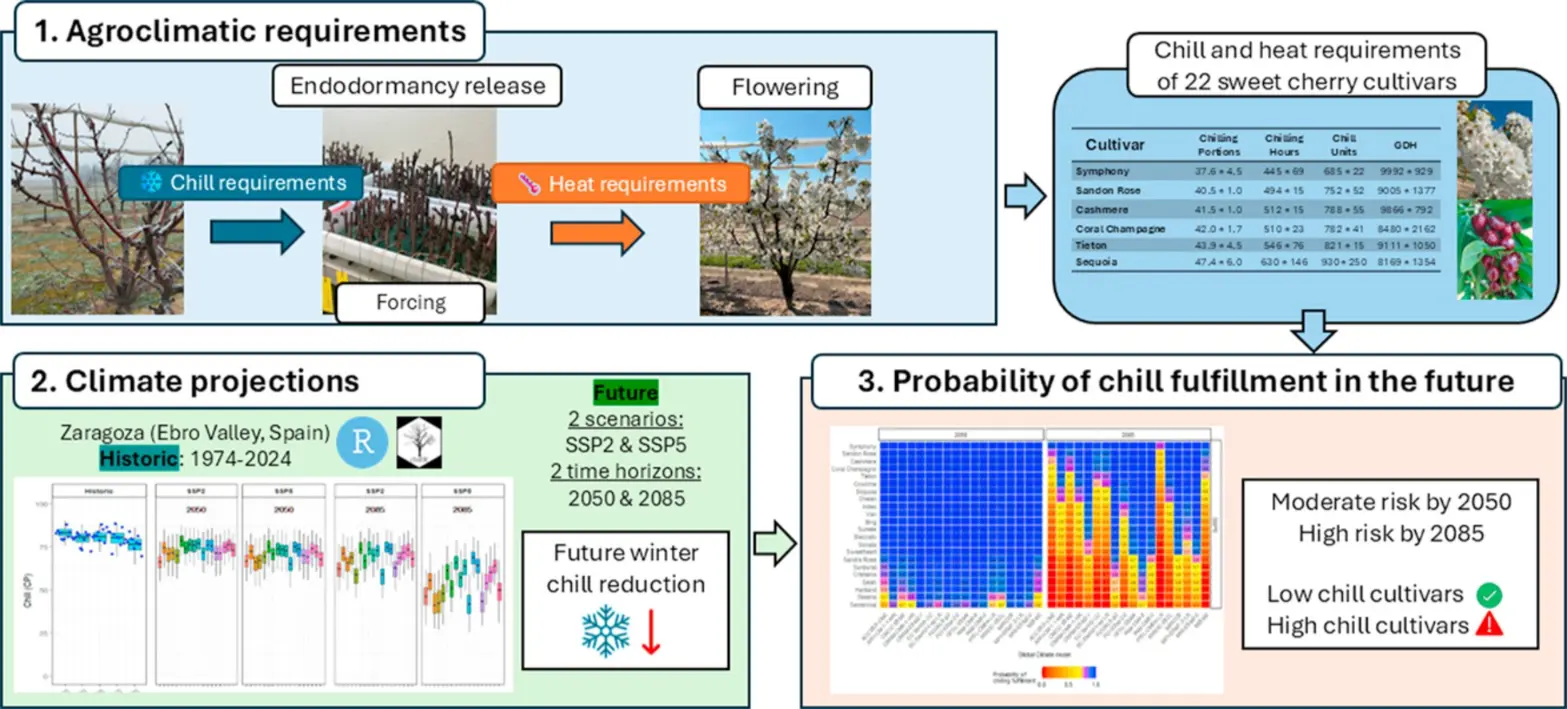
The results highlight how winter warming is altering dormancy dynamics, with important implications for orchard productivity and sustainability. The analysis, conducted over two contrasting seasons (2022–2023 and 2023–2024), allowed for precise determination of the agroclimatic requirements of the cultivars in terms of chilling and forcing.
Chilling requirements, expressed in Chilling Portions (CP), showed wide variability, ranging from 37.6 to 66.6 CP, while heat requirements for flowering (7095–9992 Growing Degree Hours) confirm the complexity of the interaction between dormancy and vegetative resumption.
Varietal differences
Low-chill cultivars, such as ‘Symphony’, appear better suited to mild winter conditions, whereas high-chill cultivars, such as ‘Sentennial’, are already approaching their adaptive limits under current conditions. This highlights the complex interaction between dormancy and growth, which varies depending on climatic conditions and genetic traits.
Climate trends
From a climatic perspective, the analysis of long-term data (1974–2024) revealed a significant reduction in winter chill accumulation, estimated at approximately 6–8 CP since the 1980s, corresponding to a decline of 6–10%. The 2023–2024 season represented an extreme case, with the lowest chill accumulation recorded in the past 50 years and a general delay in flowering up to 11 days. This finding highlights how, in mild winter environments, insufficient chilling can lead to delayed phenology rather than advancement, contrary to what is often observed in colder climates.
 Source: Santolaria et al 2026
Future scenarios
Future climate simulations indicate a continued decline in winter chill, based on 18 global models and emission scenarios SSP2-4.5 and SSP5-8.5. By 2050, most cultivars may still meet their chilling requirements, although some high-chill varieties already show potential adaptation risks. By 2085, particularly under the high-emission scenario, all cultivars are projected to face a risk of insufficient chill accumulation in at least one model.
This suggests a potential loss of production suitability for many areas traditionally devoted to sweet cherry cultivation. Another key aspect is the variable cultivar response to reduced chilling, as some exhibit non-linear flowering behavior, suggesting compensatory effects or alternative physiological mechanisms.
Adaptation strategies
These findings support the hypothesis of a dynamic interaction between chilling and forcing and highlight the need for further research into dormancy regulation. Cultivar selection emerges as a primary strategic tool, favoring low-chill cultivars, alongside adaptive agronomic practices such as site selection, pollination optimization, and targeted orchard management. In the long term, breeding programs aimed at reducing chilling requirements represent the most promising solution.
Conclusions
The study demonstrates that integrating dormancy physiology with climate modeling provides an effective approach for assessing future sustainability of cultivars, offering a valuable decision-support tool for growers and technicians in a changing climate.
Source: Santolaria, N., Castel, L., Rodrigo, J., & Fadón, E. (2026). Warming winters and cultivar resilience in sweet cherry: agroclimatic requirements and future suitability under Mediterranean-continental conditions. Agricultural and Forest Meteorology, 383, 111138. https://doi.org/10.1016/j.agrformet.2026.111138
Opening image source: Stefano Lugli
Andrea Giovannini
PhD in Agricultural, Environmental and Food Science and Technology - Arboriculture and Fruitculture, University of Bologna, IT
Cherry Times - All rights reserved