The 2025 sweet cherry pilot under the CrackSense project brought together two case studies to investigate the environmental and agronomic drivers of fruit cracking. From catastrophic rain-induced losses in an organic orchard to detailed varietal trials and sensor-based monitoring, this blog post presents the key findings, data collected, and early lessons from the sweet cherry pilot.
Lithuanian pilot: organic sweet cherry
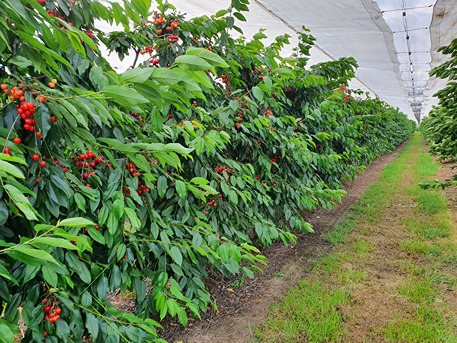
The Lithuanian pilot, led by Beta via, was designed as a representative case study for organic sweet cherry production. The project monitored one organic orchard in Kapčiškės, Lithuania, with the objective to analyse the environmental and agronomic factors that determine fruit cracking in this system.
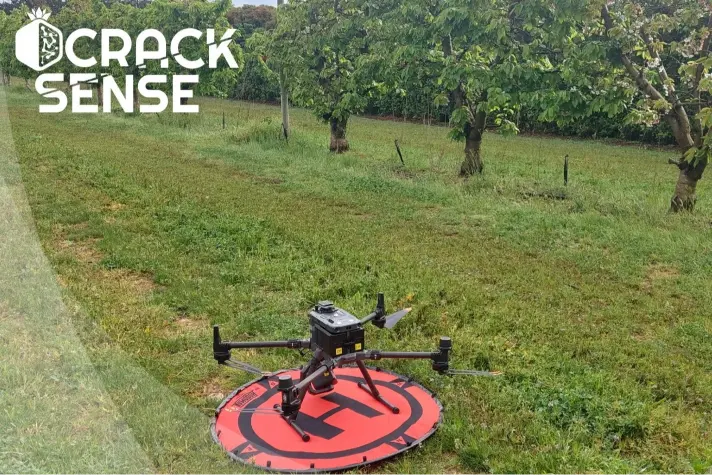
The pilot combined soil moisture and temperature monitoring for tree-level assessment, alongside fruit-level assessment using an on-ground sensing system developed by the Leibniz Institute of Agricultural Engineering and Bioeconomy (ATB).
The 2025 season proved climatically extreme. After severe spring frosts, several days of rain in early July caused approximately 95% of the yield to be lost due to fruit cracking. This event convincingly demonstrated the catastrophic impact of excessive rainfall during fruit ripening, even in an otherwise healthy orchard. The project recorded the condition of the orchard before the damaging rain, creating a clear environmental record of the event’s impact.
Key insights from the pilot
Climate extremes as the main driver: The season demonstrated that spring frosts and summer precipitation are the dominant, uncontrolled risk factors for cherry cracking, overshadowing routine orchard maintenance.
Vulnerability of organic systems: The loss of harvest underscored how organic systems – lacking protective chemical treatments – are particularly exposed to climate-related stressors.
Changing patterns from historical data: Historical data collected from this orchard showed that fruit cracking was not previously a prevalent indicator; it was a relatively rare phenomenon. The 2025 season showed that this can change very quickly in the event of extreme weather.
This work validates a cost-effective monitoring approach that integrates weather data, fruit-level and tree-level analysis, and remote sensing at the orchard scale, enabling its use as an early warning system.
Monitoring and prevention strategies
The impact of weather conditions, particularly heavy rainfall, on fruit cracking had previously been underestimated, but this pilot revealed just how substantial that impact truly is, translating directly into food losses and hardship for farmers and highlighting the need to account for these factors when designing prevention measures. Correlating forecast rainfall with orchard conditions can support the development of non-chemical mitigation strategies (e.g., reviewing drainage or considering the use of hail nets for rain protection).
In-text visual for the CrackSense Open Day at the cherry orchard. In-text visual for the CrackSense Open Day at the cherry orchard.
Broader implications
The methodology is easily transferable to other regions and fruit species. The findings provide support for policy and research initiatives to develop climate-resilient fruit varieties and agronomic practices. The pilot also provides a compelling economic case for investing in monitoring and mitigation, as single events can wipe out a season’s income, especially for smallholder farmers.
While the 2025 results were devastating for yields, they provided an unambiguous and data-driven case study of fruit cracking. This case shows the real risks faced by organic farmers who choose more sustainable practices and highlights the need for supportive innovation.
French pilot: field experimentation
The French pilot case, led by CTIFL at their Balandran site, focused on field experimentation, manual cracking assessments, physiological measurements, and support for the development of predictive models.
The monitoring included four sweet cherry varieties selected to represent a range of maturity windows and cracking sensitivities:
- Balrine: early ripening, medium to high cracking sensitivity
Bellise: mid-early ripening, very high cracking sensitivity
Folfer: early ripening, high cracking sensitivity
Regina: late ripening, low cracking sensitivity
Experimental setup and data collection
This range allowed the team to cover a wide spectrum of climatic periods favourable to cracking and to observe the behaviour of varieties with different sensitivities. The trial monitored 32 trees across two plots of 1,130 and 1,980 square metres. The monitoring period ran from April to June 2025, corresponding to the main cracking-sensitive window from fruit set to harvest.
A comprehensive dataset was built including the following variables:
- Day water potential of the leaves at ripening and maturity (hydric stress)
- Meteorological data at plot level
- Percentage of cherries with cracking and description of cracking type and location at harvest (classified into three types: lateral, pistillar, and peduncular)
- Soil water potential at two different depths using tensiometers
- Measurements using sensors installed on a drone and on the TOMMY tool at fruit set and maturity (fruit humidity, fruit temperature, thermal imaging)
- Leaf Area Index (LAI) measurements
Additional information and results
Additional general information was recorded: country, species, site, study year, year of planting, treatment, and cultivar. Tree localisation data included TreeID, longitude and latitude, elevation, variance zone, and row and line position. Soil analyses covered texture at 30, 60 and 90 cm (sand, silt, clay fractions) and nutrient analyses (N, P, K, Mg, Ca, Na, B, Cl). Yield and fruit traits recorded included total fruit weight, total number of fruits (with no cracking), and average fruit weight.
In-text visual to help illustrate the recent activities in CrackSense.
The first year was dedicated to field validation at the French site. This enabled the team to compile a set of reference data for model calibration. The work carried out in 2026 will be similar to that conducted in 2025, allowing the team to strengthen predictive analysis of cracking risk.
Text and image source:Crack Sense
Opening image source: Stefano Lugli
Cherry Times - All rights reserved