Winter dormancy is one of the most important physiological mechanisms in temperate tree species, including sweet cherry. Dormancy allows plants to synchronize growth and flowering with seasonal environmental conditions; however, increasing climate variability and rising winter temperatures are making the understanding of the genetic mechanisms regulating growth cessation, dormancy, and the subsequent resumption of vegetative growth increasingly important.
A recent study conducted in Spain described the discovery and preliminary characterization of a sweet cherry genotype showing an “evergrowing” (evg) phenotype, meaning that it is unable to enter dormancy and is characterized by continuous vegetative growth during winter. This genetic material represents a valuable resource for studying the molecular processes that control dormancy in fruit trees and for developing new breeding strategies.
The evg genotype was
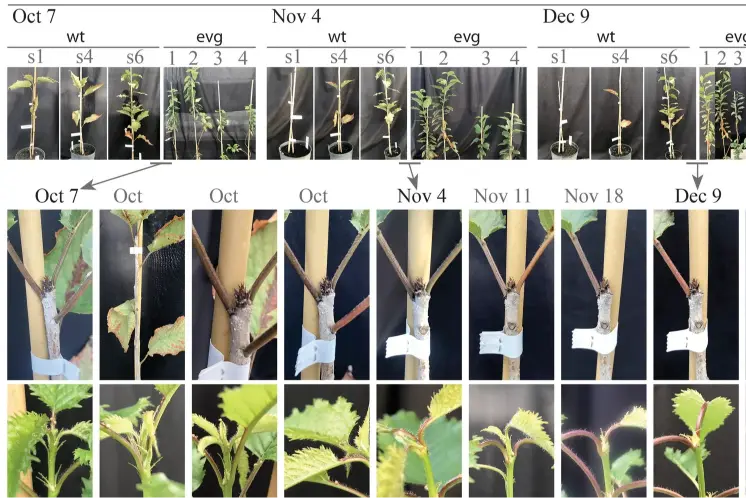
The evg genotype was obtained through in vitro embryo rescue from seeds derived from self-fertilization of the local self-compatible cultivar ‘Cristobalina’, a variety known for its very early flowering and low chilling requirement. Among the seedlings, one individual displaying an unusual phenotype compared with its wild-type siblings was identified.
Unlike normal sweet cherry plants, which cease growth in autumn, form dormant buds, and shed their leaves, the evg individual continues to produce shoots and leaves throughout the winter period without forming the typical closed terminal buds associated with dormancy.
Under greenhouse conditions, this genotype showed much more vigorous growth than wild-type plants, reaching an average height of about 160 cm by the end of the growing season, compared with approximately 48 cm for the control plants. Moreover, while normal plants completely shed their leaves in autumn, the evg phenotype retains a substantial portion of its canopy, with only the oldest leaves progressively falling.
Genetic analyses confirmed
Genetic analyses confirmed that the plant indeed originated from self-fertilization of the cultivar ‘Cristobalina’, based on the study of the S-locus associated with self-incompatibility and the mutation in the MGST gene linked to the self-compatibility of the parental variety.
This result suggests that the phenomenon may be associated with the expression of recessive alleles in homozygosis generated through the inbreeding process, a relatively rare condition in highly heterozygous species such as sweet cherry. From a molecular perspective, the researchers focused on the DAM (Dormancy Associated MADS-box) genes, a group of transcription factors known to play a key role in the regulation of dormancy in fruit trees.
In peach, for example, the evergrowing phenotype is caused by the deletion of four of the six DAM genes present in the genome. In the sweet cherry genotype analyzed in this study, however, no major structural deletions were observed in the PavDAM genes, suggesting that the genetic mechanism underlying the phenotype is different.
Nevertheless, gene expression analyses revealed altered expression patterns of DAM genes in the evg genotype compared with wild-type plants. In particular, some genes such as DAM2 and DAM3 were completely repressed throughout the entire seasonal cycle, while others (DAM1, DAM5, and DAM6) showed strongly reduced or temporally limited expression during the period when dormancy is normally established. An additional pattern was observed for DAM4, which showed signs of differential alternative splicing between the evg and wild-type phenotypes.
In conclusion, the results
In conclusion, the results suggest that the failure of the evg sweet cherry to enter dormancy is associated with abnormal regulation of DAM gene expression rather than with evident structural mutations. Although the precise molecular mechanism still needs to be clarified, this new genotype represents an important resource for functional genetics studies on dormancy and seasonal growth regulation in temperate fruit trees.
Furthermore, the study demonstrates how self-fertilization and inbreeding can generate useful genetic variability for identifying new phenotypes and key genes, offering new perspectives for sweet cherry breeding.
Image source: Hedhly et al 2025
Andrea Giovannini
PhD in Agricultural, Environmental and Food Science and Technology - Arboriculture and Fruitculture, University of Bologna, IT
Cherry Times - All rights reserved