The increasing adoption of high-density orchards in sweet cherry requires training systems capable of combining high productivity, superior fruit quality and efficient canopy management. In this context, a study conducted in the Republic of Moldova between 2010 and 2024 evaluated the influence of different training systems on the agronomic performance of sweet cherry trees by comparing the Thin spindle, Cup, Kym Green Bush and Improved thin spindle systems on several cultivars grafted onto the Gisela 6 rootstock.
The results demonstrate that the Thin spindle system is the most effective solution for increasing productivity while maintaining a proper balance between vegetative and reproductive growth in intensive orchards. The trial included the cultivars ‘Early Star’, ‘Samba’, ‘Black Star’, ‘Kordia’ and ‘Regina’, planted at spacings of either 4 × 2 m or 4 × 1 m, depending on the experimental design.
In addition to yield, numerous morphological, vegetative and fruit quality parameters were assessed, including canopy development, shoot growth, fruit size, soluble solids content and flesh firmness.
Canopy architecture
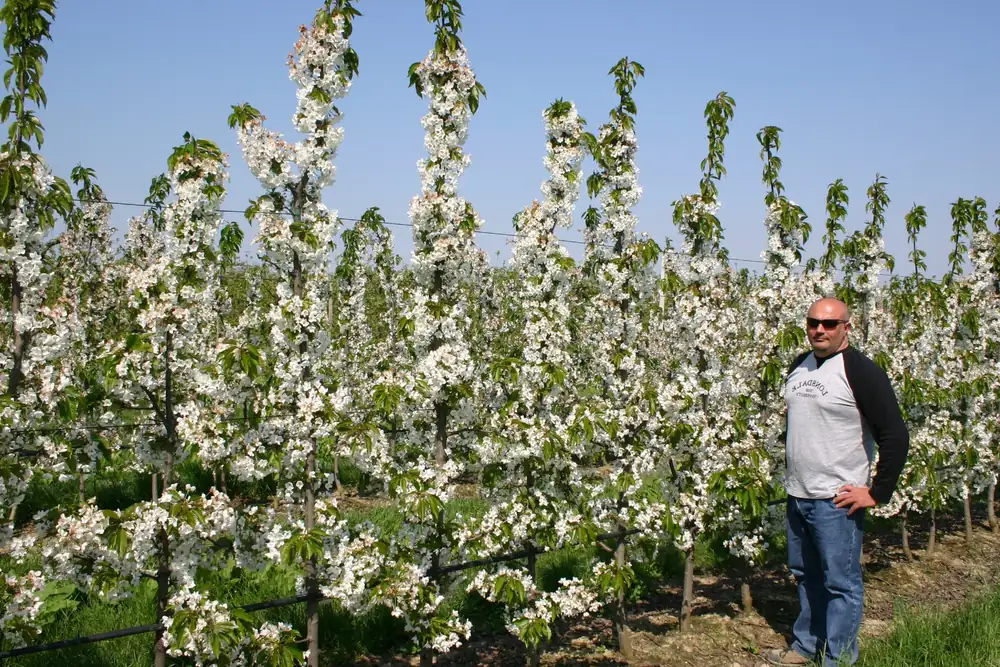
The different training systems produced distinct canopy architectures. The Thin spindle system promoted greater tree height, whereas the Kym Green Bush system produced more compact trees with larger canopy volumes. Regardless of the training system adopted, 6- to 7-year-old trees formed continuous fruiting walls along the rows, achieving 61-63.7% ground coverage.
This canopy structure ensures efficient interception of solar radiation and favorable light distribution throughout the canopy, including its inner portions, which is essential for supporting fruiting wood development and improving fruit quality. The study also highlights how vegetative growth changes as trees enter the productive phase.
During the first years after planting, current-season shoots exhibited vigorous growth, whereas increasing fruit production progressively reduced shoot length until a stable balance between vegetative growth and fruiting was established. This behavior is considered an indicator of proper tree management in modern intensive orchard systems.
Yield performance
Among all the cultivars evaluated, the Thin spindle system consistently produced the highest yields during the growth and full-bearing stages. The cultivar ‘Samba’ achieved average yields ranging from 8.43 to 10.88 t/ha, while ‘Black Star’ produced between 7.66 and 9.84 t/ha, showing significant increases compared with the Cup and Kym Green Bush systems.
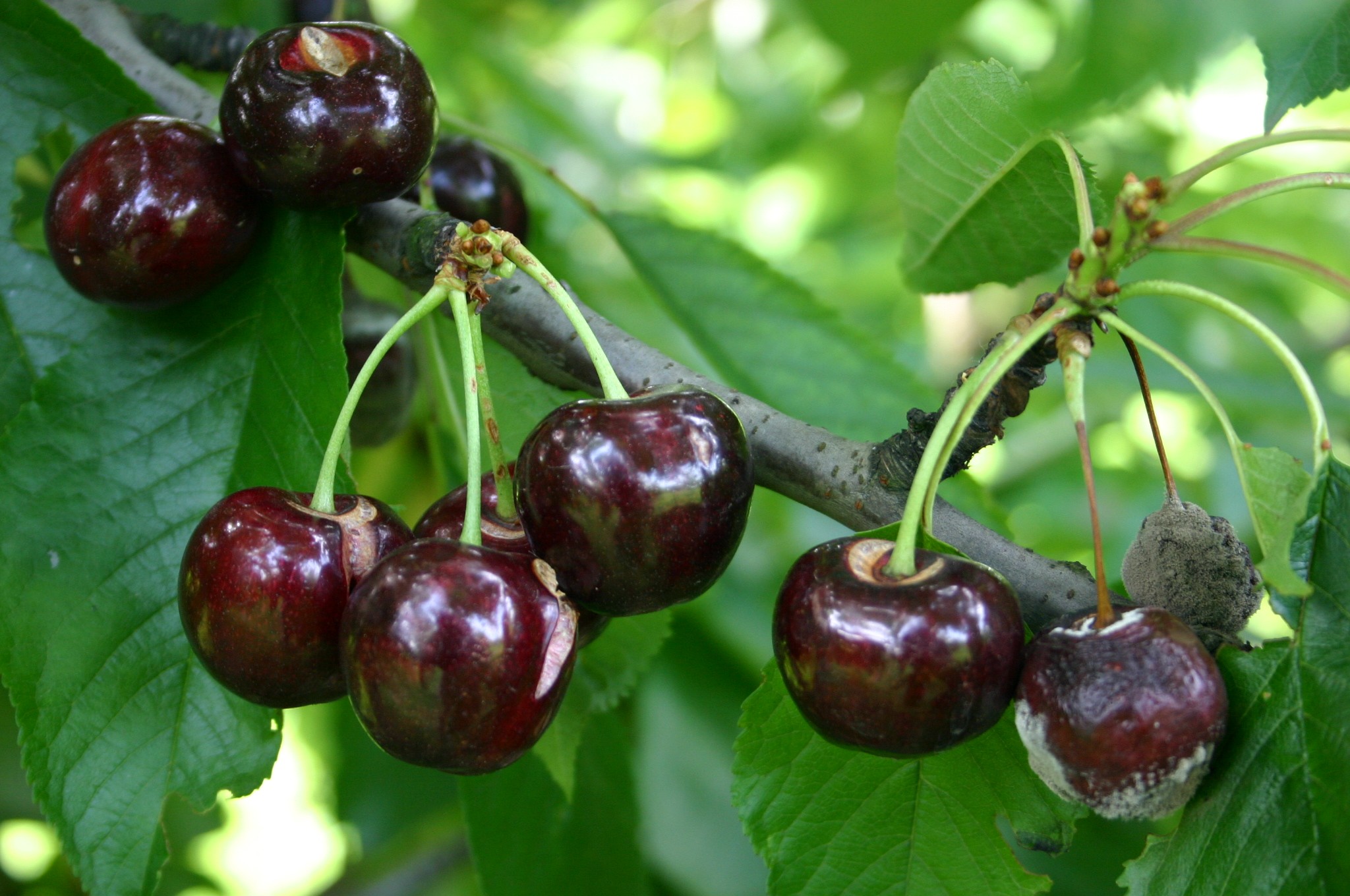
‘Early Star’ also responded positively to the Thin spindle system, although its overall productivity remained lower because its earlier ripening period makes it more susceptible to rainfall and spring frosts. All cultivars produced cherries of high commercial quality, with fruit diameters exceeding 28 mm, average fruit weights of up to approximately 12 g, high flesh firmness and soluble solids contents ranging from 17.4 to 19.2%.
Preliminary results obtained with the Improved thin spindle system are particularly promising. Although yields were comparable to those achieved with the traditional Thin spindle system, the improved training system substantially increased the proportion of fruits larger than 30 mm in diameter, a highly desirable trait for enhancing the commercial value of the crop.
Yield stability
Overall, the study confirms that the Thin spindle system is currently one of the most effective approaches for managing high-density sweet cherry orchards on Gisela 6 rootstock in Moldova. Its ability to optimize light interception, promote stable yields and maintain a balanced relationship between vegetative growth and fruit production makes it particularly well suited to intensive production systems. At the same time, the Improved thin spindle system emerges as a promising technical development that deserves further investigation to fully assess its potential under commercial growing conditions.
Source: Balan, V., Bîlici, I., Russu, S., Şarban, V., Ivanov, I., Buză, C., & Talpalaru, D. (2025). Training systems for orchards high-density cherries from the Republic of Moldova. Scientific Papers. Series B. Horticulture, (2), 61-69.
Image source: Stefano Lugli
Andrea Giovannini
PhD in Agricultural, Environmental and Food Science and Technology - General Arboriculture and Tree Crops, University of Bologna, IT
Cherry Times - All rights reserved