The increasing frequency of extreme climatic events and the progressive reduction in water availability, particularly in the Mediterranean basin, are driving a transition from uniform irrigation towards precision water management, with strategies capable of adapting water application to the actual variability within an orchard.
A recent study conducted in a commercial sweet cherry orchard in the Gediz region of Türkiye evaluated the effectiveness of Variable-Rate Irrigation (VRI) combined with satellite remote sensing, with the aim of assessing whether water productivity could be increased while maintaining the commercial quality of the fruit.
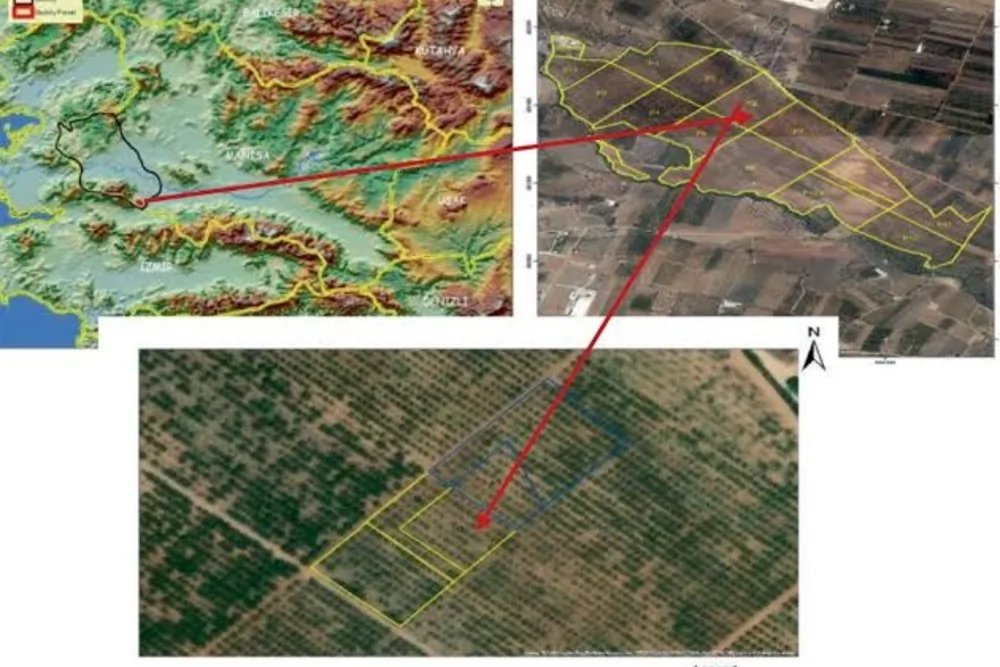
Delineating cherry orchard management zones using satellite imagery
The first phase of the study involved dividing the orchard into homogeneous management zones using high-resolution PlanetScope satellite imagery, with NDVI data collected over the 2020–2022 period.
Integration of the imagery through Principal Component Analysis (PCA) and Fuzzy c-means clustering allowed two main zones to be identified, which were subsequently validated through physical soil characterization.
Zone VR1 was characterized by greater soil depth, higher clay content, and greater water-holding capacity, whereas VR2 had a higher proportion of coarse fragments and more limited water retention capacity.
The stability of the NDVI differences observed over the three years preceding the experiment indicated that variability within the orchard was mainly associated with persistent soil characteristics rather than transient seasonal conditions.
Differences in soil water-holding capacity
This differentiation was also reflected in soil water dynamics: in the stonier VR2 zone, soil moisture declined rapidly after irrigation, requiring more frequent applications, whereas in VR1, water remained available for longer within the root-explored soil profile.
In 2023, under relatively normal climatic conditions, VRI management reduced irrigation water use by up to 49% compared with uniform management.
In VR1, 355 mm of irrigation water was applied compared with 696 mm in the control, while marketable yield reached 4,889 kg/ha, essentially equivalent to that obtained under uniform irrigation (4,860 kg/ha).
Water productivity reached 1.38 kg/m3 in VR1 and 0.88 kg/m3 in VR2, compared with 0.70 kg/m3 in the control.
Precision irrigation results in 2024
In 2024, characterized by much more severe climatic conditions, with particularly high temperatures and substantially reduced seasonal rainfall, yields decreased across all treatments.
Nevertheless, VRI maintained greater water-use efficiency: the Water Productivity Index was 0.26 kg/m3 in VR1 and 0.20 kg/m3 in VR2, compared with 0.16 kg/m3 under uniform irrigation.
The reduction in irrigation inputs did not result in any penalties in fruit quality: fruit weight, diameter, soluble solids, titratable acidity, and pH showed no significant differences among irrigation strategies in either season.
Water productivity and resilience in the Mediterranean context
Overall, precision irrigation does not simply involve uniformly reducing the amount of water applied, but rather reallocating water according to the hydrological characteristics of different portions of the orchard.
Integrating satellite imagery, management-zone delineation, and soil-moisture monitoring makes it possible to avoid excessive water applications in areas with greater water-holding capacity while compensating for zones where water is lost more rapidly.
In the Mediterranean context, this approach represents a practical tool for increasing water productivity and improving the resilience of sweet cherry production.
Source: Koparan, M. H., Gorgisen, C., Bora, E., Yildirim, Y. E., & Bayramin, I. (2026). Delineating Management Zones Using Principal Component Analysis–Fuzzy Clustering for Variable-Rate Irrigation: Effects on Sweet Cherry Yield and Quality. Applied Fruit Science, 68(4), 264. https://doi.org/10.1007/s10341-026-01969-z
Image source: KOPARAN ET AL 2026
Andrea Giovannini
PhD in Agricultural, Environmental and Food Science and Technology - Arboriculture and Fruitculture, University of Bologna, IT
Cherry Times - All rights reserved