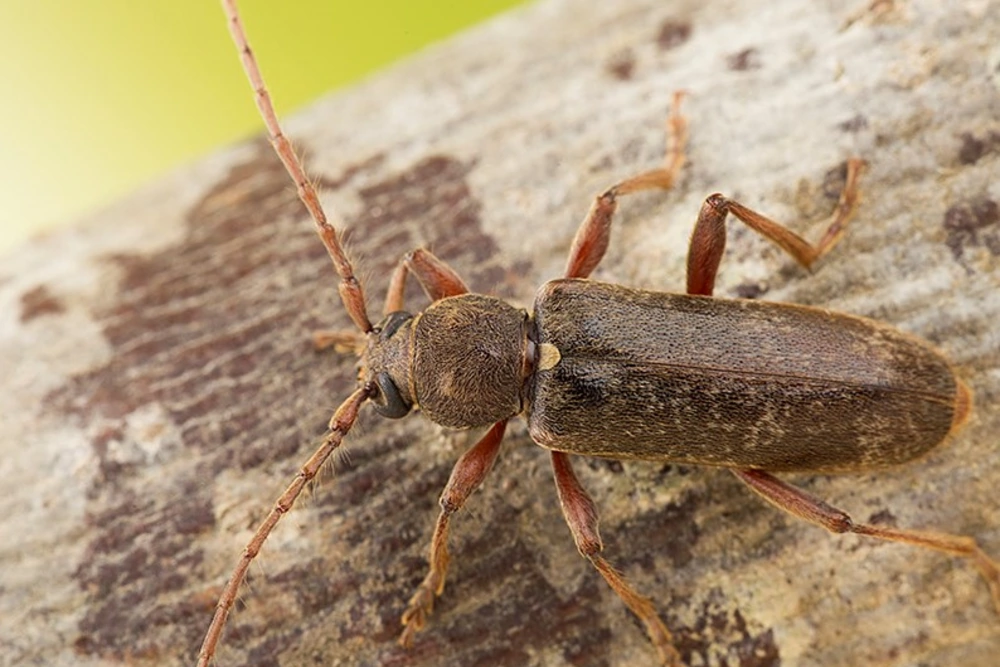
The velvet longhorned beetle (VLB; Trichoferus campestris) is a wood-boring beetle believed to be native to East and Central Asia (Wisconsin 2015).
Little is known about VLB’s biology and host range. Hosts are thought to include more than 40 genera, including apple; cherry and peach; maple; birch; mulberry and paper mulberry; beech; ash; honey locust; mountain ash; willow; and cut wood of spruce and pine.
The extent of damage to live fruit trees has been difficult to quantify (Ray pers. comm.). Observations seem to indicate it is able to successfully infest dead and dry wood with greater success than many of its congeners. Studies and improvements in scientific understanding continue (Minnesota 2016, Utah 2016).
Distribution and detections
VLB has been detected in at least 10 U.S. States since 2010. Surveys for general wood-boring insects indicate that VLB is found or established in five counties in Illinois as well as in Salt Lake County, Utah (CERIS 2017).
In Utah, the beetle has been detected in several counties near Salt Lake City. VLB was first discovered in South Salt Lake City in July 2010 (Utah 2016). The Utah population appears to be increasing; new county records were recorded in 2015 and 2016 (Ray 2017).
Traps have yielded rising numbers of beetles, beginning with four beetles in 2010 but rising to 1,863 beetles in 2015 (Utah 2016).
Individual VLBs have been collected in traps in New Jersey, New York, Pennsylvania, and Quebec (Ray 2017). In Minnesota, single beetles were trapped in 2010, 2014, and 2015; ten beetles were trapped in 2016. Most captures were near the Minneapolis / St Paul International Airport (Minnesota 2016).
Furniture and pathways
Individual VLBs have also been detected emerging from imported wooden furniture in Illinois, New Jersey, New York, Pennsylvania, and Quebec. (Ray 2017). In 2016 a Minnesota resident discovered a beetle emerging from rustic, bark-covered furniture that she had purchased more than a year earlier.
Furniture from this shipment was shipped to at least 10 other states [Mark Abrahamson, Minnesota Department of Agriculture, pers. comm. February 16, 2017]. The Minnesota Department of Agriculture is working with USDA APHIS other State departments of Agriculture, and the furniture seller to recover and destroy all infested furniture (Minnesota 2016).
Like other woodborers, VLB has been intercepted periodically in wood packaging material and dunnage at U.S. ports of entry since 1997. USDA APHIS’ laboratory in Otis, Massachusetts, has identified at least 25 specimens of the species taken from wood packaging intercepted at multiple ports since 2014.
The genus Trichoferus was the third most commonly detected genus of Cerambycids in the study. The Utah outbreak is among several that have been linked to the intended destination of specific shipments (Wu et al. 2017).
Dry wood and detection
VLB seems to be more tolerant of tunneling in dry wood than other Cerambycids. The life cycle of the insect might take longer to complete when it is infesting dry wood products. In some pieces of infested furniture, insect activity was not detected until 18 months after the furniture was purchased.
Furthermore, the beetle might be capable of infesting dry wood products as long as the bark remains (Minnesota 2016).
Detection efforts are currently limited by the lack of a lure. USDA APHIS has worked with researchers at Xavier University in Ohio to develop and test one. Funded in FY16 with a grant from USDA APHIS’ Section 10007 program, Dr. Ray identified a sex-attractant pheromone.
She believes another field season of testing is needed to determine how much pheromone should be used in each trap and is actively seeking funding for this portion of her research (Ray pers. comm.). Also hampering detection is the appearance of the beetle: it is brown and medium sized, so it is easily overlooked.
Threat and conservation
It remains to be seen what long term threat, if any, this beetle presents to North American trees.
USFS scientists and managers developed a conservation priority-setting framework for forest tree species at risk from pest & pathogens and other threats.
The Project CAPTURE (Conservation Assessment and Prioritization of Forest Trees Under Risk of Extirpation) uses FIA data and expert opinion to group tree species under threat by non-native pests into vulnerability classes and specify appropriate management and conservation strategies.
The scientists prioritized 419 tree species native to the North American continent. The analysis identified 15 taxonomic groups requiring the most immediate conservation intervention because of the tree species’ exposure to an extrinsic threat, their sensitivity to the threat, and their ability to adapt to it.
Conservation priorities
Each of these 15 most vulnerable species, and several additional species, should be the focus of both a comprehensive gene conservation program and a genetic resistance screening and development effort.
The velvet longhorned beetle is not known to currently be a threat to any of these 15 most vulnerable species.
Image source: O. Manci
Faith Campbell e Leigh Greenwood
Cherry Times - All rights reserved