As the horticulture industry in Australia is grappling with varroa mite and other pressures on honeybee populations, researchers are looking into alternative pollinators.
At the recent Fruit Growers Tasmania Cherry Growers Workshop in Jericho, research entomologist, Raylea Rowbottom from seedPurity, presented her recent findings about Hoverflies as pollinators in sweet cherry.
This research has been funded through Hort Innovations Frontier’s program, and focuses on a type of hoverfly called Eristalis tenax, affectionately known as E. tenax, or drone fly.
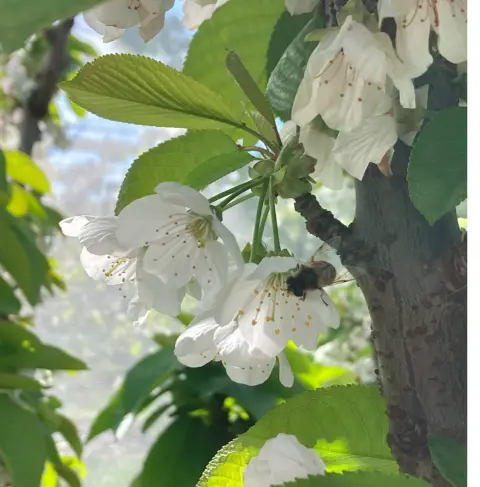 E. tenax, a type of hoverfly that to the untrained eye, could look like a large honeybee
As the most recent Tasmanian spring demonstrated, when cherries flower it can often be cold, wet and potentially windy, which presents challenging conditions for foraging insects.
Hoverflies as alternative pollinators
Hoverflies have the potential to increase productivity in cool conditions, because of their ability to forage in cooler conditions and non-discriminating foraging pattern.
When asked how the hoverflies adapt to rain, Raylea explained that when it rains, the bees will return to their hives, hoverflies however do not have hives to return to. Instead they seek shelter within the orchard, under the leaves, meaning they return to pollinating activity sooner than bees.
Cherry growers are interested in improving their yield, having more sustainable and reliable yields, as well as safeguarding against the potential impacts of Varroa mite, which is yet to be detected in Tasmania. Eristalis tenax is showing great potential to address all these concerns.
Research conducted in 2023, through an earlier Hort Frontiers funded project, found that pollination efficiency of E. tenax is both comparable and complimentary to that of honeybees.
Pollination in challenging conditions
However, introducing additional pollinators into orchards must be carefully managed. While E. tenax does not directly interfere with honeybees, the number of hoverflies released needs to be balanced.
Building on this earlier work, the 2024 research examined the optimum stocking rates of E. tenax for sweet cherry production. The findings showed that more hoverflies do not automatically translate to improved pollination.
Instead, researchers identified stocking rates that maximise pollination efficiency, with the recommended number of hoverflies differing depending on whether honeybees are also present.
Early results using E. tenax with honeybees are really promising, with a preliminary open stocking trial in 2024 showing an increased fruit set of 42 per cent, compared with honeybees alone.
Stocking rates and fruit set
A second set of open release trials last season demonstrated foraging activity of E. tenax outnumbered honeybee activity on most dates.
Stocking with a combination of hoverflies and honeybees resulted in a 34 per cent increase in fruit set on Kordia as well as an increase in fruit weight per ha by 61 per cent, as observed by Andrew Hall, at Reid Fruit.
Likewise, a 12 per cent increase in fruit set was observed with the combined stocking of hoverflies and honeybees at Lucaston Park (2025).
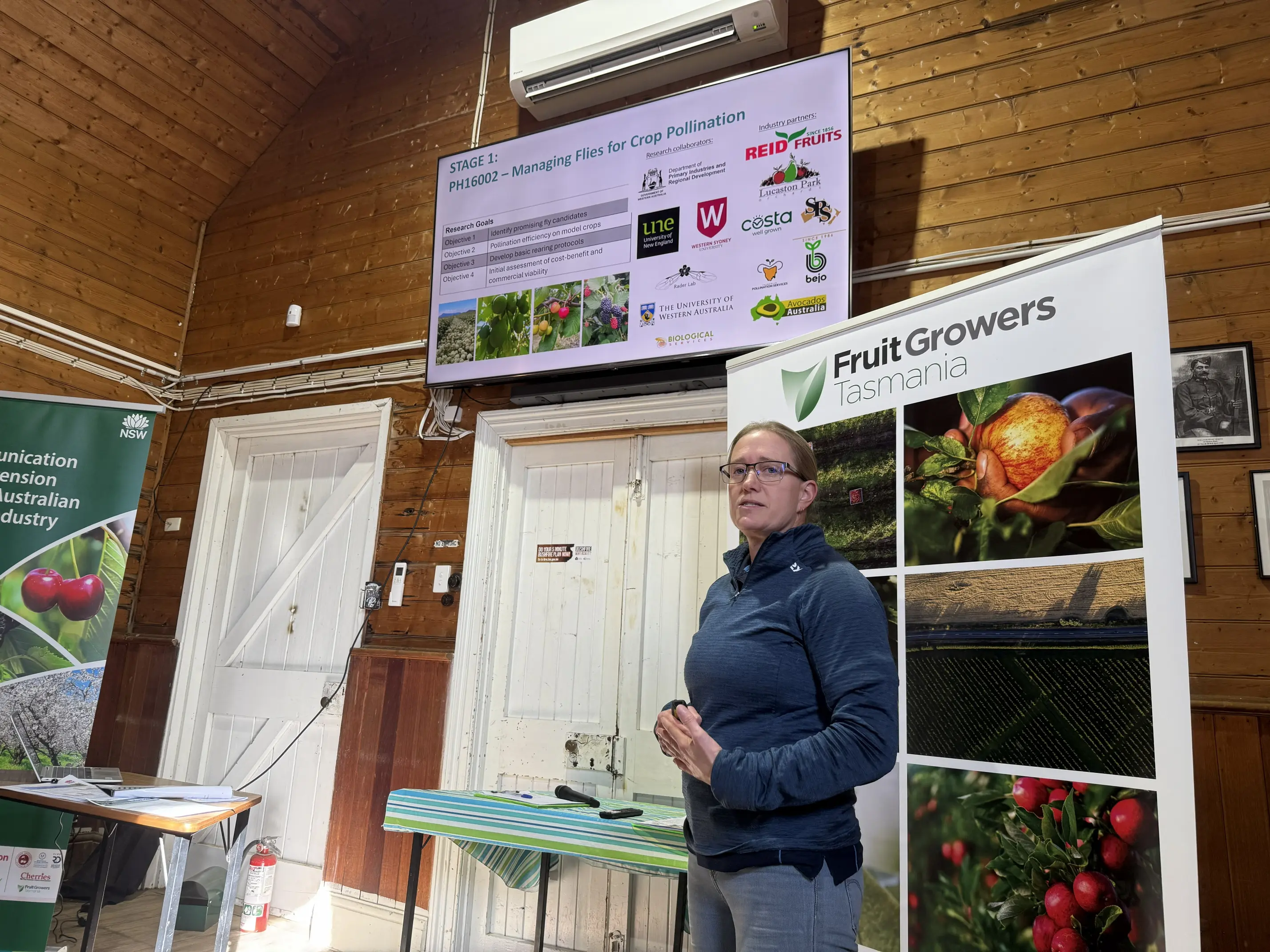 Raylea Rowbottom presenting at Fruit Growers Tasmania’s Cherry Growers Workshop, Jericho
When asked about the commercial availability of E. tenax, Raylea commented that attempts to rear them commercially were proving successful with two industry partners involved in establishing rearing facilities.
Commercial availability and future research
It is predicted that once commercial scale is achieved, the supply of E. tenax will be economically comparable to that of commercial honeybees.
The research continues this year, building on seasonal data for open releases of hoverflies combined with honeybees to provide yield benefit data, and to establish a cost benefit analysis for use of hoverflies in sweet cherry.
text and image source: Fruit Growers Tasmania
Cherry Times - All rights reserved