While the world moves forward, Italian large-scale retail remains stuck in place. Despite global cherry flows being in full expansion — Chile alone will export 670,000 tonnes in the 2025/26 season — cherries remain a mirage on Italian supermarket shelves, especially out of season.
A survey carried out this week in Brescia speaks volumes: out of 18 stores visited, only two — Carrefour and Italmark — offered cherries in their assortment.
A déjà-vu
The situation seems to echo the same scepticism that, until less than ten years ago, surrounded berries. Back then, they were considered niche products before being suddenly rediscovered and pushed toward double-digit growth rates. Why couldn’t the same happen with cherries?
According to many buyers, the issue is strong seasonality: cherries remain among the few fruits that consumers still perceive as “summer-only”, tied to a very specific time window.
Even late Italian varieties struggle to maintain consumer interest beyond June. But this does not mean there is no room for a niche market willing to purchase high-quality cherries, even in the middle of winter.
Imported cherries: quality
Chilean and South African varieties available in Europe during winter have nothing to envy Italian cherries.
Size availability is wide: from 26/28 mm, which represents the minimum standard for imported cherries, up to 32/34 mm, sizes that are virtually unavailable in Italian production.
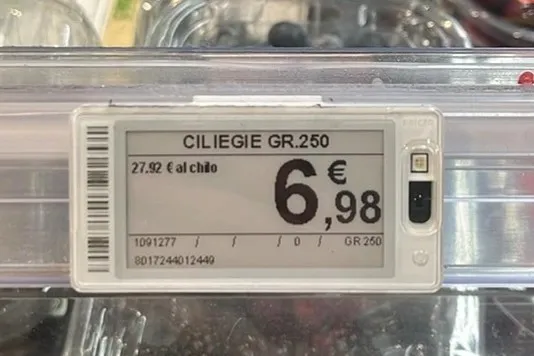
Prices, although often perceived as high, are actually aligned with major international markets. This week (week 51 of 2025), Carrefour in Emilia-Romagna offered South African cherries, size 26mm+, at €6.98 per 250 grams (equivalent to €27.92/kg).
In Brescia, the Chilean variety Santina was sold at €4.98 (€19.92/kg), while Italmark offered Santina 28/30 mm and Royal Dawn 22/24 mm at €3.99 (€15.96/kg).
Comparison with international markets
Comparing these figures with those of major international retailers reveals an interesting picture: in the same week, Mercadona in Spain sold 300g punnets at €11.73/kg; Sainsbury’s in the UK at €15.00/kg (250g); Kroger in the US at €13.21/kg (approximately €12.20/kg); while Woolworths in Australia offered 500g packs at €13.40/kg (around €8.10/kg).
Italy out of sync
The high prices on Italian shelves are not justified by upstream costs: wholesale market prices are under pressure and supplies arrive at competitive costs, thanks also to flows passing through major European hubs such as the Netherlands.
The issue lies within the Italian supply chain: margins, intermediations and lack of planning inflate retail prices, reducing the product’s attractiveness.
According to operators, it would have been possible to offer imported cherries at promotional prices between €2.99 and €3.49 per 250 grams (€12–14/kg), provided adequate volumes had been planned.
A strategy that Italian large-scale retail, at least for now, does not seem willing to pursue.
An untapped market
And yet, the potential is there. If just 1% of Italians who buy cherries in summer also did so during the Christmas period — about eight weeks — this would generate additional sales of over 300 tonnes, corresponding to an estimated turnover of €4 million.
Some European retail groups have already understood this: they aim to keep cherries on shelves 52 weeks a year. In Italy, meanwhile, there is renewed debate over yet another missed opportunity.
Text and image source: www.myfruit.it
Cherry Times – All rights reserved