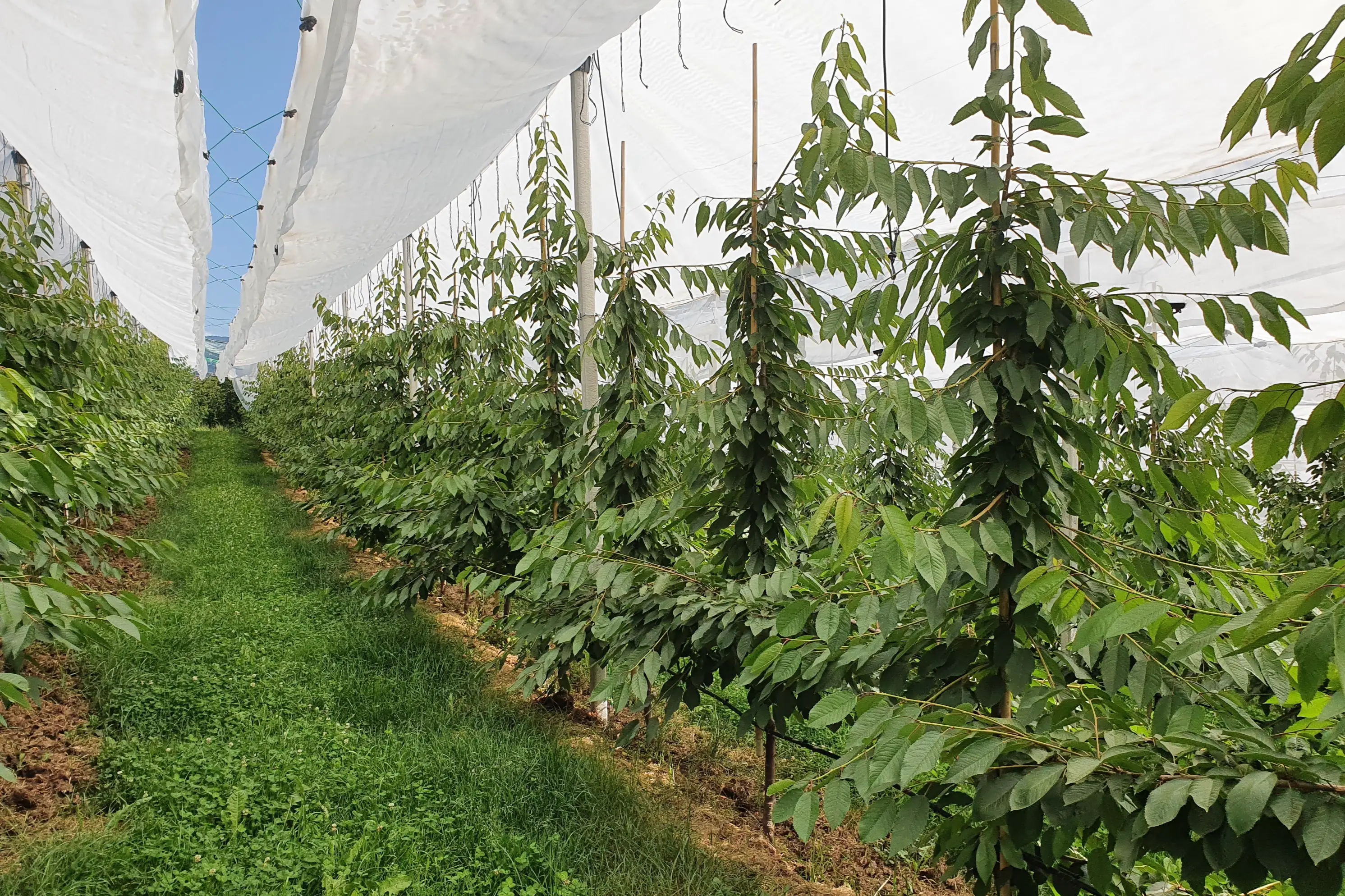
In recent years, cherry production has been facing increasingly variable climatic conditions, making it necessary to use protective coverings to shield orchards from rain, hail and, in the case of multifunctional nets, also from Drosophila suzukii and other atmospheric agents. However, the market offers a wide range of coverings characterized by different levels of shading, permeability, impermeability and color, which can influence plant physiology in different ways, also depending on tree vigor, canopy architecture and the growing environment of the orchard.
The “CHOICE” project – “Optimizing cherry physiological performance through the correct CHOICE of multifunctional covers”, funded by the Italian Ministry of University and Research and carried out in collaboration between the University of Bologna, the University of Modena and Reggio Emilia, and the University of Naples Federico II – investigated the effects of coverings across different cherry-growing and environmental contexts. The aim was to develop models to support growers in selecting the most suitable cover based on factors such as rootstock vigor (and therefore plant architecture) and cultivation environment.
The results were presented during an international webinar and a final conference held on February 17 and 20, 2026 respectively. Recordings are available at the following links:
The studies were conducted both in Emilia-Romagna, by the team led by Prof. Brunella Morandi at the University of Bologna experimental farm, and in Campania, by the team led by Prof. Boris Basile at a commercial orchard. Trials carried out on different cultivars evaluated the effects of different covering systems on microclimate, plant physiology, fruit growth, yield and fruit quality at harvest. The orchards differed in management practices, training systems, rootstocks and vigor, creating a range of conditions in which crop responses to different shading levels and types could be assessed.
Orchard microclimate and environmental conditions
Both trials showed consistent results, clearly demonstrating that the presence of shading rain nets (20–40%) modifies the orchard microclimate, reducing VPD in covered trees compared to the control. This means that under a net, when ventilation is adequate, a less stressful microclimate is created for the plant: solar radiation is partially reduced and relative humidity tends to remain higher, lowering the rate of water loss through transpiration. This effect becomes particularly evident during the central hours of the day, when high temperatures and low relative humidity can cause strong evaporative stress in uncovered trees.
However, these results may not be replicated with fully impermeable plastic covers, which can instead create a greenhouse effect and excessively increase temperature.
Tree water status and photosynthesis
The modification of the microclimate also had direct effects on the physiological behavior of the trees. In both environments, trees under covers showed a less negative stem water potential, indicating better water status compared to uncovered plants.
At the same time, a higher stomatal conductance was observed, along with increased photosynthetic rates. This suggests that a moderate level of shading allows plants to maintain greater physiological activity without experiencing the negative effects of water stress. When shading becomes more intense, as in the case of the 40% net, the benefit tends to decrease. Excessive reduction of radiation can limit the energy available for photosynthesis.
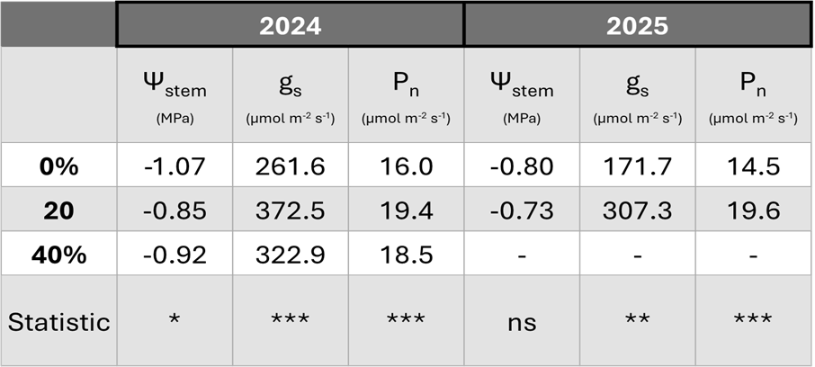 Table 1: Mean values of stem water potential (Ψstem), stomatal conductance (gs) and net photosynthetic rate (Pn) measured in 2024 and 2025 under different shading levels (0%, 20% and 40%) in the Bologna trial on the “Sweet Saretta” cultivar. Symbols in the “Statistic” row indicate the level of significance between treatments: ns = not significant; * = p < 0.05; ** = p < 0.01; *** = p < 0.001
Fruit growth and productivity
The physiological differences observed were also reflected in fruit growth. Across different trial seasons, trees under 20% shading nets generally produced fruit with slightly larger diameter compared to the control, particularly during the final rapid growth phase. This result is consistent with the improved physiological status of the plants: greater assimilate availability and better water balance support fruit development. From a productivity standpoint, trees under 20% nets also showed higher average yield per plant, while the 40% shading treatment resulted in intermediate values.
Fruit quality and variability of results
Regarding fruit quality, results were more variable, suggesting that while shading can promote fruit growth and productivity, it may reduce dry matter content and soluble solids, potentially leading to less sweet fruit. However, data indicate that the effect of shading on quality also depends on the specific climatic conditions of each season.
Data generated from trials in Emilia-Romagna and Campania enabled the group led by Dr. Francesco Reyes at the University of Modena and Reggio Emilia to adapt existing models for predicting the effects of coverings on canopy microclimate and, consequently, on assimilation capacity. Although still under development, these models aim to support the optimization of covering selection (e.g. shading level, material, etc.) based on environmental conditions and orchard vigor, in order to maximize physiological performance. This would allow nets to act not only as protection against atmospheric and biotic stressors but also as key tools for adaptation to abiotic stress such as excessive temperatures or drought.
Conclusions and outcomes of the CHOICE project
Overall, the results of the “CHOICE” project indicate that moderate shading, around 20%, represents a good balance between climatic protection and light availability for photosynthesis.
Higher shading levels may reduce some of the benefits, highlighting the importance of carefully selecting the most appropriate cover based on orchard conditions. In a context of climate change, shading nets and single-row systems are therefore confirmed as valuable tools to enhance orchard resilience, improving microclimate and supporting plant physiology without compromising production.
Image source: Stefano Lugli
Brunella Morandi
University of Bologna
Cherry Times Scientific Committee
Cherry Times - All rights reserved