The technical manager of Abud & Cía. warns that oversupply, cost pressure, and increasing market demands will force a redefinition of production areas, varieties, and minimum productivity levels in order to remain in business.
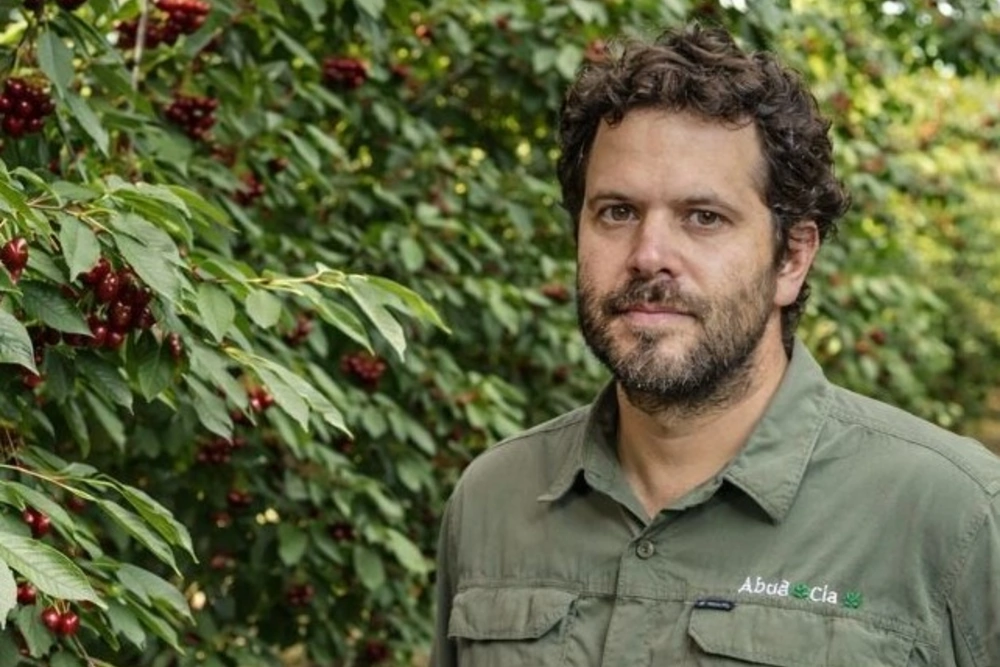
Raimundo Cuevas, an agronomist and currently technical manager of Abud & Cía., has established himself as one of the most relevant technical voices in two of the most sensitive debates in Chilean fruit growing: the need to produce better and the obligation to redefine where, how, and under what standards to continue operating.
Although his name is often associated with the kiwi sector — particularly in agronomic management, irrigation, nutrition, chill accumulation, budbreak, the potential of new rootstocks, and long-term strategies — his work also focuses on another symbol of Chilean exports: cherries.
In his presentations, Cuevas does not issue simple warnings, but rather proposes a structural diagnosis. According to him, the cherry industry has moved beyond the phase where relying on quality or fruit size was enough to correct market fluctuations.
Today, he states, the business has changed. And not just due to China or a single season, but because volumes have completely reshaped the sector’s economic equation.
He adds that, beyond all the critical issues affecting cherries in China — “economic slowdown, harvest brought forward by two weeks, the delay of the Chinese New Year, or the fact that the product is no longer perceived as an exclusive gift” — the real cause of the seasonal crisis lies elsewhere.
“All these factors have an impact, but the main cause is excess volume. It is no longer about reducing production to push prices up from one year to the next. The cherry business has changed, and we are facing four to five very complex years that will require a downsizing of planted areas,” he states.
Not all orchards will withstand the sector’s new phase
This leads Cuevas to a second conclusion: not all orchards will be able to survive. The adjustment will involve the exit of less competitive plantations, retaining only those capable of meeting higher standards.
“Producers must run the numbers and understand whether their orchards are truly ready to face this change,” he explains. It is no longer enough to produce attractive fruit: it must be done with competitive costs and sustainable profitability.
According to the technical manager of Abud & Cía., the scenario will be particularly challenging because supply pressure will not decrease in the short term. In addition to the already difficult last two seasons, around 5,000 hectares are expected to come into production by 2030.
His assessment is clear: “the scenario is extremely complex.” Even if forecasts may vary slightly, many new orchards are entering production, so volumes will not decline in the coming years, especially considering that the last season already recorded a production drop.
For this reason, he warns that, with a normal or favorable climatic year, supply will rise sharply again. “Everything points toward increased supply, and nothing suggests that prices will be better than this year. As a result, difficult, even painful decisions will have to be made in orchards based on this new reality.”
One of the most critical issues concerns the possible removal of orchards. Cuevas does not give an automatic answer: “we must understand which orchard standards will be able to withstand the coming years.” He recalls that last season was based on the idea that size and quality would support prices, but this did not happen. “Even with lower volumes and overall better quality, prices declined.”
In other words, quality remains essential, but it is no longer sufficient on its own.
An even more critical analysis when considering costs
The picture becomes even more complex when considering production costs. Cuevas points out that, in many cases — especially for December production — returns will be lower than costs.
“In many cases, production costs for orchards yielding below 10 tons per hectare exceed $2 per kilo, while today, particularly for December fruit, returns to growers are below this level.”
For this reason, he proposes to redefine the production standard. The main way to reduce costs is to spread them over larger volumes, without compromising commercial quality. A competitive orchard must therefore ensure high quality and good size, but also a minimum productivity of between 12 and 16 tons per hectare, depending on the variety and area.
Only in this way is it possible to achieve a competitive cost per kilo in a scenario where prices will hover around $2/kg. For early production (November), returns may still approach $3/kg, but with costs around $2/kg, the sector will align more closely with the profitability of other fruit crops, at around $10,000 per hectare.
“We must understand that the profitability of past years will not return.”
Production, quality, and structural limits
When asked whether increasing production compromises quality, Cuevas responds that everything depends on technical capacity and zoning. Not all orchards can reach those yields while maintaining high quality.
“We need to be honest and ask which orchards are unable to achieve that balance between quantity and quality.”
Some orchards, due to structural limitations — climate zone, plant health, variety, rootstock-variety combination — will not be competitive. In these cases, he insists, it makes no sense to continue in the coming years if profitability is not there.
The standard of a competitive orchard includes: suitable climatic positioning, soil adapted to the rootstock, uniformity, productivity, and varieties demanded by the market. This is particularly important for December fruit, while early fruit still retains a commercial advantage.
The varietal issue
The issue of varieties becomes central. Cuevas notes that the Chinese market no longer appreciates certain varieties such as Sweetheart and Nimba due to firmness issues. He also cites difficulties for Skeena, Bing, Stella, and some late varieties such as Sentennial and Staccato, which are penalized because they do not arrive in good condition on the Chinese market.
The problem is not only agronomic but also commercial and logistical: the market is increasingly distinguishing between fruit that withstands transport and fruit that does not.
However, there are opportunities: early November varieties and earlier bicolour varieties have shown good returns.
On the contrary, those producing in December or in the late season have less room to maneuver: “late fruit, in a saturated market, will not achieve good prices.”
Geographical reorganization and zoning
Cuevas openly speaks of a “geographical cleanup” of production. It is necessary to rethink the most suitable areas for cultivation.
He highlights critical issues in the sixth and seventh regions of Chile, as well as in some southern areas (particularly Ñuble), where varieties such as Regina have shown disappointing performance.
In contrast, the most promising areas are those with early harvests, up to the first week of December. These are the zones where the greatest growth potential is concentrated, also because they are where the most important projects with varieties such as Santina are being developed.
Andrea Bustos
Diario Frutícola
Image source: Diario Frutícola
Cherry Times - All rights reserved