Now that the cherry settlement results are known, with very negative outcomes in some production areas after a season marked by over-exportation and misalignment with Chinese demand, the discussion about the future of the sector must necessarily move beyond the concept of the so-called crisis, poorly defined as such, and lead us to action: containing the problem and designing a plan whose effects can be measured in the coming seasons.
Cherry Mission 30%
The mission is as follows: we need to remove 30% of Chilean cherries from China, we need to shift 45 million boxes before China pushes us out. It is an ambitious goal, like any company would set in its board meetings for a given period of time, and it does not mean eliminating one in every four hectares planted with cherries in Chile from the system, but rather planning, reconverting, relocating and communicating.
Over the past eight years, and because we allowed ourselves to be carried away by enthusiasm despite the warnings, cherries were planted everywhere, even where it was not advisable to do so. From a production perspective, therefore, I fully agree with those who argue that agronomy must return to the center of the sector. Why did we lose it? This implies a productive reorganization involving varieties, management practices, territories and markets.
Going back to the root of the problem, however, the Chilean over-exportation of cherries to China is the passive continuation of the “2018 mindset”, when we were already beginning to see that the existence of a market capable of absorbing everything we would send it was not so obvious, yet we still failed to react. We ended up becoming our own worst competitors on Chinese docks, and that 30% of cherries we need to remove from there has caused our product to lose value in the eyes of importers and consumers.
Value and consumption
Today, in China, Chilean cherries are no longer perceived as the luxury item we always took for granted they were. And that is not all. Today they have to face a higher substitution rate from an offering that is consistent with what it promises to be. If value is not aligned with price, with the average household size, with the consumption occasion or with the actual experience, consumers quickly switch to an alternative.
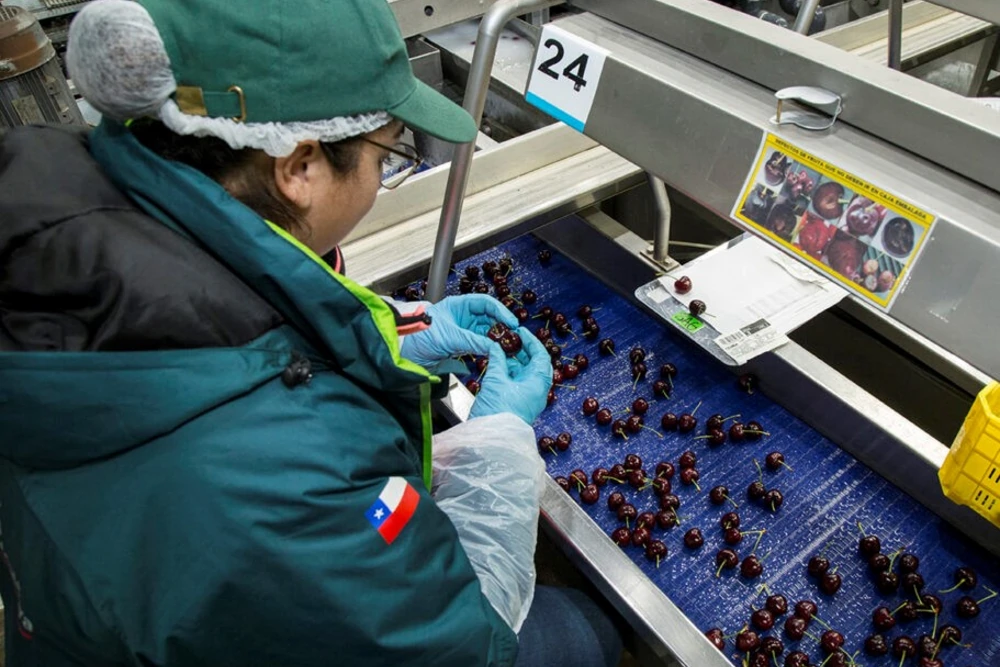
There is no discussion of the fact that the average Chinese household consists of only three people, and that we send them 2.5-kilo boxes that they cannot consume before half of the product rots. Chinese importers take these boxes out of the containers and try to change the packaging directly on site, but the only result is a loss of cherry condition. They always ask us for quality, to arrive with the best fruit, and the fruit does arrive in China in good condition, but that quality is compromised there, without consulting us on the refrigeration process, the cold chain and the packaging.
Because buying an expensive product that gets damaged and rots in the refrigerator at home is not a good experience. Today, Chinese consumers have lower purchasing power, so they will think carefully before deciding whether it is worth it.
Trust in e-commerce
Furthermore, we cannot continue to underestimate the user experience in e-commerce. Consumers buy cherries by looking at them on an app, expecting to receive exactly that product. If the fruit arrives damaged, poorly repacked or simply far from the visual promise, trust drops to zero.
This is one of the reasons why our cherry exports respond more to our expectations than to market reality, because we are not dealing with a simple surplus of fruit, but with shipments that are often not suited to the current scenario.
Agronomy must return to cherry growing
Removing 30% of Chilean cherries from China does not mean thinking about uprooting hectares from the system. It means proposing a sector-wide objective, measurable over three, five or even ten seasons, as any company would do when facing structural change and the need to reorganize its components. This means understanding that we need to find new destinations, new commercial windows and new varieties in order to be competitive outside the current framework.
So, what should be done? First, we must assume that the Cherry Mission 30% is a collective task. It will not be solved by a single exporter, nor by an isolated producer, nor by a campaign without operational support. Then, a national objective must be established: to reduce, in a planned way, dependence on China for 30% of Chile’s supply, with the task of building markets where that fruit truly makes sense for consumers: India, Brazil, the United States and Europe, as far as possible.
Equally important will be the mission’s task of accelerating varietal renewal with a strategic vision, giving nurseries the role they deserve in this conversation, building trust and ensuring that triangulation between breeder, nursery and producer, with attention to known plant health status, adaptation and a long-term vision. Agronomy will return to cherry growing through biotechnology, genetics, collaboration and guaranteed progress for orchards.
Renewal and competitiveness
Let us not forget the history of table grapes, which had a single market and a comfortable position, until we first began competing with ourselves and then, very strongly, with Peru.
When a business matures, renewal becomes an active search, both from a production and commercial perspective. In cherries, we are fully entering this phase, late, but honestly still in time. For agronomy to return to cherry growing means using the correct rootstocks, competitive varieties, suitable growing areas, high-level phytosanitary and agronomic management, precision irrigation, timely harvesting, impeccable packing and a final condition truly capable of withstanding the journey and supporting the commercial promise.
The “Cherry Mission 30%”, in summary, means shifting that percentage of our exports away from China before the market itself, in its own way, deprives us of all that space. The market does not forgive. And this is exactly what is missing: a national objective with a timeline, defined responsibilities and leadership.
Jorge Valenzuela Trebilcock
CEO of Nueva Vid, director of Grupo Hijuelas and Fedefruta
Source: Portal Fruticola
Image source: Portal Fruticola
Cherry Times - All rights reserved