The world’s largest cherry exporter analyzes the end of a cycle that once seemed unbeatable. After many years of extraordinary profitability, Hernán Garcés warns that the Chilean industry is now facing its first real trial by fire: a highly challenging scenario that forces every stage of the business to be recalibrated.
Quality is the starting point and must go hand in hand with alliances, disruption, and consistent brand building. At the San Francisco de Mostazal facility, processing lines are silent. There are no boxes moving forward, nor cherries flowing along rollers and conveyor belts.
The absence of the fruit’s hypnotic glow under the optical graders is the clearest sign that the season has come to an end. It is a warm mid-February morning. The Chilean summer weighs heavily on the metal sheds, as if refusing to grant any relief just as the campaign prepares to draw the curtain.
The production context
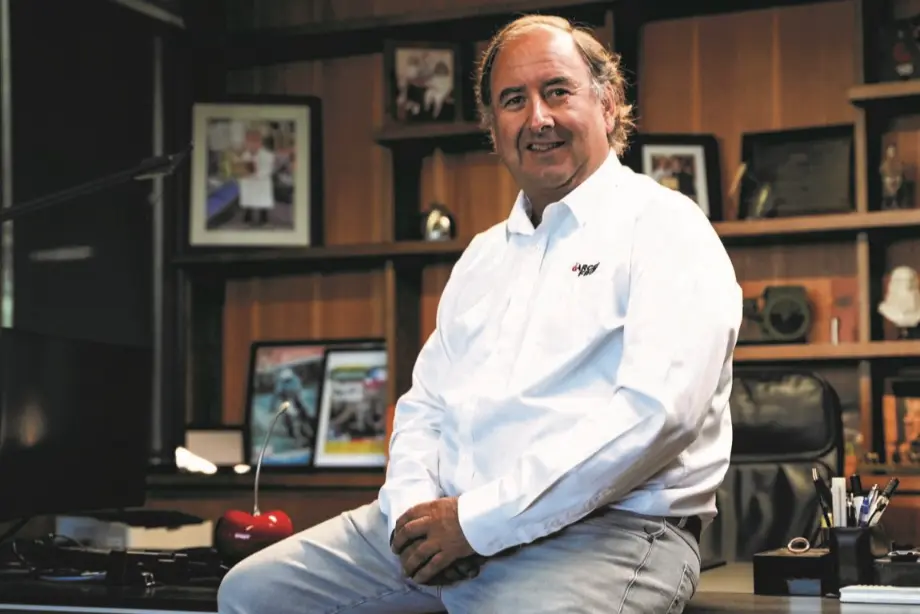
Hernán Garcés Echeverría welcomes me with a smile in the lobby of the central offices and invites me up to his office. He walks at a calm pace, very different from the frantic rhythm of late November, just before the first cherries left the packing house.
From this modern infrastructure, located on the Santa Margarita estate, more boxes of cherries depart than from anywhere else on the planet. Over 90% are destined for China. “The cherry business is for and thanks to China,” Hernán repeats every time he is asked about the need to diversify markets.
He does not say it as a slogan, but as a blunt acknowledgment of reality. At the time of our meeting, there were still a few days left before the Chinese New Year celebrations. However, on the eve of the campaign’s key turning point, the feeling in the industry was, at the very least, strange.
Market challenges
Compared to the previous season, the fruit has improved, but not to the level the market now demands. Prices have once again been penalized and, in an industry used to extraordinary growth rates, two consecutive difficult seasons weigh more than many are willing to admit.
Hernán, not a fan of euphemisms, says it loud and clear: “A cycle has ended here.” Although he appears calm, steady as always, he is clearly concerned. A month earlier, however, Hernán Garcés was ecstatic.
While the last ships were heading to Asia and the season entered its most intense phase, the “king of cherries” was crossing the sands of Saudi Arabia aboard his Toyota Hilux. It was his fourth Dakar, “the one I enjoyed the most,” he says.

The Dakar interlude
For fourteen days his attention was focused on another goal, 7,000 kilometers away from Guangzhou, Hong Kong, Shanghai, and Tianjin. When I take him back to those exhausting days, his face changes, lights up.
He finished 28th in the T1 Ultimate category and, in the final stage, crossed the finish line ten positions ahead of Qatari driver Nasser Al Attiyah, winner of the competition.
“I had set myself the personal challenge of racing the Dakar in a pickup truck when I turned 60 and, well, it was an incredible experience, it went really well,” he tells me, still emotional, recalling the finish in Yanbu, on the shores of the Red Sea.
Eight thousand kilometers. Nothing compared to the more than 20,000 that cherries must travel to reach China. In this intersection of passions, it still surprises me that, in the middle of the season, the world’s largest cherry exporter manages to mentally disconnect from the business.
“Tell the truth, Hernán, did you call between stages to check how the campaign was going?” I ask him. Garcés laughs before answering. He talks about teams, trust, processes that do not depend on one person alone. “I spoke with my team in China every morning and in the afternoon, after each stage, I spoke with Chile... but only a little, more out of passion than to give instructions.”

Corporate structure
A team now led by his eldest son, Hernán Garcés Gazmuri, who after eleven years in commercial roles between China and the United States returned to Chile in 2024 to take over as general manager of exports.
Four of his eight children now work in the company. In addition to Hernán, there are Camila in R&D, Matías in agricultural operations, and Rosario in human resources. “For me this is a blessing, I’ve been incredibly lucky with these kids,” he laughs. “In them I see the continuity of the company.”
Vision and outlook
Having a journalistic conversation with Hernán Garcés is almost a privilege. A low-profile figure, this successful entrepreneur rarely gives interviews. Today, however, the context is different. Success is no longer measured only by growth. It is measured above all by the ability to adapt.
However, his outlook is far from apocalyptic. The moment is complex, yes, but “this industry is very powerful and still has a long way to go.”
Exports began in November with ambitious projections: over 130 million boxes, around 650,000 tons. But the starting point was already conditioned by the memory of a very difficult previous season.
This was compounded by traumatic events such as the Maersk Saltoro, with losses close to 160 million dollars (around 147 million euros). Consumption was expected to increase during the holidays, but perhaps not enough to reverse an already established trend. The world’s largest cherry exporter
“What is your analysis of the current situation?” I ask him immediately. “Is it another bad season or definitively the end of a phase?” Hernán takes a few seconds before answering. He looks out toward the resting orchards visible from the window, as if seeking in the silence of the trees help to organize his thoughts.
“Let’s see, every new season leaves us with a huge amount of learning. This is a business that has doubled every five years. It’s wonderful! Obviously, we need to diversify and develop more markets, but also be more efficient, create new alliances, explore different distribution channels and build new forms of value along the entire supply chain.”
According to Garcés, the extraordinary growth of recent years has pushed the industry into a new normal. A normal where volume alone is no longer enough, nor is repeating formulas that worked in another cycle. “Management must be more strategic and coordinated.”
The new normal
Chile, despite everything, will continue to hold a privileged position in the global cherry industry, he says. But that advantage is no longer automatic. It must be defended every season. “I firmly believe in the strength of this business. China will continue to be the key market for Chilean cherries and today what China wants is quality.”
According to Hernán, the question now facing the sector is not whether the business still exists, but what decisions it is willing to make to remain competitive in a market that has changed faster than many expected.
Hernán Garcés has lived through every cycle. He was part of the beginning, the boom, and now the turning point. With all this experience, and from the same place where weeks ago the heart of the global cherry industry was beating and now silence reigns, his outlook is not one of discouragement, but of someone who knows that markets are born, develop and mature.
“Hernán, if the cherry market has matured and China is no longer predictable, do you think the Chilean industry is adequately addressing this cycle shift?” Hernán adjusts himself in his chair, crosses his arms, and answers.
The cycle shift
“There is no doubt that the industry has incorporated the lessons from the previous season. Sizes, for example, have been much larger this year. But we are also extending the season, planting both in the south and in the north of the country. And this creates a different scenario.”
“With the extension of the season, isn’t there a risk that cherries lose their premium product status?” “No,” he answers categorically. “Cherries are still a desired gift. I do not agree with those who say cherries have become a commodity.
But the market has matured. This is no longer pack and ship. There is a lot of volume, the Chinese economy is slower, and cherries are no longer that almost magical product that sold itself.”
The cherry brand
China remains the main market, the nerve center of consumption, but it is no longer the same. The consumer is more informed, more demanding, and much more sensitive to quality. They no longer buy only as gifts. They buy for home consumption.
They demand precision in size, sugar content, crunchiness, and condition. They know exactly what they want and penalize when they do not get it. “So what should the Chilean industry do?” I ask. “Reduce volumes, change varieties, become more efficient?”
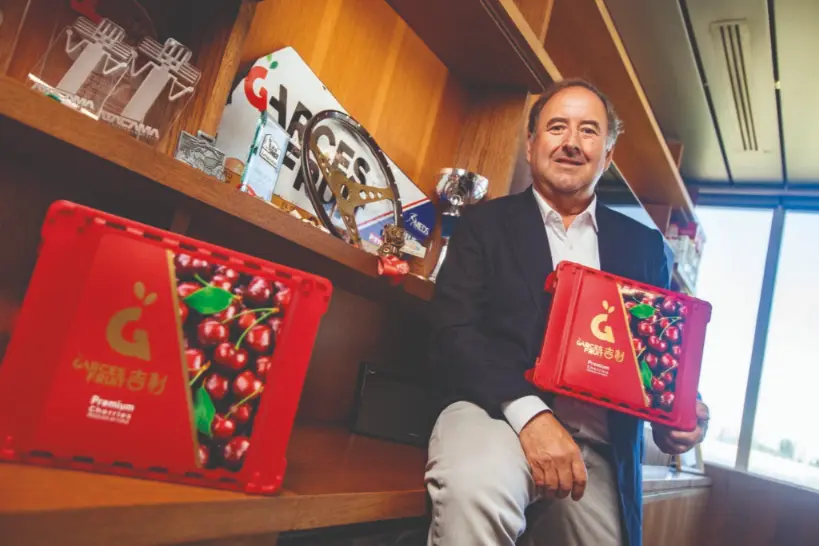
“Quality, first of all,” he replies emphatically. “And in parallel, something that is talked about far too little: brand building.” Indeed, according to Hernán, one of the decisions that best explains his company’s positioning in China was the consistent focus on developing its own brand.
The idea was as simple as it was profound: to plant a name in the consumer’s mind, generate trust and familiarity in a geographically and culturally distant market, and build an emotional relationship that goes beyond occasional purchases. Over the years, that bet has become a competitive advantage.
Competitive advantage
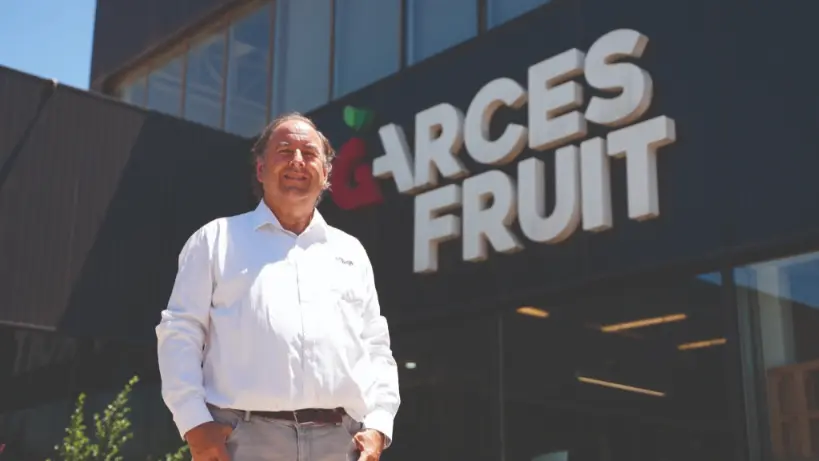
Garces Fruit has managed to speak directly to the Chinese consumer, leveraging a clear promise: fresh fruit, logistical speed, and “top quality” standards. In this, its commercial office, Forever Fresh Asia, has been key, directly managing promotion, distribution, and market insights.
Especially during critical moments like Chinese New Year. “Our strategy, which includes Cherry Express logistics, aims to arrive with spectacular, recognizable fruit, supported by a brand the consumer identifies.”
For Garcés, in a market that no longer buys impulsively and has started to choose carefully, brand building and marketing have become essential factors. “With more and more fruit in circulation, being competitive is not an option.
We must be disruptive and constantly challenge a market that already has 120 or 130 million boxes and that next season could reach 140. We must transform the business!”