Drosophila suzukii, commonly known as spotted wing drosophila (SWD), is a highly invasive and economically major pest that inflicts significant damage on soft-skinned fruit crops, including raspberries, blueberries, strawberries, blackberries, cherries and grapes.
The recent invasion of D. suzukii in Africa represents a key impediment to the berry industry on the continent.
Conventional control strategies for this pest rely heavily on chemical insecticides, which pose several adverse side effects on biodiversity and environmental health.
In this study, we evaluated five Metarhizium anisopliae isolates (ICIPE 7, ICIPE 18, ICIPE 20, ICIPE 30, ICIPE 78) for development as a biopesticide for D. suzukii management, by assessing both their direct pathogenicity and indirect effects via fungal volatile-mediated behavioral responses.
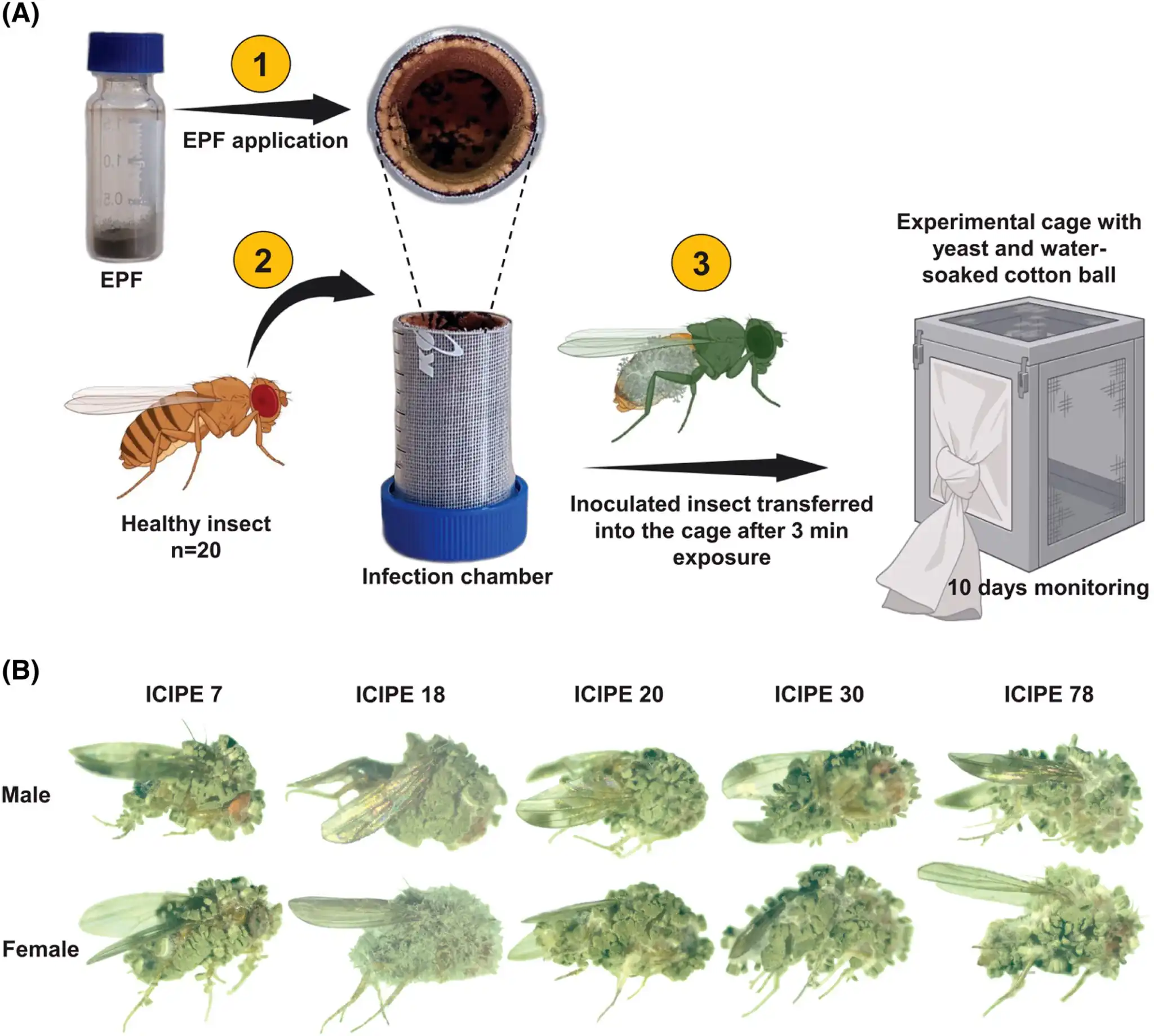 Figure 1. (A) Drosophila suzukii infection protocol and (B) sporulated D. suzukii after infection by fungal isolates
of Metarhizium anisopliae. The images were captured 6–7 days after the death of infected D. suzukii.
Figure 1. (A) Drosophila suzukii infection protocol and (B) sporulated D. suzukii after infection by fungal isolates
of Metarhizium anisopliae. The images were captured 6–7 days after the death of infected D. suzukii.
Result
All five M. anisopliae isolates led to high mortality in D. suzukii.
The median lethal time (MLT 50) showed that the ICIPE 78 isolate had the fastest action (4.75 ± 1.03 days) followed by ICIPE 7, ICIPE 18, ICIPE 30, and ICIPE 20, with MLT 50 of 5 to 8 days.
ICIPE 78 was horizontally transmitted by donor flies, and the fertility of recipient females was negatively impacted.
We further documented that ICIPE 78 induced significant attraction to D. suzukii.
Sporulated cadavers hosting ICIPE 78 attracted and infected healthy flies.
Conclusion
The high pathogenicity of ICIPE 78 and its attraction to D. suzukii could be explored for pest suppression, especially as this isolate is already commercialized against other pests, which could facilitate its registration for use against D. suzukii through label extension.
Source: Fonte: Farid, I.M., Ndlela, S., Becher, P.G., Weldon, C.W., Azrag, A.G., Schiöth, H.B., Mohamed, S.A. and Ekesi, S. (2026), Conned by the enemy: the entomopathogenic fungus Metarhizium anisopliae lures and kills Drosophila suzukii. Pest Manag Sci. https://doi.org/10.1002/ps.70576
Source opening image: Joseph Moisan-De Serres, Laboratoire d'expertise et de diagnostic en phytoprotection - MAPAQ
Cherry Times - All rights reserved