Fruit size is one of the most important traits in cherry breeding, as larger fruits are generally associated with higher commercial value. However, selection based exclusively on phenotype requires several years of field evaluations and entails considerable costs, especially in segregating populations.
A recent study investigated the potential of two SSR molecular markers, BPPCT034 and CPSCT038, located on either side of the FW_G2a region of linkage group 2, which has already been identified as an important genomic hotspot associated with fruit weight and size in sweet cherry.
The analysis involved a Hungarian germplasm collection comprising 40 sweet cherry (Prunus avium) accessions evaluated for 3–5 years and 31 sour cherry (Prunus cerasus) accessions characterized over three years, relating genotype and phenotype.
Variability in sweet cherry
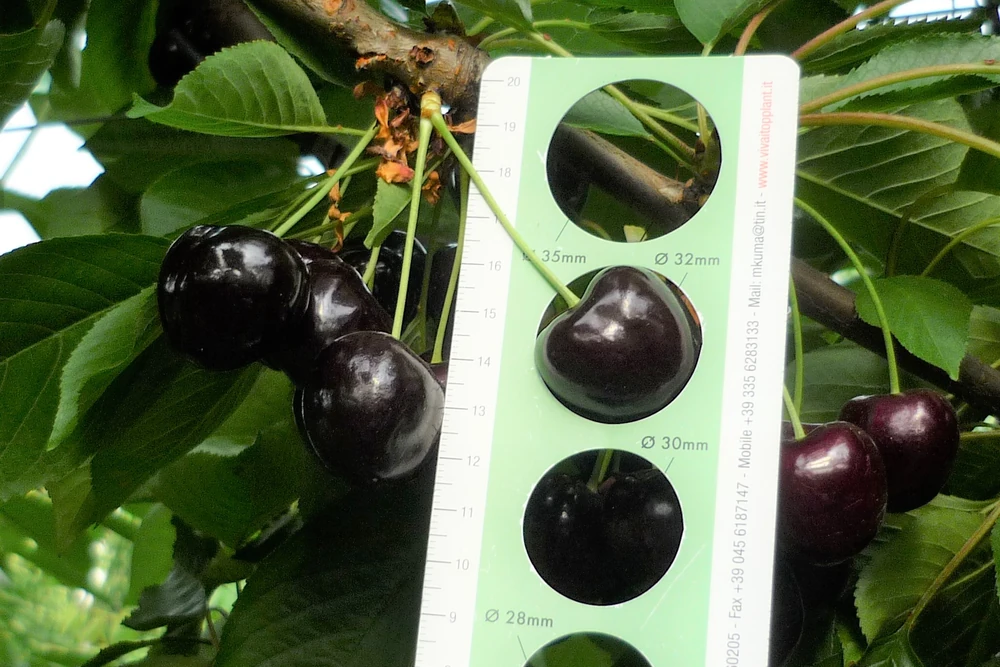
In sweet cherry, marked variability emerged: fruit weight among the different accessions ranged, at the observed extremes, from 2.55 g to 12.18 g. The two markers showed associations with fruit diameter, length, thickness, and weight.
In particular, the CPSCT038190 and BPPCT034255 alleles showed positive correlations with fruit size, whereas CPSCT038192 and BPPCT034223 were associated with smaller fruits.
The most interesting result concerned the 190–255 haplotype: in agreement with previous studies, its presence in homozygous form was associated with large fruits, confirming the value of this combination as a potential selection indicator. Conversely, the 192–223 haplotype was associated with accessions producing smaller fruit.
Principal component analysis also made it possible to distinguish genetically characterized groups with different weight classes, further supporting the usefulness of the markers for discriminating among germplasm accessions.
Complexity in sour cherry
In sour cherry, the picture was more complex. The allotetraploid nature of P. cerasus resulted in greater diversity in allelic combinations: 21 unique genotypes were identified among the 31 accessions analyzed.
Although associations emerged between individual alleles and fruit size, it was not possible to define a single allelic combination that clearly predicted fruit size.
Some results nevertheless indicate BPPCT034204 and BPPCT034237, together with the CPSCT038185 and CPSCT038204 alleles, as potential indicators of larger fruit, whereas BPPCT034208 and CPSCT038190 were more frequently associated with smaller fruits.
The difference compared with sweet cherry highlights the extent to which ploidy and genetic background can influence the expression and applicability of markers associated with quantitative traits.
Marker-assisted selection
Overall, the study confirms that BPPCT034 and CPSCT038 can represent effective tools for germplasm screening and, above all, for integrating phenotypic selection with marker-assisted selection (MAS).
The application of these tools would make it possible to identify, already at the seedling stage, genotypes carrying alleles favorable for large fruit size, while early eliminating those potentially associated with small fruits.
This would reduce the number of individuals that need to be grown and evaluated over several years, consequently lowering costs and labor requirements.
Accessions of interest
Particularly interesting for future breeding programs are the accessions ‘Vaszilisza’ in sweet cherry and ‘Mogyoródi kései’ in sour cherry, which produced the largest fruits in their respective collections, as well as some sweet cherry accessions carrying the 190–255 haplotype in homozygous form.
Source: Szilágyi, S., Desiderio, F., Marton, B., Mohay, P., Therese Navarro, A., & Békefi, Z. (2026). The Bigger, the Better: Genetic and Phenotypic Analysis of Fruit Size in Sweet (Prunus avium L.) and Sour Cherry (Prunus cerasus L.) Germplasm. Plants, 15(6), 856. https://doi.org/10.3390/plants15060856
Image source: Stefano Lugli
Andrea Giovannini
PhD in Agricultural, Environmental and Food Science and Technology - Arboriculture and Fruitculture, University of Bologna, IT
Cherry Times - All rights reserved