An ongoing study led by Dr Carolina Torres, a professor at Washington State University, is seeking the best method to provide the cherry industry with a technical tool, rather than a purely sensory one, to measure cherry texture, an aspect that compression often fails to reflect.
Soft or firm cherries are often an attribute that sparks debate among consumers, but one that always remains tied to personal opinion and individual experience.
What would happen if we assigned numerical values to this attribute? Especially considering that, in some cases, the external firmness of a cherry is dissociated from its internal firmness.
A study to measure
Starting from this premise, Dr Carolina Torres, a WSU researcher, is conducting a study to identify the best way to measure cherry texture, both internally and externally.
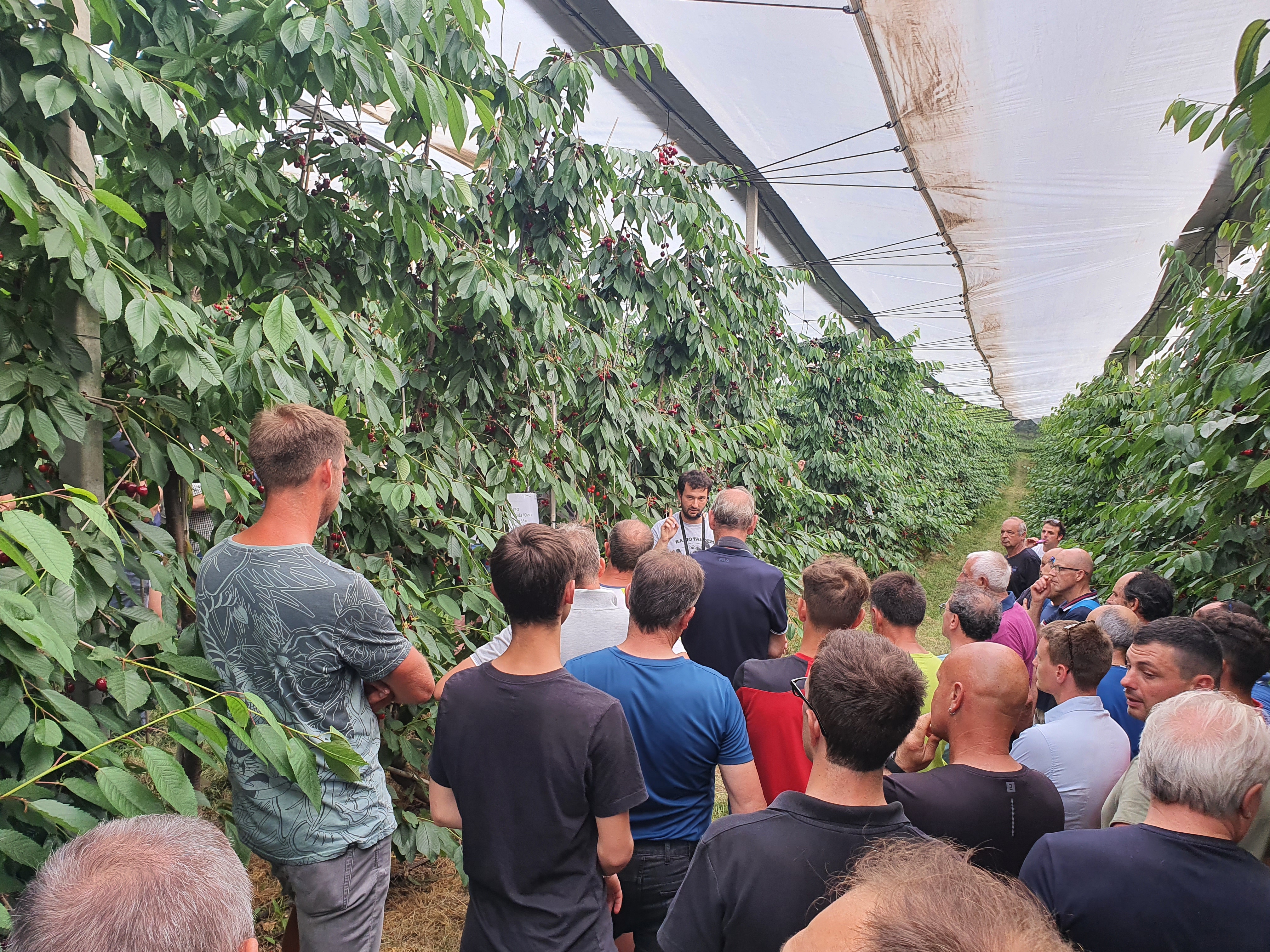
Dr Carolina Torres, professor at Washington State University.
The post-harvest specialist explains that it all began thanks to the fact that her university has a breeding programme and that some genotypes show a particular phenotype: two textures within the same cherry. During chewing, the fruit feels soft on the outside, but when the tooth enters the flesh, it is firm; the opposite also occurs: firm on the outside and soft on the inside.
“This is what pushed me to clarify certain aspects related to texture and, potentially, to reconsider compression as a parameter, integrating another unit or metric to evaluate texture,” Torres explains. The search for new tools and techniques took three years.
Firmness is not texture
The questions the research aims to answer stem from issues raised within the North American cherry industry, one of which concerns firmness and the different techniques used to measure it, opening the door to a new way of evaluating the connection between various factors and fruit texture.
Compression is the metric used to measure firmness in small fruits such as cherries and blueberries. The problem is that firmness measurement is a good metric when the fruit has a homogeneous texture, but in cherries many varieties, though not all, do not show a homogeneous texture, Torres explains.
“A cherry may register 400 grams per millimetre (g/mm), but when you bite it, despite being a firm cherry, the internal texture is soft and does not reflect that value. Therefore, the question producers wanted this research to answer was to find a new tool to measure not only firmness, but texture across the entire edible area of the fruit. This is with the aim of reducing the gap between sensory evaluation at consumption and the measurement used as a ‘trade index’.”
Another issue with compression is that in some varieties values actually increase during post-harvest. “This parameter definitely does not interact well with texture; if a fruit starts at 350 g/mm but after two weeks reaches 425 g/mm, which regularly occurs in some varieties, this distorts the perception of texture.”
The “trade index” and texture
According to Dr Torres, compression has become a “trade index”, where buyers require a specific compression value that, as already highlighted, often does not correlate with internal texture.
If there is not always a good correlation between compression and the perception of texture or firmness when biting the fruit, it is because texture actually depends on the cultivar, fruit condition, pre- and post-harvest practices, maturity stage at harvest, storage conditions, among many other factors, as Torres points out.
“There are many factors influencing texture for it to be correlated solely with compression in the first millimetres of the fruit; it is therefore something rather complex to define.”
The expert explains that texture depends on the water status of the tissue and its structure; on cell wall characteristics, with a higher or lower wall material content; and on the degree of pectin polymerisation, although, according to the specialist, the degree of softening in cherries could not be correlated with soluble pectin content.
Penetrometer and reflectance
“There are several characteristics we try to measure solely through compression: cell size, compressive and tensile forces that give the tissue its elastic properties. So the working question or hypothesis was: can compression be replaced with another method to measure texture in cherries? With this approach, we started with the penetrometer and the hyperspectral camera,” she noted.
Initially, they measured penetration resistance using a probe, not the one commonly used for apples, but a custom-made probe, four millimetres in diameter, to measure the fruit’s texture curve.
The correlations established were: soft fruit up to 350 g/mm, medium fruit between 350 and 425 g/mm, and above 425 g/mm for firm fruit.
Using these parameters, they moved on to the hyperspectral camera, with results showing that fruit with low compression exhibited higher reflectance between 450 and 600 nanometres at pigment level and between 800 and 900 nanometres, correlated with water content.
Instrumental limitations
“Although a model can be built with these results, it is not very promising. We decided to move to a different technique than reflectance, which is what the multispectral camera measures,” she explained, adding that “the associated models did not show sufficient correlation to apply them in a non-destructive way that represents what happens inside the fruit. This could be an instrumental problem, because the light used in spectral cameras penetrates only a few millimetres into the fruit; to better represent the flesh, another light source or transmittance would be required.”
Nevertheless, she stresses that it would be ideal if spectral cameras could provide better results, since this technology is present in all cherry packing facilities, and therefore the practical potential is enormous. If a good correlation with internal conditions could be achieved, fruit segregation would be easy.
Sensory panels and varieties
Another approach addressed was instrumental evaluations of texture and firmness; in addition, expert sensory panels were conducted using cherries from the WSU breeding programme, showing high precision in dividing fruit groups into the three levels of firmness and texture.
“This information is what we use to correlate compression values, hyperspectral models and texture curves.”
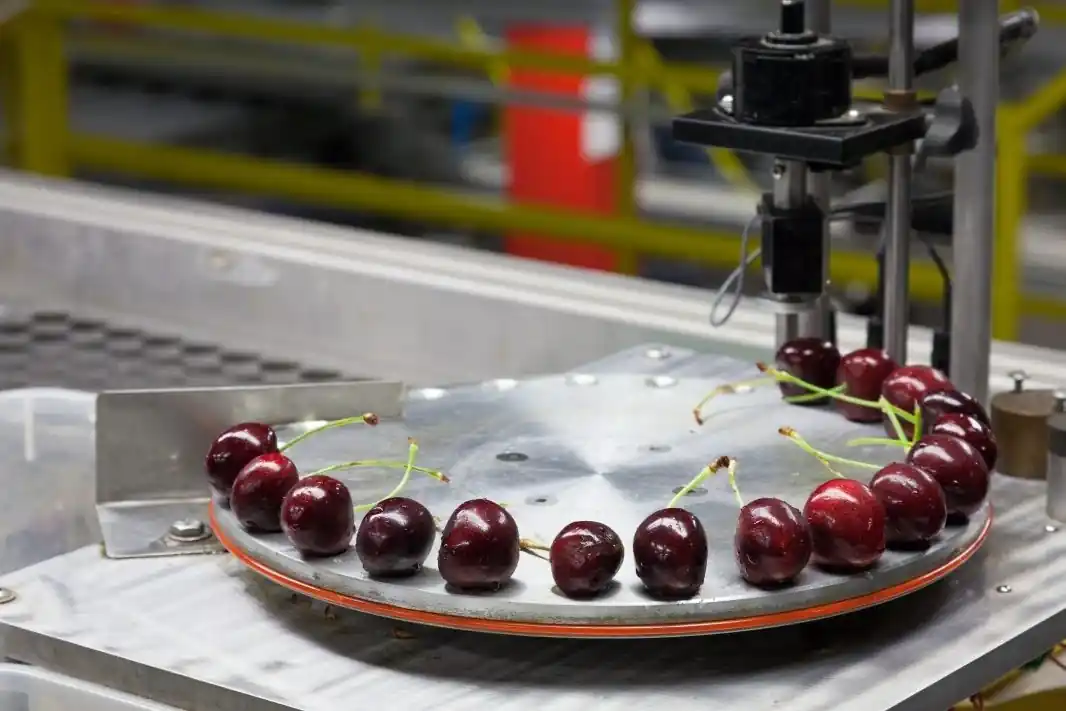
Cherry compression with FirmPro, used to measure fruit firmness.
Another factor affecting texture, according to the professor, is that as storage time increases, firmness measured by compression increases, a phenomenon particularly evident in varieties such as Rainier and Bing.
Influence of maturity
To measure this effect, cherries were harvested on two different dates: the first harvest took place four to five days before commercial harvest, and the second coincided with commercial harvest. Unfortunately, the results were inconclusive, as another issue emerged: in the United States, harvest occurs later (at a more advanced maturity stage) than in Chile.
“Temperatures are lower than those in Chile at the time of cherry harvest, so we decided to harvest earlier than commercial harvest, using Chilean parameters for storage longer than 30 days,” she explains.
“The effect of harvest on firmness was inconsistent. We observed that in the first harvest, in Sweetheart, compression was much higher than in the second harvest, but this effect did not appear in other varieties. Therefore, the effect of maturity on compression levels is variety-dependent.”
More than just a bite
Although, to date, the results obtained using reflectance have been disappointing, Carolina Torres will continue her research, focusing on how texture curves change in fruits with different textures. In the study, this characteristic is analysed using clones from the WSU breeding programme, but in the future it could be applied to the US and Chilean cherry industries.
The aim of the study is for parameters obtained from the texture curve to be applied to large volumes of cherries, ultimately enabling the segregation of fruit groups with different textures.
The idea of the project is to provide more information to buyers in destination markets, allowing them to anticipate what they will experience with the cherry, because “this is something that often is not connected within the industry.”
Measuring texture in post-harvest would represent new information to provide to consumers.
Microscopic investigation
Dr Torres notes that they are currently studying, through microscopy, cellular components and genes that may be involved in texture differences in cherries, with the help of clones from the breeding programme.
Finally, she points out that with reflectance models they were not able to accurately predict texture parameters, compression or firmness categories.
“Another non-destructive tool capable of measuring deeper into the fruit would be needed; penetration better represents the texture perceived by panellists compared to compression. The development of a new index could be the next step,” she explains. The aim is to observe exactly which parts of the texture curve provide the best indicator of the full bite of the cherry.
Compression does not correlate with texture parameters, so we have a problem using it as a ‘trade index’ for cherry sales when internal texture does not represent the measured value. A fruit may have a firmness of 400 g/mm, which is what is measured, but when bitten the flesh may be soft.
Image source: Redagricola
Miguel Patiño
Redagricola
Cherry Times – All rights reserved