Irrigation management in modern orchards involves several technical challenges, especially in areas affected by summer drought, irregular rainfall, and high temperatures.
Sweet cherry trees are particularly sensitive to water stress during flowering, fruit set, and fruit growth, and require a constant water supply to ensure productivity and commercial fruit quality.
In this context, a recent study carried out at the Fruit Growing Institute in Plovdiv (Bulgaria) within the European DIVAGRI project evaluated, between 2021 and 2023, a new subsurface micro-irrigation system: Self-regulating Low-Energy Clay-based Irrigation (S.L.E.C.I.).
Technical features of the system
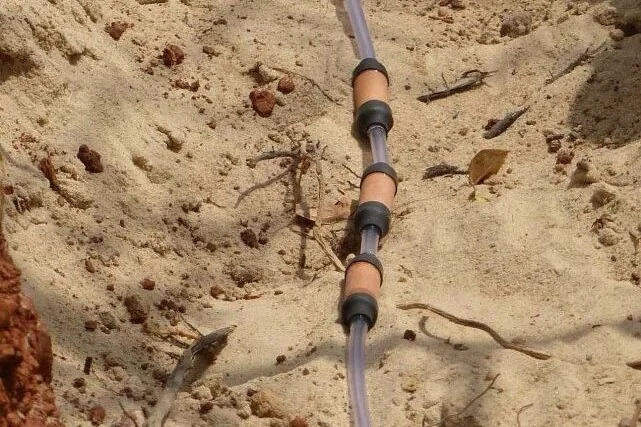
Developed by Wismar University, this system uses cylindrical microporous clay emitters installed in the soil and connected through small-diameter tubes to a gravity-fed water source.
Its key technical feature is self-regulation: water is released only when soil water tension exceeds that of the emitter, allowing “on-demand” water delivery without the need for sensors, control units, or electricity.
The study compares the S.L.E.C.I. system with a conventional drip irrigation system and a non-irrigated (rainfed) management, analyzing soil moisture dynamics at different depths (30, 60, and 90 cm), applied irrigation volumes, yield performance, fruit quality parameters, and irrigation water productivity (IWP).
Water use and productivity results
The results show that S.L.E.C.I. ensures more stable soil moisture throughout the soil profile, particularly at 60 and 90 cm, demonstrating lower dependence on short-term climatic fluctuations.
A deeper and more uniform water distribution reduces peaks of water stress and improves root functioning in tree crops.
Probably the most interesting result concerns water use: S.L.E.C.I. used on average about 157 m3/ha of irrigation water, whereas the drip irrigation system required more than 2183 m3/ha, i.e., over 14 times more.
Despite this, average yield was similar between the two irrigation systems, with 1147 kg/ha under S.L.E.C.I. compared to 1234 kg/ha under drip irrigation, while the rainfed treatment produced only about 307 kg/ha.
Efficiency and qualitative aspects
In other words, irrigation is essential to maintain acceptable production levels, but S.L.E.C.I. is able to achieve this with an extremely low water input.
This is directly reflected in irrigation water productivity (IWP): the S.L.E.C.I. system reached an average value of 5.72 kg/m3, compared to only 0.44 kg/m3 for drip irrigation, resulting in an efficiency more than 12 times higher.
From a qualitative perspective, S.L.E.C.I. produced fruits with greater weight and size compared to the non-irrigated control, often showing equivalent or even better performance than drip irrigation, and above all a lower variability among fruits, which is a key aspect for commercial standardization.
Conclusions and limitations
In conclusion, S.L.E.C.I. emerges as a promising and sustainable technological solution, particularly suitable for areas facing water scarcity and limited energy availability.
However, some practical limitations are also highlighted: high initial costs of clay emitters, installation complexity, difficulty of inspection due to the subsurface layout, and potential damage to tubing caused by rodents.
Despite these constraints, the study confirms that self-regulating irrigation using clay emitters can represent a concrete alternative to conventional drip irrigation, with strong potential for sustainable fruit production and for regions where producing “more with less water” is no longer an option, but a necessity.
Source: Malchev, S., Tanaskovik, V., Chukaliev, O., Germanova, D., & Kornov, G. (2025). Sweet Cherry (Prunus avium L.) Response to Self-Regulating Low Energy Clay-Based Irrigation (SLECI) System. Plants, 14(22), 3533. https://doi.org/10.3390/plants14223533
Image source: University of Applied Sciences Wismar
Andrea Giovannini
PhD in Agricultural, Environmental and Food Science and Technology - Arboriculture and Fruitculture, University of Bologna, IT
Cherry Times - All rights reserved