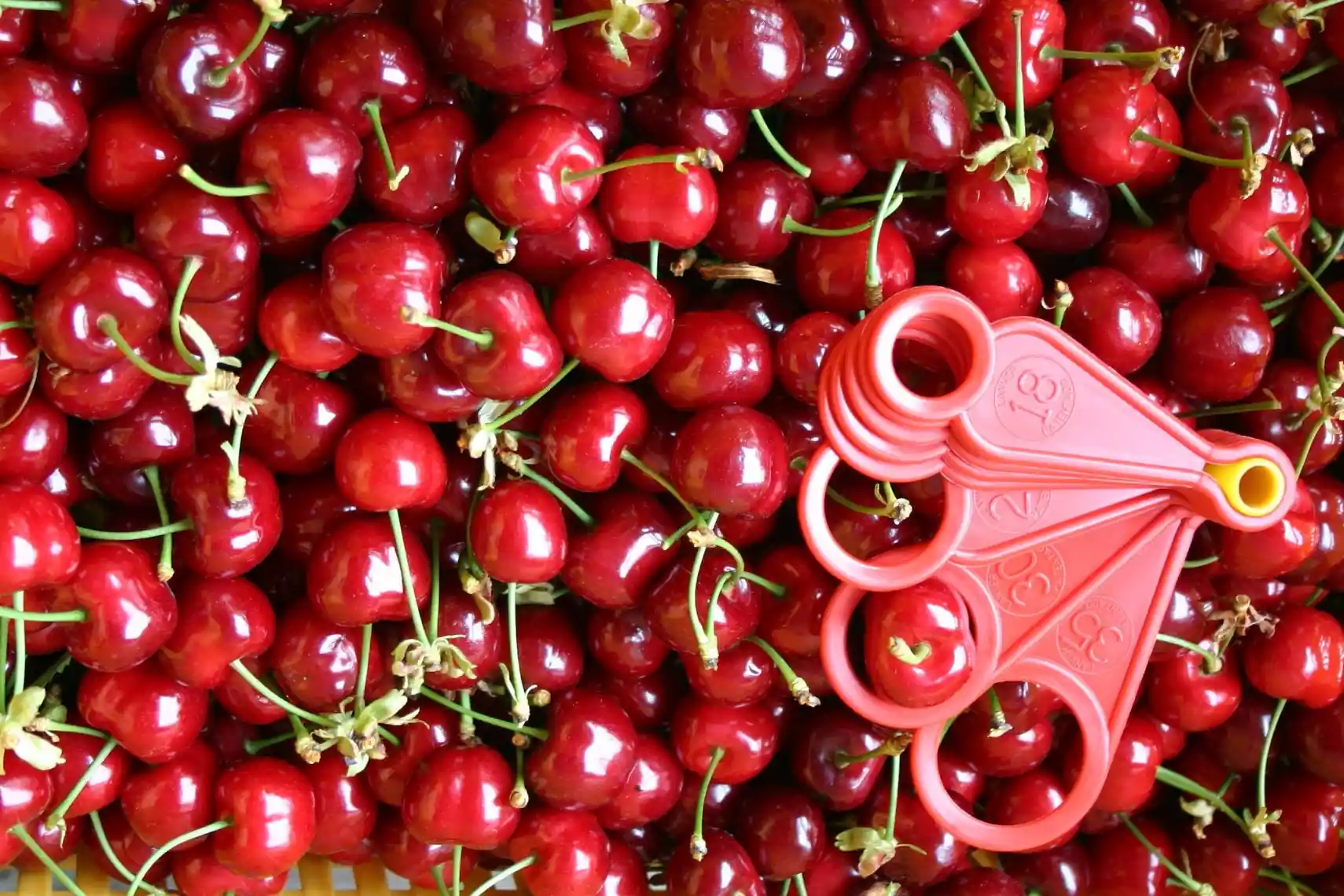
Sweet cherry is one of the most delicate fruits in postharvest management, being characterized by a high respiration rate, rapid loss of turgor, and a marked susceptibility to decay, even under refrigerated conditions.
These critical aspects make it necessary to develop targeted preservation strategies capable of integrating technological effectiveness, food safety, and environmental sustainability.
In this context, a recent study evaluated the use of nanostructured edible coatings based on chitosan and alginate, enriched with pomegranate peel extract (PPE) at concentrations of 0.5%, 1%, and 1.5%, to improve the quality and stability of sweet cherries during cold storage.
Biopolymers and nanotechnology
The proposed approach is based on the use of biopolymers widely studied in postharvest applications, combined with a natural extract rich in polyphenols and with the advantages offered by nanotechnology, which improves film homogeneity and its functionality as a semi-permeable barrier.
The resulting nano-coatings showed particle sizes ranging from 150 to 230 nm and zeta potential values indicative of high colloidal stability, conditions that are essential to ensure uniform distribution on the fruit surface and good persistence during storage.
From a qualitative perspective, the results show that the application of these coatings significantly reduces physiological weight loss by slowing down transpiration and respiration processes responsible for the rapid deterioration of the fruit.
Quality and decay reduction
Treated cherries, particularly those coated with nano-chitosan enriched with 1.5% pomegranate peel extract, maintained better freshness for up to 20 days of storage at 4 °C (39.2 °F), with weight loss limited to about 8%, compared with the much higher values observed in the untreated control.
At the same time, a marked reduction in decay incidence was observed, with deterioration limited to around 21%, attributable to the combined action of the intrinsic antimicrobial properties of chitosan and the high content of phenolic compounds in PPE.
Another noteworthy aspect concerns the preservation of the internal quality of the fruit: the coatings helped maintain more stable levels of total soluble solids and titratable acidity by slowing ripening and respiration, and promoted better retention of anthocyanins and antioxidant activity, which are key parameters for the nutritional and commercial value of sweet cherries.
Microbiological performance
From a microbiological standpoint, PPE-based treatments were able to limit the development of yeasts and molds for a prolonged period, keeping microbial loads within acceptable limits and delaying the appearance of visible spoilage symptoms.
When comparing the two biopolymers, chitosan proved overall more effective than alginate, probably due to its polycationic structure, higher film-forming capacity, and direct interaction with microbial cell membranes.
Conclusions and implications
In conclusion, the study provides solid technical evidence supporting the use of natural nano-coatings as an effective and sustainable tool to extend the shelf life of sweet cherries.
Therefore, the incorporation of pomegranate peel extract into polymeric matrices, particularly chitosan, emerges as a promising solution to reduce postharvest losses, valorize agro-industrial by-products, and meet the needs of a sweet cherry industry increasingly oriented toward quality, safety, and sustainability.
Source: Wani, S. M., Zehra, A., Naseem, Z., Bashir, I., Hussain, S. Z., Malik, A. R., Amin, T., Rasool, K., & Mustafa, S. (2025). Enhancing the postharvest quality and storage stability of sweet cherries (Prunus avium) using nano-chitosan and nano-alginate coatings enriched with pomegranate peel extract. Biocatalysis and Agricultural Biotechnology, 103820. https://doi.org/10.1016/j.bcab.2025.103820
Image source: SL Fruit Service
Andrea Giovannini
University of Bologna (IT)
Cherry Times - All rights reserved