Pruning is one of the most effective orchard management practices for optimizing the balance between vegetative and reproductive growth. A recent study conducted in the Republic of Moldova evaluated the effects of pruning timing on the sweet cherry cultivar 'Kordia' grafted onto the MaxMa 14 rootstock, demonstrating that the timing of pruning can significantly influence canopy development, productivity and, consequently, the overall efficiency of the orchard.
The study was carried out in a commercial orchard planted at a spacing of 5 × 3 m, where trees trained to a compact canopy system were subjected to four different pruning strategies: during the dormant season (control), at flowering, after summer harvest, and in early autumn. The objective was to identify the most suitable pruning period to maximize yield potential without compromising the correct vegetative development of the trees.
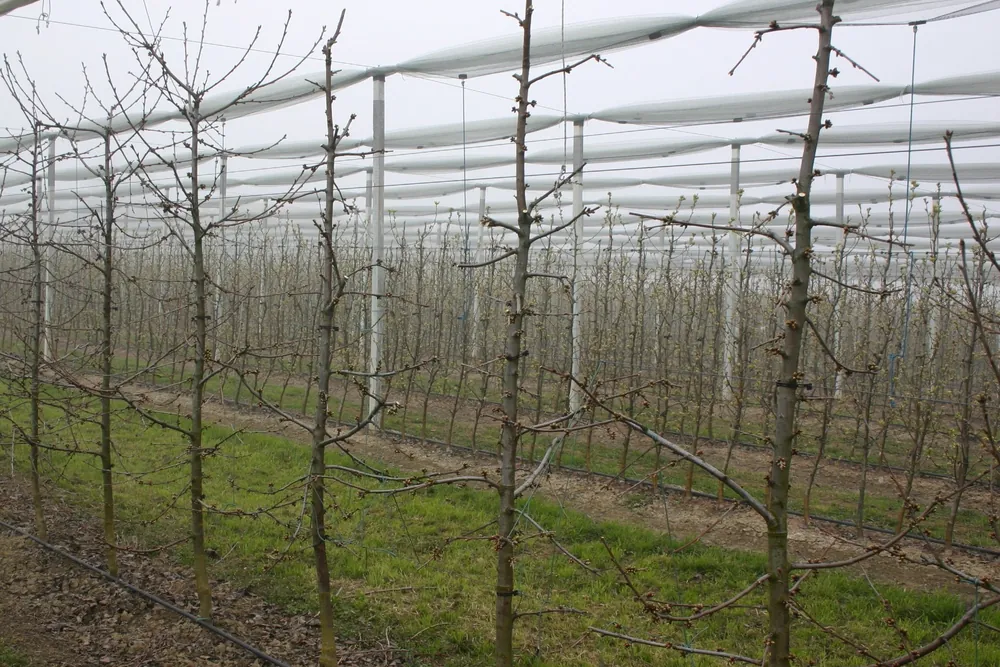
The results first showed that canopy development is a reliable indicator of the productive potential of sweet cherry trees. As the trees aged, canopy height, width and canopy volume progressively increased, accompanied by a larger photosynthetically active surface and greater ground coverage. By the eleventh year after planting, the trees had reached dimensions considered optimal for fully expressing their productive potential.
Pruning timing
Pruning timing significantly influenced vegetative development. Trees pruned after harvest and those pruned in early autumn produced longer annual shoots, indicating greater vegetative vigor than trees pruned during dormancy or at flowering. Likewise, trees pruned in early autumn achieved the greatest canopy height.
The 'Kordia' cultivar concentrated most of its fruiting spurs on two-year-old wood, with their number progressively declining on three- and four-year-old branches. Post-harvest pruning resulted in the highest total number of fruiting spurs, suggesting a greater capacity to renew productive wood. At the same time, shorter annual shoots exhibited a higher density of flower buds than longer shoots, indicating that controlling vegetative growth may help maintain high canopy productivity.
Although yields showed the expected year-to-year variability, partly due to climatic conditions, the multi-year comparison revealed a clear advantage for early autumn pruning. On average, this strategy produced the highest yield, approximately 19.8 kg of fruit per tree, compared with 18.1 kg per tree for dormant-season pruning. Post-harvest pruning also outperformed conventional dormant pruning, confirming the benefits of interventions carried out at the end of the growing season.
Final recommendations
In conclusion, the study demonstrates that pruning timing is an important management factor for optimizing the performance of 'Kordia' sweet cherry trees grafted onto MaxMa 14 under Moldovan growing conditions. Pruning immediately after harvest or, even more effectively, in early autumn promotes a better balance between vegetative growth and fruit production, allowing the cultivar to express its full productive potential. These findings provide valuable guidance for technicians and cherry growers seeking to refine canopy management strategies in modern sweet cherry orchards, improving both agronomic efficiency and the economic sustainability of production.
Source: Bîlici, I., Balan, V., Şarban, V., Buză, C., & Talpalaru, D. (2025). The influence of pruning on vegetative growth, yield and quality of cherry fruits of the ʻKordiaʼ variety grafted on ʻMaxMa 14ʼ (Prunus avium). Scientific Papers. Series B. Horticulture, (2), 70-75.
Image source: Stefano Lugli
Andrea Giovannini
PhD in Agricultural, Environmental and Food Science and Technology - Arboriculture and Fruitculture, University of Bologna, IT
Cherry Times - All rights reserved