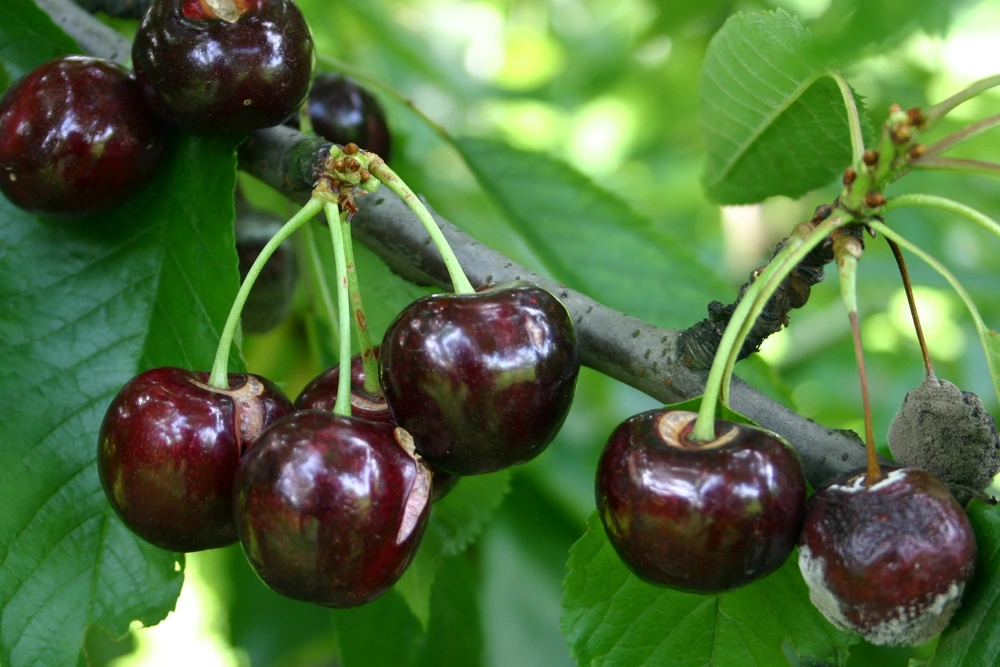
Cracking is one of the main limiting factors in sweet cherry production, with significant impacts on both yield and market quality of the fruit. In this context, understanding the mechanisms that regulate cell-to-cell adhesion within fruit tissues is essential for interpreting the processes leading to the formation of the typical cracks associated with cracking.
A recent study investigated cell wall composition and the role of different polysaccharide fractions in cell-to-cell adhesion, combining immunolocalization techniques with enzymatic digestion assays.
Immunohistochemical analysis revealed a widespread presence of pectins particularly both methylated and demethylated homogalacturonans, and arabinans across different fruit tissues, including the epidermis, parenchyma, and vascular tissues.
Role of pectins in cell wall structure
In contrast, hemicelluloses, such as xyloglucans and xylans were less abundant and more limited in their distribution. These findings already suggest a central role for pectins in the structure of the cherry cell wall, especially at the level of the middle lamella, the primary site of adhesion between adjacent cells.
The most compelling experimental evidence, however, comes from enzymatic digestion assays conducted on tissues of the fruit.
The use of pectinases (galactanase, polygalacturonase, and pectate lyase) resulted in significantly higher levels of tissue degradation compared with hemicellulases or cellulase.
Effects of enzymatic digestion
In particular, digestion with pectinases led to extensive release of isolated cells protoplasts, and cell wall fragments, indicating a substantial loss of cell-to-cell adhesion.
In contrast, treatments with enzymes targeting hemicelluloses and cellulose produced only limited effects, with tissues largely maintaining their structural integrity.
Digestion increased with fruit maturation, consistent with the rise in endogenous pectolytic enzyme activity during growth and ripening. Moreover, calcium emerged as a key factor in cell wall stability: its presence reduced pectic degradation, whereas its removal enhanced it.
This effect is attributable to the ability of Ca2+ to form cross-links between homogalacturonan chains (the “egg-box” model), thereby limiting pectin hydration and swelling and strengthening cell adhesion.
These findings have important implications: cracking in sweet cherry primarily occurs through cell separation along the middle lamella, rather than by direct rupture of the cell walls.
Implications for cracking in sweet cherry
Pectin swelling, promoted by calcium loss and the action of pectolytic enzymes reduces cell cohesion, facilitating the progression of microcracks into macroscopic fractures.
In this process, malic acid also plays a key role by contributing to calcium extraction from the cell walls and thus weakening adhesion.
The researchers also highlight significant variability among cultivars in susceptibility to pectic digestion suggesting possible differences in cell wall composition and structure.
Conclusions and perspectives
Although the relationship with cracking susceptibility was not directly assessed, these findings open promising perspectives for cultivar selection and targeted agronomic strategies.
In conclusion, experimental evidence indicates that pectins are the primary component responsible for cell-to-cell adhesion in sweet cherry fruit, whereas hemicelluloses and cellulose play a secondary role. Understanding these mechanisms provides a solid basis for developing innovative approaches to manage fruit cracking, with particular attention to pectin metabolism and calcium nutritional status.
Source: Culemann, E., Schumann, C., Winkler, A., Sitzenstock, S., & Knoche, M. (2026). Cell: cell adhesion in sweet cherry fruit primarily due to pectins. Frontiers in Plant Science, 16, 1690728. https://doi.org/10.3389/fpls.2025.1690728
Image source: Stefano Lugli
Andrea Giovannini
PhD in Agricultural, Environmental and Food Science and Technology - Arboriculture and Fruitculture, University of Bologna, IT
Cherry Times - All rights reserved