When the last bin leaves the orchard, it is tempting to think the growing season is over. For the cherry tree, however, harvest is not the finish line—it is the beginning of the next season.
From harvest through leaf fall, leaves remain photosynthetically active, flower buds continue developing, roots may experience additional growth, and carbohydrates and nutrients are stored for spring. These reserves support bloom, fruit set, early fruit growth—especially in early cultivars—fruit retention, and canopy development before new leaves can fully supply the tree.
Flower structures for the following season continue differentiating within the buds during this period. Conditions can influence flower quality, fruitfulness, and abnormalities such as doubled fruit. At the same time, shoot growth should slow, terminal buds should set, wood should mature, and the tree should redirect resources from vegetative growth toward storage and acclimation.
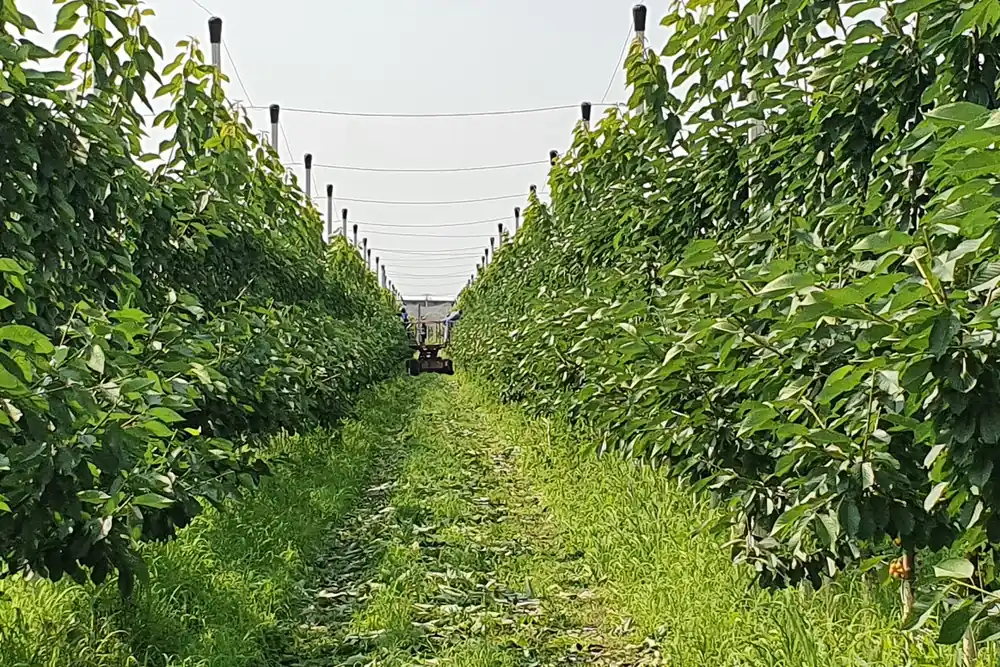
Postharvest management
Postharvest management should therefore focus on three objectives: maintain, mitigate, and replenish. Maintain tree health and functional leaf area, mitigate environmental stress and excess vigor, and replenish the carbohydrate and nutrient reserves needed for the following season.
Maintain a healthy canopy
Maintaining healthy leaves until natural senescence is one of the most important postharvest objectives. Postharvest leaves continue producing sugars that are stored primarily in roots, but also in shoots, trunks, and buds (Keller and Loescher, 1989; Ayala and Lang, 2015). Nitrogen, the other major reserve pool, is stored in forms such as asparagine and glutamine and can be remobilized the following spring (Millard et al., 2006) to support spring growth.
Premature defoliation shortens the reserve-accumulation period. In contrast, excessive late vigor can divert resources into shoots and suckers that provide little useful fruiting wood and increase canopy shading. The goal is a balanced tree with functional leaves, adequate but not excessive water, moderate vigor, and limited pest or disease pressure. Management must be evaluated block by block because cultivar, rootstock, soil, crop load, irrigation system, and orchard history affect tree response.
Mitigate heat stress
Heat can affect cherry trees in more than one way.
During flower-bud differentiation, temperatures above approximately 86°F (30°C) may increase the risk of doubled pistils and doubled fruit. The period of greatest susceptibility varies with cultivar, location, harvest timing, and seasonal conditions. For early cultivars, the sensitive period may begin in June and finish in late July or early August. Later cultivars may remain susceptible into late August or early September.
During this period, overhead cooling, shading, appropriate irrigation and labeled particle films and other sun-protection materials may help reduce bud temperatures below damaging levels. Additional information is available in the article “When and How to Reduce Doubling in Sweet Cherry”.
Canopy protection
Once the primary doubling-sensitive period has passed, canopy protection should continue. The objective shifts from protecting developing flower structures to preserving photosynthesis and preventing premature defoliation.
When sun-exposed leaf temperatures remain near 95–104°F (35–40°C) for several hours, the combined effects of temperature and solar radiation can cause oxidative stress, damage proteins and cell membranes, reduce photosynthesis, limit reserve accumulation, and contribute to early leaf loss. These effects can be intensified by inadequate irrigation (Beppu, 2003).
Heat-mitigation strategies include maintaining adequate irrigation, managing orchard-floor conditions, using evaporative cooling where appropriate, and applying labeled particle films or other sun-protection materials. Their performance and economics depend on orchard conditions and application timing.
Use summer pruning selectively
Not all orchards require summer pruning. It is most beneficial in vigorous orchards where excessive shoot growth shades the canopy, reduces light penetration, or competes with the desired tree structure. Summer pruning can be performed selectively by removing individual shoots or non-selectively using mechanical toppers and hedgers, depending on the orchard system and management objectives.
Removing vigorous, non-productive shoots improves light distribution, promotes flower bud development, and eliminates unwanted wood that would likely regrow vigorously if removed during dormancy, while maintaining adequate productive leaf area.
Replenish nutrients without stimulating late growth
Postharvest nutrition should be based on individual block needs rather than a universal fertilizer program. See “Nutrient Management in Sweet Cherries“.
Postharvest is also an appropriate time to collect leaf samples and assess current nutritional status. See “Leaf Tissue Analysis“.
Leaf results should be interpreted together with crop load, fruit analysis and the nutrients removed with the harvested crop, tree vigor, rootstock, soil nutrient availability, and nutrients supplied through irrigation water. Guidance on soil sampling is available in “Soil Sampling for tree fruit orchards“.
Fertilizer efficiency
Using these sources of information together can improve fertilizer efficiency and help avoid unnecessary costs. The purpose of postharvest fertilization is to replenish reserves—not to stimulate a new flush of vegetative growth.
A postharvest checklist
Before considering the season complete, evaluate each block:
- Keep leaves healthy and photosynthetically active.
- Irrigate using evapotranspiration, soil, and plant information, or an appropriate regulated deficit irrigation strategy.
- Reduce excessive shading and remove overly vigorous growth to let light into the canopy
- Use leaf, fruit, soil, and water analyses to guide nutrition.
- Replenish nutrients according to crop load and test results.
- Manage diseases that may cause early defoliation or wood decline.
- Mark weak trees, cankers, poor-performing areas, and irrigation problems.
- Review crop load, fruit size, packout, and stress history.
- Develop a block-specific fall and dormant-season plan.
Preparing for dormancy
Postharvest management is not simply about finishing the current season. It is about maintain health within the tree, mitigating stresses and vigor, rebuilding reserves, and preparing it to enter dormancy in good condition. Next year’s bloom and early fruit development may look like a short race, but preparation begins months earlier.
The 2027 crop starts immediately after the 2026 harvest.
Image source: Stefano Lugli
Antonia Sánchez-Labbé
Science communicator specialising in fruit growing at Washington State University
Cherry Times - All rights reserved