The frequency of extreme weather events during the fruit growing season has increased recently. Extreme spring temperatures, heat waves, heavy rain, and wildfire have been the main culprits, although the list is not exhaustive. In Washington state, the largest sweet cherry producer in the United States, variability in weather patterns has been more intense.
In 2021, one of the largest heat waves ever recorded worldwide was experienced on the west coast of the U.S., lasting from the end of June to the beginning of July. Fruit physiology suffers from extreme temperatures, and this was observed in 2021, with maximum temperatures reaching around 117 °F (47.2 °C) in some areas. As with most crops, the effect of these temperatures was variety dependent. With yellow cherries such as ‘Rainier’, there is a greater sensitivity to environmental pressures, and firmness (g/mm) was reduced by 60% at harvest compared to what would be considered a “normal” year. In years without extreme heat events, cherries tend to increase in firmness, measured by compression (g/mm) during cold storage. In 2021, however, the postharvest softening rate reached up to -0.8 g/mm per day for ‘Rainier’, ‘Skeena’, and ‘Sweetheart’ (Fig. 2).
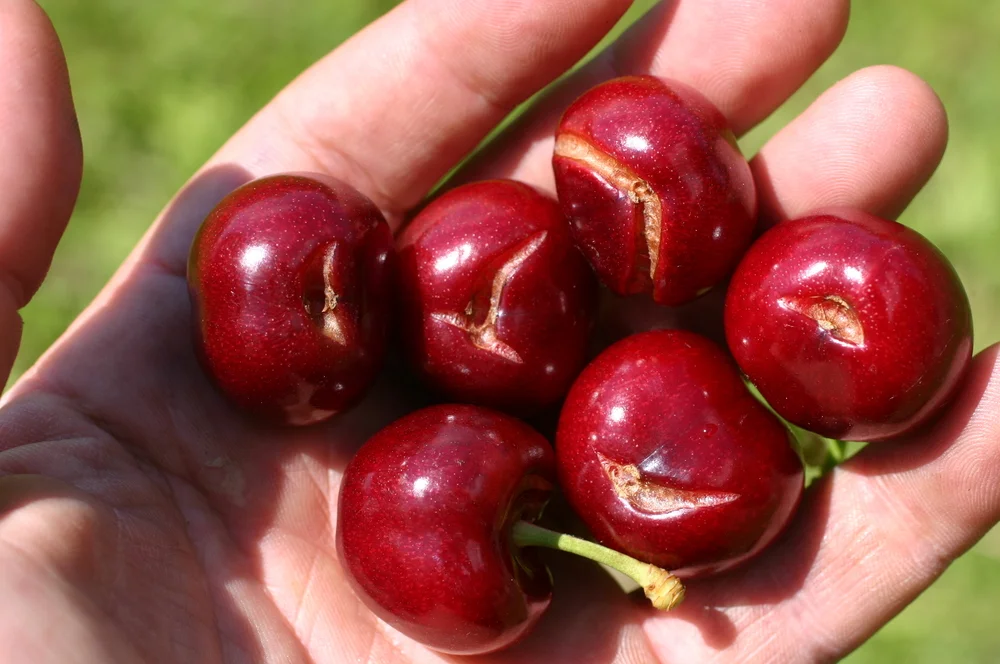
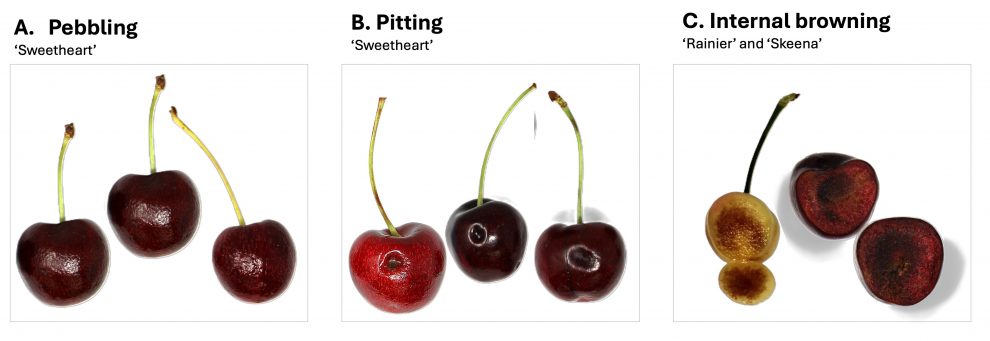 Figure 1. Cherry disorders: pebbling in ‘Sweetheart’ (left), pitting in ‘Sweetheart’ (middle), and internal browning in ‘Rainier’ and ‘Skeena’ (right). PC: Gabriela Bolaños.
Stem conditions
Stem conditions also suffered greatly during the 2021 weather events. Cherries also deteriorated much quicker in relation to browning and dehydration under postharvest conditions (Fig. 2). Fruits from Washington state are harvested at more advanced maturity rates compared to Chile to meet market demands, which made the deterioration of the fruits more advanced.
Bar graph for firmness (graph a) and stem condition (graph b) on the y-axis and days in storage on the x-axis
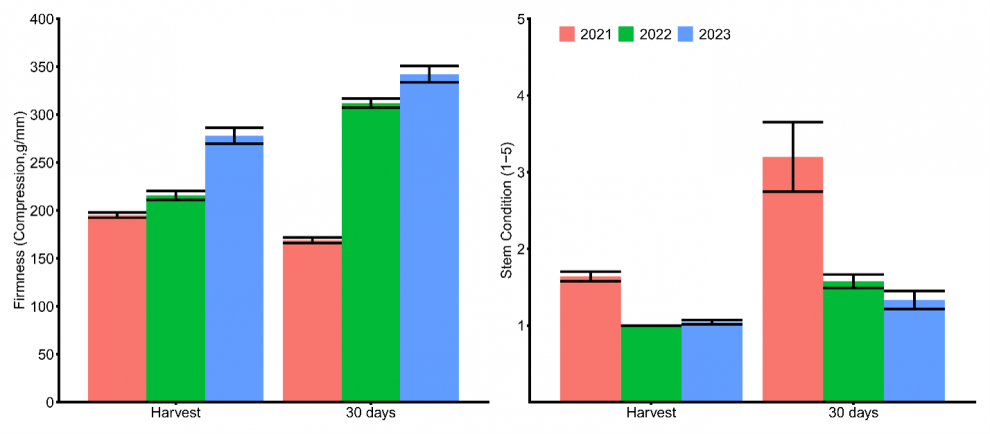 Figure 2. Firmness (mean ± standard error) and stem condition (1= green to 5= brown and dehydrated) in ‘Rainier’ cherries from harvest to 30 days after storage (0 °C). Seasons 2021, 2022, and 2023.
Storage disorders
Looking at other years, the 2023 season was characterized by consistent warm temperatures during fruit growth without any extreme heat events. In these conditions, pebbling was observed in ‘Bing’, ‘Skeena’, and ‘Sweetheart’ during storage (Fig. 3). Pebbling was also positively correlated to low temperatures during bloom (<50 °F, <10 °C), especially for ‘Bing’ and ‘Sweetheart’. In ‘Bing’, pitting incidence was much higher in 2023 when compared to 2021 or 2022. From these results, one can draw the conclusion that ‘Bing’ is sensitive to swings in temperature, both high and low, and should be treated as such in years where stress events occur. For the 2021 season, pitting increased in ‘Skeena’ and ‘Sweetheart’ cherries (Fig. 3).
Figures of pitting and pebbling incidence in bing, skeena, and sweetheart cherries
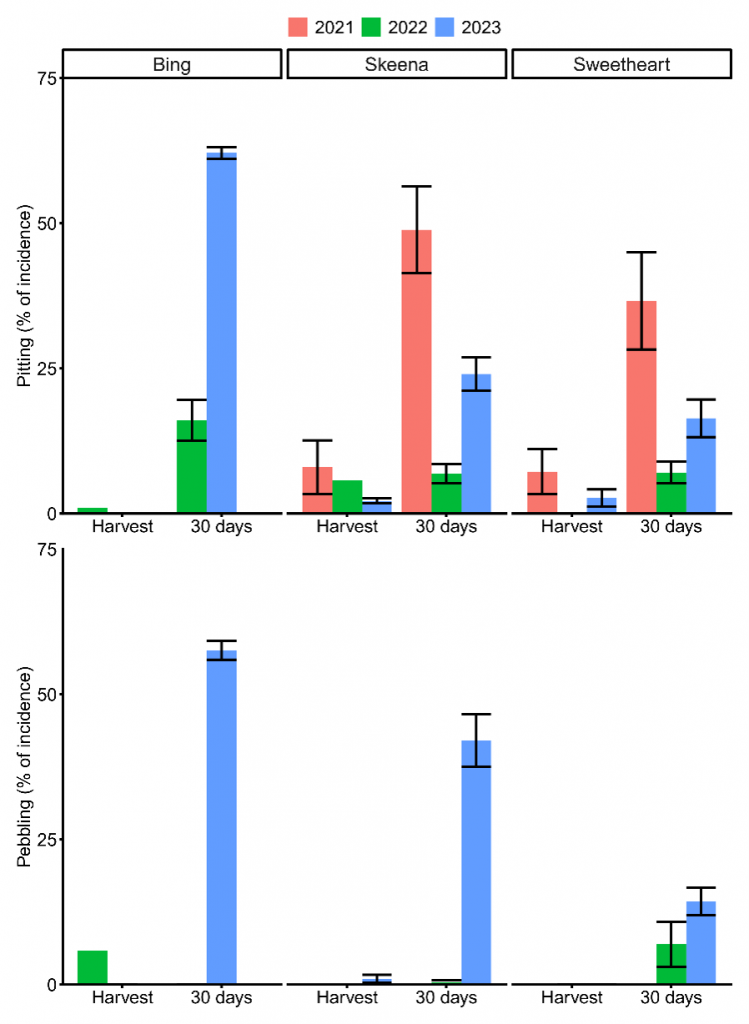 Figure 3. Incidence of pitting and pebbling (mean ± standard error; n=270) in ‘Bing’, ‘Skeena’, and ‘Sweetheart’ cherries from harvest and 30 days after storage (0 °C). Seasons 2021, 2022, and 2023.
Stem retention force
Stem retention force is another quality indicator for sweet cherries destined to fresh markets. The retention of stems is a positive market indicator for quality and is used as a basis for accepting or rejecting fruit upon delivery. Weather conditions in 2023 led to a significant reduction in the stem retention force of ‘Skeena’ (Fig. 4), leading to an increased number of fruits without stems postharvest (+27 % than in 2022). Cooler maximum temperatures at bloom also led to a decrease in stem retention force.
Bar graph of stem retention force (y-axis) vs days after harvest (x-axis)
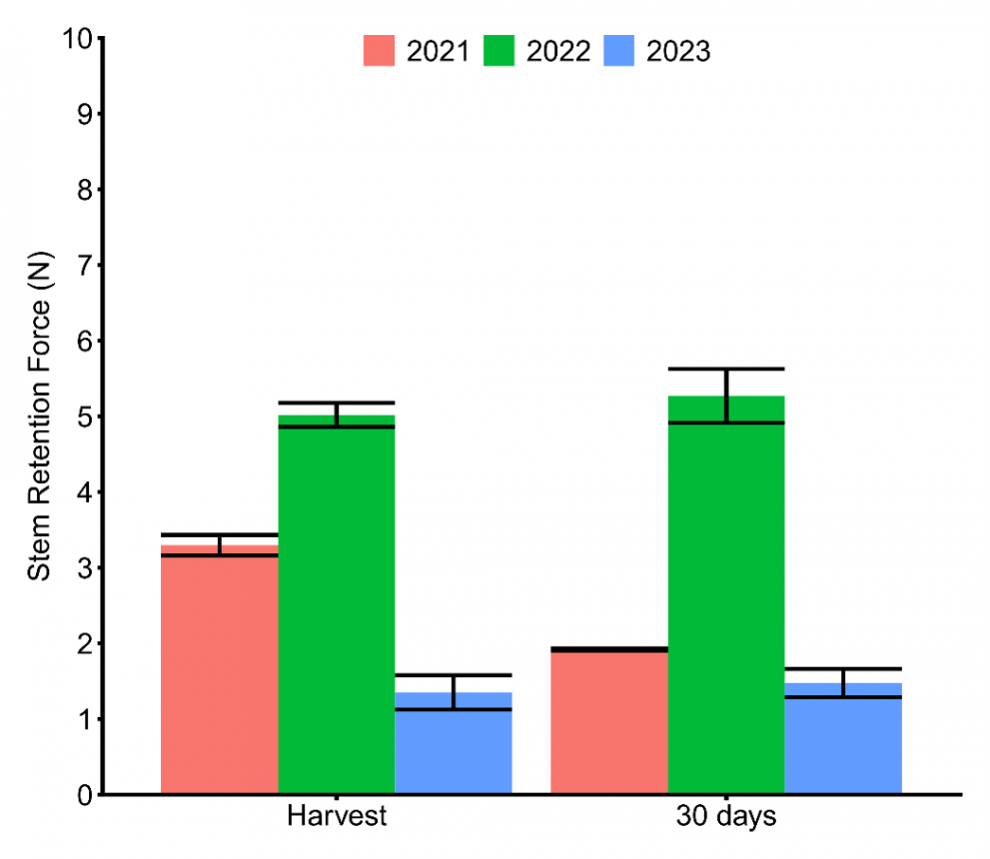 Figure 4. Stem retention force (mean ± standard error; n=270) in ‘Skeena’ cherries from harvest to 30 days after storage (0 °C). Seasons 2021, 2022, and 2023.
Harvest decisions
In stressful years, timely harvest is important, avoiding delays that only accelerate postharvest quality loss. Higher quality fruit has a positive relationship with long-term market profitability. This is worth considering when making harvest decisions.
Knowing your markets also plays a key role in understanding the intended storage time, transport time, and time before fruits reach the consumer. Immediate cooling of fruits from the field reduces respiration rates and improves storability, allowing fruit to a wider range of markets over a longer period. Proper use of modified atmosphere (MA) packaging is another key factor in knowing which packaging will help carry your fruit the longest without compromising on quality. Lastly, temperature fluctuations during storage can be one’s worst enemy and should be avoided at all costs, within reason.
Carolina Torres e Thiago Campbell
Washington State University
Source: Fruit Matters
Opening image source: Stefano Lugli
Cherry Times - All rights reserved