Dale and Brandon Goldy want their cherry trees in production in the third leaf. To create an orchard that starts returning on their investment sooner, they had to rethink their approaches to tree training and vigor management to encourage young trees to break as many branches as possible.
“Our focus has been to shoot for vigor and turn it into fruiting wood fast,” Dale said. This spring, they showed Good Fruit Grower the painstaking scoring and plant growth regulator, or PGR, applications they use to set up trees for success.
By early summer, the results were apparent: bushy leaders flush with fresh shoots that will be branches with fruit set at their bases next summer. “I can’t glue them on if I don’t have them,” Brandon said. “Our goal is to induce every one of the buds to break.”
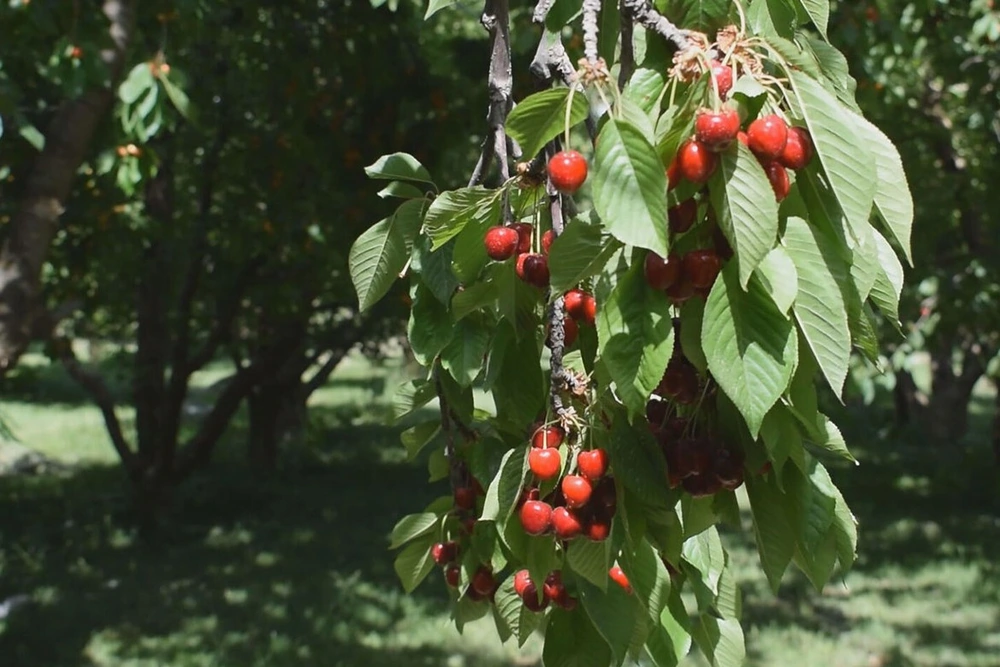
The father and son team said they were pleased with the results in a Quincy, Washington, orchard, planted with a proprietary variety on Mazzard roots that they trained with two leaders in a narrow, inline V. That angle seems to produce fewer upright suckers than a wider angle, Dale said.
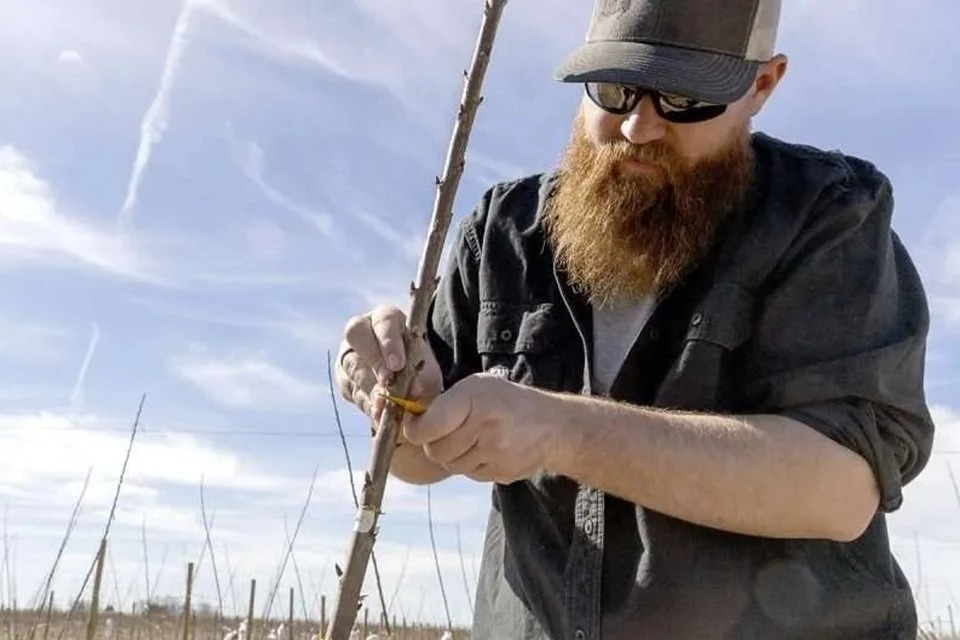 Image 1. Grower Brandon Goldy demonstrates the scoring technique used to promote branching on young, high-density cherries in an orchard in Quincy, Washington, in March 2025. (Kate Prengaman/Good Fruit Grower)
Establishment and dominance
“The way we used to farm, this would be an excessive amount of growth and difficult to manage,” he said. “If we weren’t using Promalin and scoring on this thing, we would end up with all our vigor at the top and a bunch of blind wood down here at the bottom, and it would be an uncontrollable tree.”
Dale agreed to share his current approach to cherry establishment with one strict caveat: recognition that the approach must be tailored to each variety, rootstock and site. This Quincy block, for example, offers a lot of vigor for them to work with.
“I could give everybody the recipe and it will fail in other locations,” he said. “There are opportunities here to radically change how we are treating cherries, but it’s not a cookie-cutter deal.”
Cherries want to grow up, up, up, and that apical dominance can lead to blind wood and spur extinction, especially as trees age and less light penetrates the lower canopy. The inline V, which creates a vertical canopy, allows for more light interception than a traditional V, Dale said.
Branch selection and growth
After planting, crews headed back the trees to 18 inches (circa 45 cm) and subsequently selected two equal shoots when they had just 3 inches (circa 7,5 cm) of growth. Trying to grow two-leader trees in the nursery (which he also owns) never translated into consistent height once trees were planted out in the orchard, he said.
“If they are not equal from day one, you are going to fight it for a long time,” Dale said. He has used the same branch-building approach on single-leader trees planted on less vigorous roots.
Once the trees are growing in the spring, they use several applications of MaxCel (6-benzyladenine) every seven to 10 days. The key is to start early, because the induced branches end up higher in the tree than they were when the product was applied during those high rates of growth, Dale said.
Dyeing the product blue helps workers track the applications. Once he has six to nine branches, they stop. The gaps — and many trees will have gaps — can be induced to fill by applying Promalin (6-benzyladenine and gibberellins) and scoring in the second leaf, and even in the third.
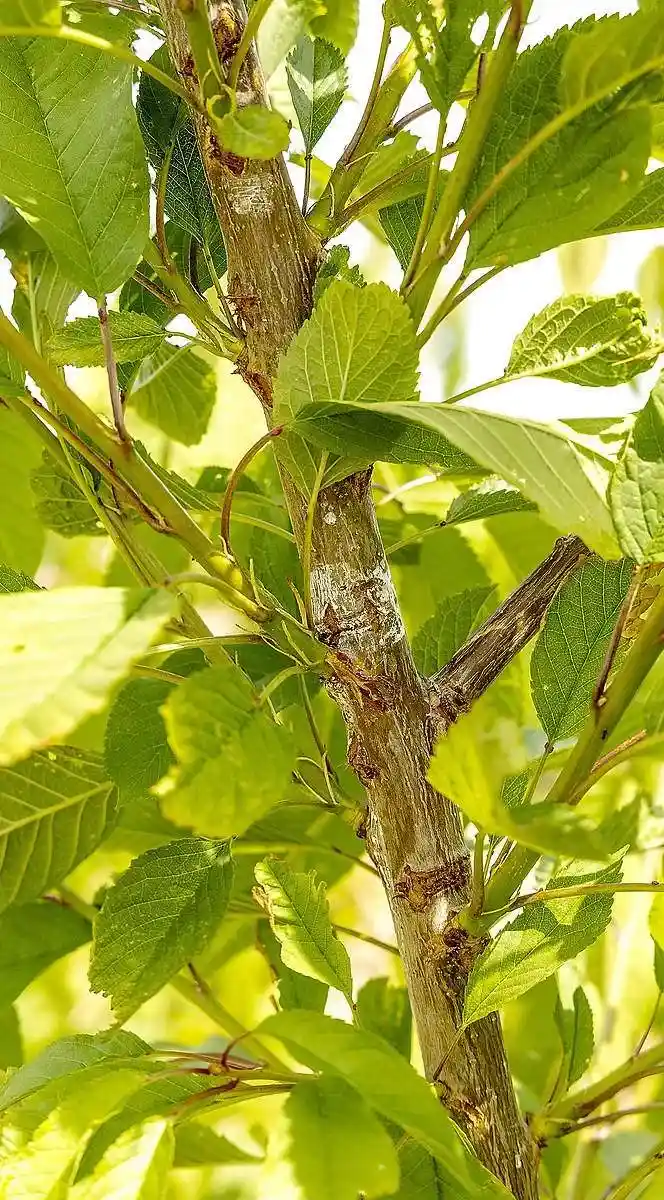 Image 3. One dab of Promalin per foot of the leader is enough to promote branching throughout that area, when paired with scoring, as the young trees in Goldy’s orchard demonstrate in mid-May. (Kate Prengaman/Good Fruit Grower)
Scoring and Promalin application
“As the tree gets older, the score response slows, but you still get 60 percent to push a branch in 4-year-old trees if there is plenty of sunshine,” Dale said. “You have to stay aggressive with it.” Promalin application is visible, on alternating sides of the two leaders, about every foot (circa 30 cm).
After 20 years of using Promalin to induce branching, Dale believes he’s dialed in his approach: a three-pass system. Brandon explained the process.
On the first pass, workers focus on the leader, making scoring cuts every foot (circa 30 cm) on alternating sides. They use a sawblade that’s taped to a paintbrush for applying the paint and hormone solution — a tool that’s exactly a foot long.
For a second pass, workers use a lower rate of the PGR for the smaller-caliper, upper leader. The hormone just needs a wound to enter; its effect doesn’t only target one bud, Brandon said. But it is directional, so they avoid applying it on the insides of the leader because they don’t want branches inside the V.
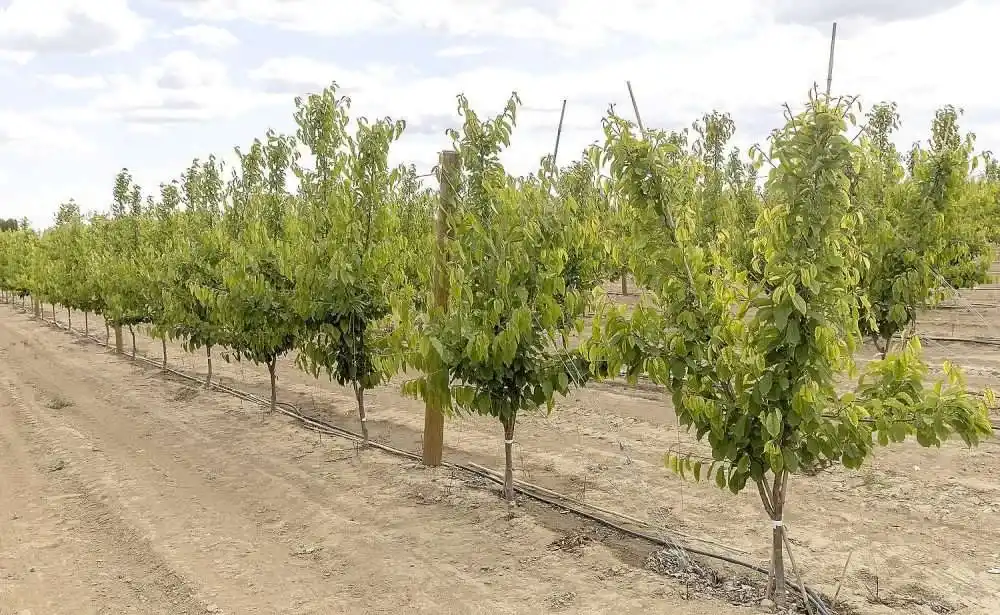 Image 4. These second-leaf cherries, a proprietary variety planted on Mazzard roots, have responded well to the branching treatments. Building renewal options is necessary to speed these high-density cherries into production and keep them there, Dale Goldy said. (Kate Prengaman/Good Fruit Grower)
Bud scoring and early fruiting
With this approach, the total amount of Promalin needed is just three quarts (circa 2,8 litri) for the 10-acre (circa 4 ettari) block, he said. The final step in the second leaf is individual bud scoring, no hormone needed.
The small cut protects the bud from the auxin flowing down from the leader, reducing the signal that tells the bud to stay dormant in favor of the apical growth. The Goldys score just above every bud they want to become a branch.
That’s a lot of buds — and a lot of supervision of the crews. “We’re spending money this year because we planned for this — the branches that will be induced by these cuts will have cherries on the base of them next year,” Dale said.
“If we hadn’t planned that, we wouldn’t be standing here today talking about a third-leaf crop potential.” Setting that first crop early also helps control vigor going forward.
“It shocks the tree out of juvenility and convinces the tree it’s in the business of producing cherries,” Dale said. After all, so is he.
Source images: good Fruit Grower
Kate Prengaman
Editor of Good Fruit Grower
Cherry Times - All rights reserved