The 4th edition of CherryTech 2026 was attended by Jordi Casas, an international technical consultant specializing in stone fruit, grapes, kiwifruit and cherries, who analyzed both the past and future seasons of Chilean cherries.
During his presentation, Casas carried out a technical and commercial analysis of the season, indicating that production decreased compared with the historic record of 125 million boxes and that better sizes were achieved, thanks to agronomic practices that allowed for more efficient crop load regulation in orchards.
Despite this, prices continued to decline.
“With the same or lower volume, and with fruit that was theoretically better, we should have seen a positive response from the market. However, that did not happen,” he pointed out.
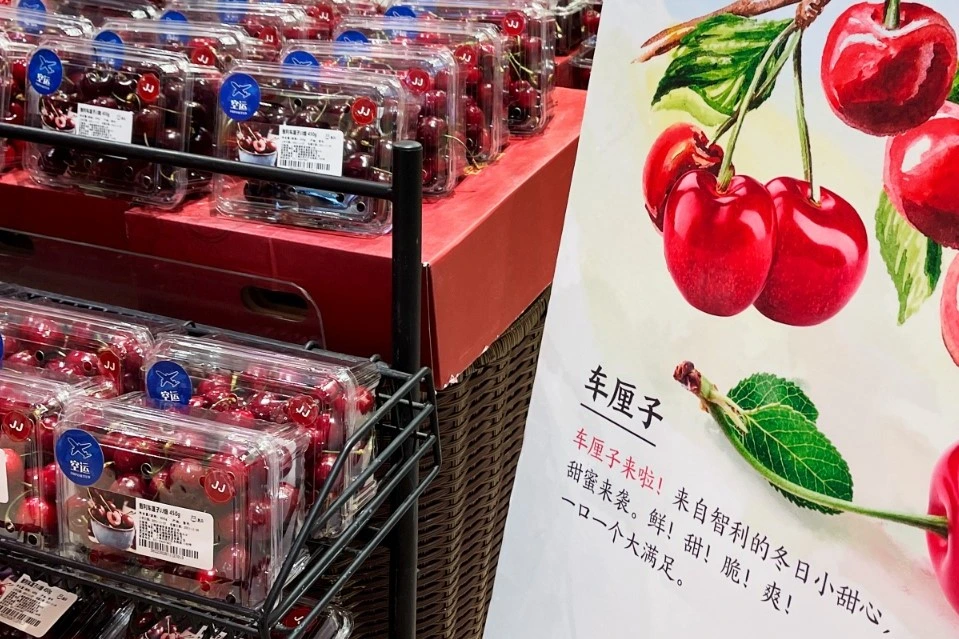
He explained that last season Chile reduced its shipments to China by 9% and increased its exports to other markets.
He added that the industry also had to face significant issues related to quality and fruit condition. He specified that, in some cases, an increase was detected in soft fruit, browning, pedicel dehydration, cracking and other defects that compromised the perception of the product at destination.
According to Casas, the main factor that contributed to the drop in prices was the commercial management of supply. He explained that holding back fruit during periods of high volume generated an accumulation that ultimately put further downward pressure on values.
“We are talking about a highly perishable product. When a large volume arrives, more developed markets understand that it is necessary to run promotions and move the fruit quickly. Holding it back can end up damaging the market and accelerating the fall in prices,” he stated.
Chilean cherries and the adaptation process
Despite the difficulties, Casas stated that the South American country maintains a privileged position as the main supplier of cherries in the Southern Hemisphere and will continue to be the dominant player in the coming years.
However, he warned that this competitive advantage requires greater coordination and a broader capacity for adaptation to change.
“The challenge is no longer just to produce more. We must learn to manage this machine that we have built as an industry better,” he argued.
Urgent decisions to restore profitability
Without a doubt, one of the main turning points in the Chilean cherry business is profitability.
Casas emphasized that the new scenario is forcing the industry to analyze each plot and each variety individually, in order to determine which are still sustainable and which should exit the business.
“There are orchards and varieties that are no longer profitable. If production and commercial conditions have changed, we must make decisions now and not continue to increase losses,” he indicated.
In his view, varietal renewal will be a key tool for the future, as has already happened in the past for species such as table grapes, apples and nectarines.
Taking a long-term view, the consultant stressed that the sector’s competitiveness will increasingly depend on the ability to produce consistent, high-quality fruit.
To this end, he mentioned as priorities more precise irrigation management, proper crop load regulation, balanced use of growth regulators, rigorous phytosanitary programs and strict control of field operations.
New strategy
The specialist explained that the Chilean industry must move toward a new, more coordinated strategy, taking successful models such as Zespri in kiwifruit as an example. He stressed that this does not mean replicating that scheme exactly, but rather recovering one of its main lessons: the ability to build a direct relationship with the consumer.
“We continue to work mainly with importers and distributors. The challenge is to win over the consumer and recover the value of the Chilean cherry,” he declared.
Finally, he called for stronger market diversification, more demanding quality standards both at origin and destination, and the recovery of the premium character that has historically distinguished Chilean cherries.
“We have a privileged position and an enormous competitive advantage. But if we continue doing the same things, we will achieve exactly the same results. This season has left us with many lessons, and we must use them to build a stronger and more sustainable industry.”
Source: Macarena Bravo, Portal Fruticola
Image source: Stefano Lugli
Cherry Times - All rights reserved