Climate change is increasingly altering the biological cycles of fruit tree species, with direct impacts on orchard management and production stability.
In this context, a recent study conducted at the experimental station in Iași, Romania, investigated the phenological dynamics of several species belonging to the genus Prunus in response to interannual climate variability.
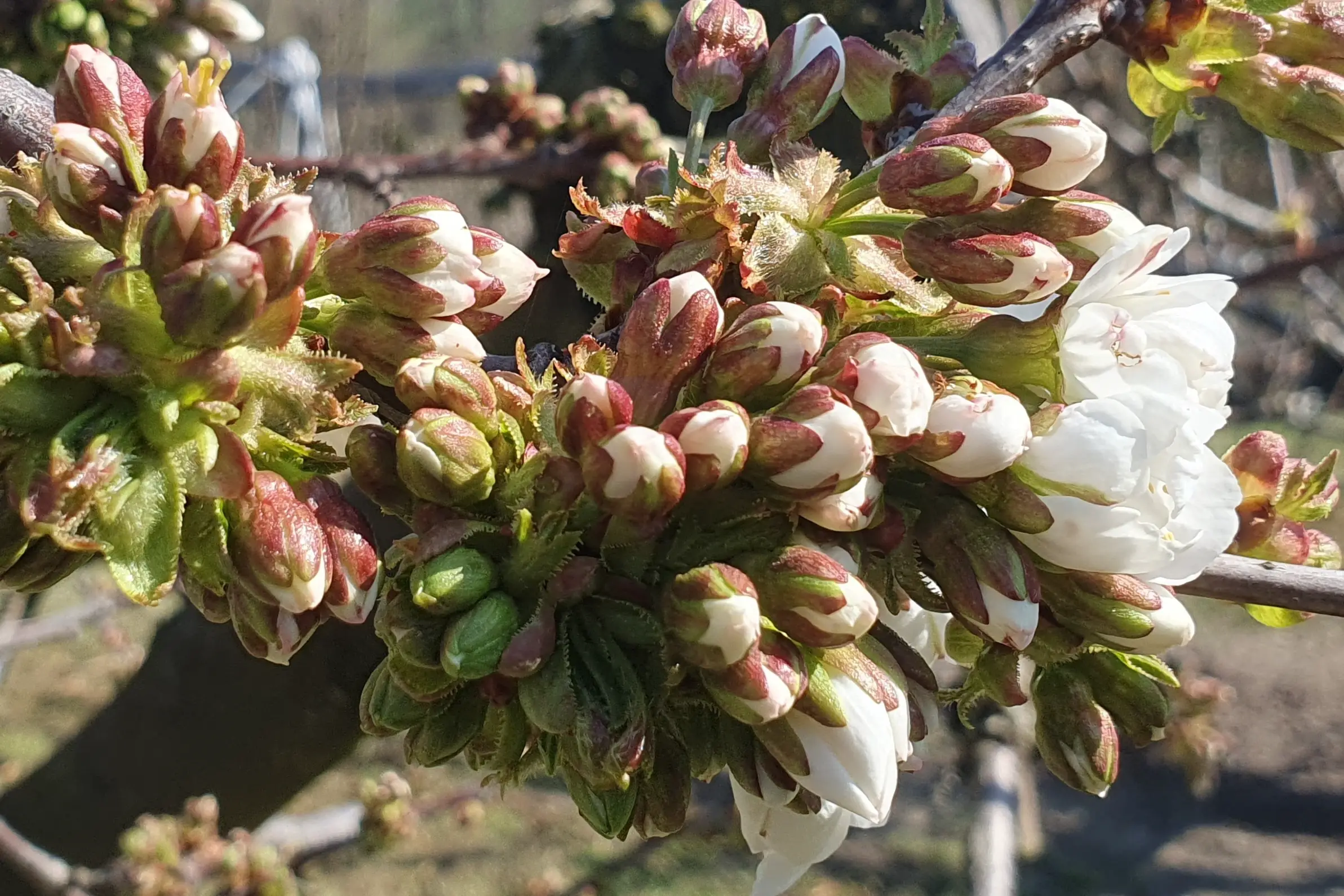
The research analyzed, over the years 2023 and 2024, four stone fruit species: sweet cherry (Prunus avium), sour cherry (P. cerasus), plum (P. domestica), and apricot (P. armeniaca), monitoring the main phenological stages from the onset of vegetative growth (BBCH 51) to the end of flowering (BBCH 69).
Study context and objectives
The observed values were compared with historical averages recorded over the 1972–2022 period.
The results show that annual climatic conditions significantly influence both the timing of vegetative resumption and the duration of the different phenological stages, confirming the high sensitivity of these species to temperature and precipitation fluctuations.
In particular, 2023 was characterized by a general advancement of phenological stages compared to 2024, with substantial differences in the onset of vegetative growth: up to 29 days earlier in sweet cherry and 21 days in plum.
However, this advancement was associated with a reduction in the overall duration of phenological stages, attributable to water and heat stress conditions caused by high temperatures and significantly lower-than-average precipitation.
Climatic differences between 2023 and 2024
Conversely, 2024, characterized by greater water availability and a different thermal pattern, showed a delay in vegetative resumption but a longer duration of phenological stages, suggesting a complex interaction between temperature and water availability in determining plant developmental dynamics.
Indeed, climate data analysis revealed positive temperature anomalies compared to the historical average (+2.9°C), along with irregular precipitation patterns, consistent with broader climate change trends.
An interesting aspect emerging from the study is the variability observed not only among species but also among cultivars, highlighting a strong genotype-specific influence on phenological responses.
Implications for orchard management
This has important strategic implications for varietal selection and orchard planning, particularly under increasingly unstable climatic conditions.
From an operational perspective, the findings emphasize that phenological monitoring represents a simple yet highly effective tool for predicting agronomic risks, especially those related to late spring frosts, which can severely compromise production.
Earlier flowering, in fact, exposes crops to a higher likelihood of cold damage in the event of temperature drops.
Furthermore, variations in the duration of phenological stages may affect key processes such as fruit set and fruit development, with consequences for both yield and final quality.
Physiological processes and conclusions
The chilling and heat requirements of temperate species play a critical role in regulating dormancy and subsequent vegetative growth, and the failure to meet these requirements, an increasingly common occurrence under mild winter conditions, can lead to imbalances in phenological development.
In conclusion, the experimental evidence confirms that the phenology of stone fruit species is strongly influenced by annual climatic conditions and that the observed variations represent a sensitive indicator of climate change effects.
The integration of phenological and climatic data is therefore essential for developing effective adaptation strategies, from cultivar selection to orchard management, in order to ensure the resilience and sustainability of modern fruit production systems.
Source: Mineață, I., Perju, I., Sîrbu, S., Ungureanu, I. V., Golache, I. E., & Iurea, E. (2025). Phenological dynamics of some fruit species from the Northeastern area of Romania in the context of climate change. RJH, 6, 143-148. https://doi.org/10.51258/RJH.2025.13
Image source: Stefano Lugli
Andrea Giovannini
PhD in Agricultural, Environmental and Food Science and Technology - Arboriculture and Fruitculture, University of Bologna, IT
Cherry Times - All rights reserved