Controlled deficit irrigation is now widely regarded as a best management practice particularly when applied during the post-harvest period. However, its effectiveness must be supported by experimental evidence.
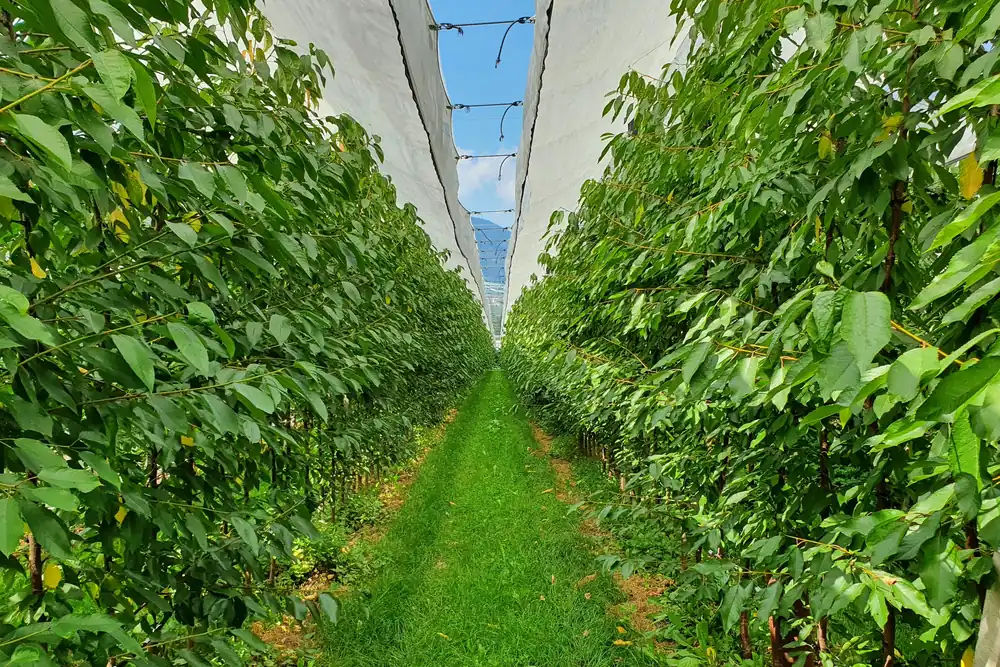
For this reason, a study conducted at the University of Concepción (Chile) investigated the effects of post-harvest controlled water deficit on a sweet cherry orchard in cv. “Santina”, with special emphasis on plant physiological responses, productivity, and soil microbial dynamics.
The main objective was to assess whether a strategic reduction in irrigation during a less critical phenological stage could optimize water use without negatively affecting agronomic performance or the overall soil–plant system.
The experiment
The experiment was carried out by applying different irrigation regimes, comparing a control treatment (meeting full crop water requirements) with one or more controlled deficit irrigation treatments measured variables included key plant physiological parameters.
Measured variables included key plant physiological parameters such as leaf water potential, stomatal conductance, and photosynthetic activity, along with productivity indicators like yield fruit size, and quality.
In parallel, the soil microbial community in the rhizosphere was analyzed to understand how variations in water availability influence the structure and function of root-associated microorganisms.
The results
The results showed that post-harvest controlled deficit irrigation induces a moderate reduction in plant water status indicators, without causing irreversible stress. Plants exhibited adaptive responses through stomatal regulation and improved water-use efficiency.
Maintaining adequate photosynthetic activity, this finding suggests that the post-harvest phase represents an optimal window for implementing water-saving strategies from a productive perspective.
From a productive perspective, no significant reductions in yield or fruit quality were observed in the following season, indicating that controlled water deficit does not compromise the productive potential of cv “Santina”.
Productive perspective
When properly managed, in some cases improvements in fruit quality were even detected, likely due to more efficient resource allocation and physiological regulation a key aspect of the study concerns the response of the soil microbial community.
Reduced water availability led to shifts in microbial composition and diversity, favoring taxa better adapted to drought conditions. These microorganisms may play a crucial role in enhancing plant resilience.
By improving nutrient availability and providing protection against environmental stress, therefore controlled deficit irrigation affects not only the plant directly but also indirectly through modifications of the soil microbiome.
In conclusion
In conclusion, the study demonstrates that post-harvest controlled deficit irrigation is an effective strategy to improve water-use efficiency in orchard systems without compromising productivity.
Moreover, the interaction between plants and soil microbial community emerges as a fundamental component in the overall response to water stress, offering valuable insights for the development of sustainable agricultural practices in water-limited environments.
Source: https://repositorio.udec.cl/items/db971c4f-e504-415f-9af8-aacb83e52054
Image source: Stefano Lugli
Melissa Venturi
Ph.D. in Agricultural, Environmental, and Food Sciences and Technologies – Fruit Tree Physiology and Cultivation - Bologna, Italy
Cherry Times - All rights reserved