In recent years, cherry cultivation has had to face increasingly complex challenges linked to climate variability. Heavy rainfall during fruit ripening, hail events, and periods of intense heat can compromise both the quality and quantity of production.
To reduce these risks, many modern cherry orchards have been equipped with covering systems. These structures are mainly used to protect fruit from rain, which can cause cracking, but also from hail, wind, and excessive solar radiation. However, in addition to physically protecting the plants, covers also modify the orchard’s growing environment.
To better understand these effects, the CHOICE research project (Optimizing Cherry Physiological Performance through the Correct Choice of Multifunctional Covers) was developed, thanks to the collaboration between several Italian research groups, including the University of Bologna, the University of Modena and Reggio Emilia, and the University of Naples Federico II.
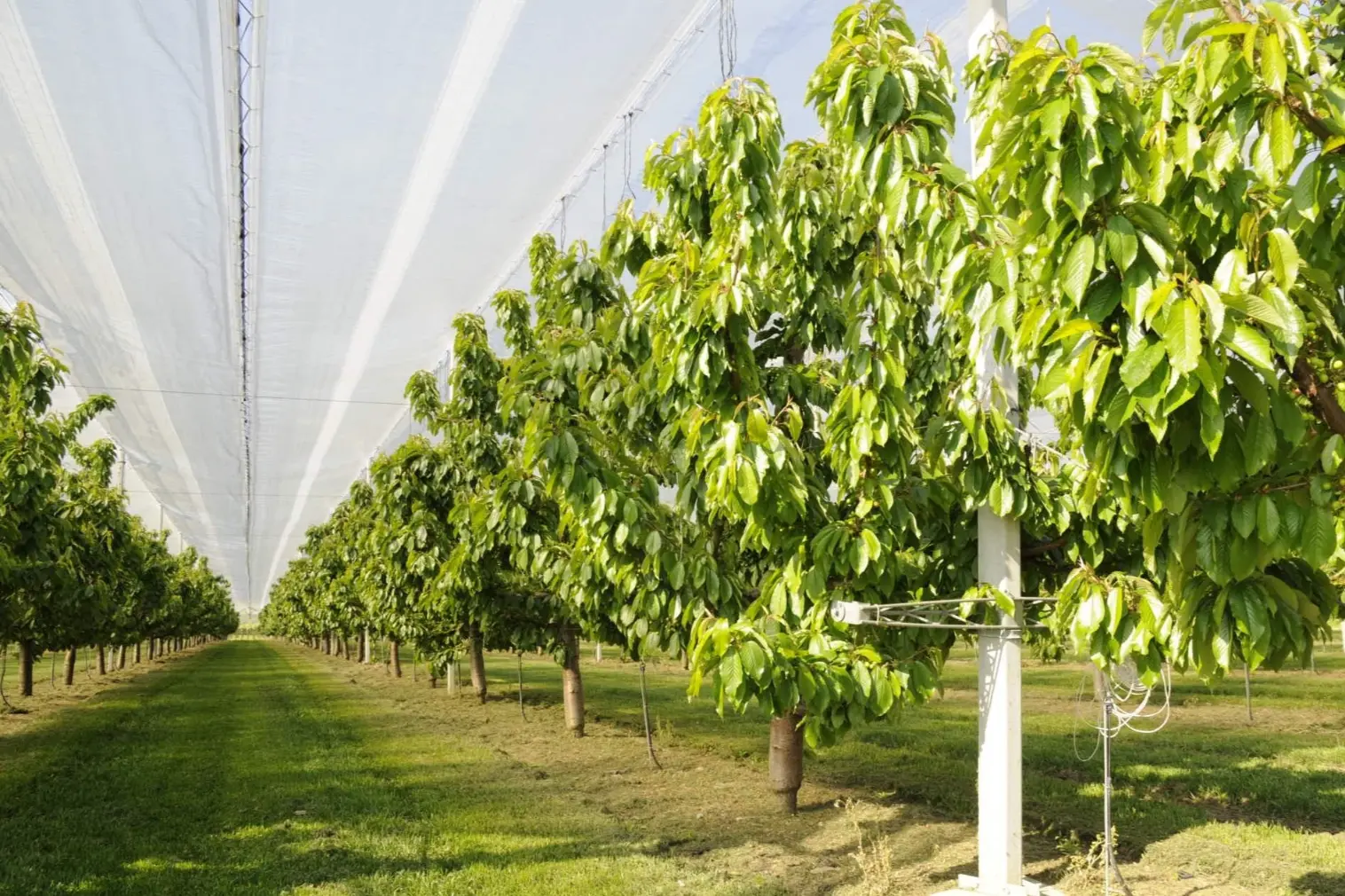
The objective of the project was to understand how different coverings influence the microclimate of cherry orchards and how these changes affect the physiology of cherry plants.
When a cover is installed over a cherry orchard, certain environmental conditions change significantly. The first concerns solar radiation, that is, the amount of light reaching the plant canopy. Nets and plastic films used as covers partially reduce photosynthetically active radiation (PAR), i.e., the light used by plants for photosynthesis. However, this reduction does not always lead to negative effects.
In fact, many covers increase the diffuse light component. Unlike direct light, diffuse light penetrates more effectively into the canopy and reaches leaves located in the inner zones. This can improve light distribution within the canopy and allow a larger portion of the leaves to participate in photosynthesis.
Covers also influence the air temperature inside the cherry orchard. The shading effect generally reduces maximum temperatures during the hottest hours of the day. This can be particularly useful in summer, when high temperatures and strong solar radiation can cause heat stress in plants. In many cases, covers also help stabilize the orchard microclimate by reducing temperature fluctuations throughout the day.
Another factor
Another important factor is the vapor pressure deficit (VPD), which indicates the evaporative demand of the atmosphere. Under conditions of strong radiation and low relative humidity, VPD increases and plants lose more water through transpiration. Covers tend to reduce VPD because they limit solar radiation and reduce ventilation within the orchard. This means that the atmosphere under the cover demands less water from plants, helping to reduce transpiration and improve plant water status.
These microclimatic modifications directly affect some fundamental physiological processes of the cherry tree. One of the most important is photosynthesis, the process by which plants use light to produce energy in the form of carbohydrates. In theory, a reduction in radiation could decrease photosynthetic activity.
However, the results obtained in the CHOICE project show that this effect strongly depends on canopy structure. In modern cultivation systems, characterized by dwarfing rootstocks and relatively open canopies, the diffuse light generated by covers can compensate for the reduction in direct radiation. Under these conditions, photosynthesis remains at adequate levels because light is better distributed among the leaves.
Covers also influence stomatal conductance, that is, the degree of stomatal opening. Stomata are small openings on the leaf surface that regulate gas exchange between the plant and the atmosphere. Through the stomata, carbon dioxide enters for photosynthesis, and water vapor is released during transpiration.
When VPD is very high, plants tend to close stomata to reduce water loss. Under covers, however, the reduced evaporative demand allows stomata to remain more open, promoting gas exchange and maintaining active photosynthesis.
Another aspect
Another very important aspect concerns the plant water balance, that is, the equilibrium between water absorbed by the roots and water lost through transpiration. During the CHOICE project, it was observed that plants grown under covers often show better water status compared to those grown in open field conditions.
This was verified by measuring leaf water potential, a parameter that indicates the plant’s level of water stress. In many cases, plants under cover showed less negative water potential values, indicating reduced water loss and more favorable physiological conditions.
To analyze these aspects, several experimental trials were conducted in experimental and commercial cherry orchards. The trials compared plots equipped with different types of coverings with control plots without protection. Sensors were installed within the plots to continuously monitor microclimatic conditions, including photosynthetically active radiation, air temperature, relative humidity, and wind speed. This monitoring made it possible to precisely quantify the environmental changes caused by the covers.
At the same time, ecophysiological measurements were carried out on the plants. Leaf gas exchanges were measured using portable analyzers, instruments that allow direct determination of photosynthesis rate, stomatal conductance, and leaf transpiration.
Measurements were taken at different times of the day and at various stages of the growing season, in order to observe how plant responses changed depending on environmental conditions. In addition to these measurements, plant water status was assessed by measuring leaf water potential using a pressure chamber.
Overall results
The overall results of the project showed that the effects of covers strongly depend on the characteristics of the cropping system. In modern cherry orchards, with low-vigor rootstocks and well-lit canopies, covers can help improve plant water status and reduce heat stress without compromising photosynthesis. In more vigorous systems with very dense canopies, however, excessive reduction in radiation could limit the photosynthetic activity of inner leaves.
For this reason, the choice of cover should not be based only on fruit protection, but also on orchard characteristics. Rootstock vigor, planting density, and canopy structure are all factors that influence plant response to covers.
Research conducted within the CHOICE project therefore highlights the importance of adopting a more targeted approach when selecting covering systems, in order to optimize both fruit protection and plant physiological performance. In conclusion, multifunctional covers represent an increasingly important tool for managing modern cherry orchards.
In addition to reducing risks related to adverse climatic events, these structures can help create microclimatic conditions more favorable to plant physiology. Understanding how covers influence the microclimate and physiological processes of the cherry tree is therefore essential to improve orchard efficiency and make cherry production more stable and sustainable over time.
Image source: Valente
Francesca Galizia
Foglie TV
Cherry Times - All rights reserved