Have you ever wondered why perfectly healthy-looking fruits suddenly split open before harvest? Fruit cracking is one of the most common and costly challenges growers face, often appearing just when fruits seem ready for the market.
This physiological disorder not only affects the appearance of the fruit, it also reduces yield, profitability, and the overall sustainability of orchard management.
Overview of the fruit cracking phenomenon
Fruit cracking occurs when the outer layers of the fruit - the peel or skin - rupture due to internal pressure or environmental stress. It is a widespread issue affecting several high-value crops such as citrus, table grapes, sweet cherries, and pomegranates.
In pomegranates, for instance, the outer red skin and the inner white spongy layer are very sensitive to changes in water supply. When the fruit absorbs too much water after a dry spell, its inner tissues expand faster than the skin can stretch, causing it to burst.
Cracking in pomegranate can cause up to 50% loss in marketable yield, with severe effects on fruit quality and storage potential. This is particularly common in semi-arid Mediterranean regions, where irregular irrigation and climate fluctuations put trees under stress.
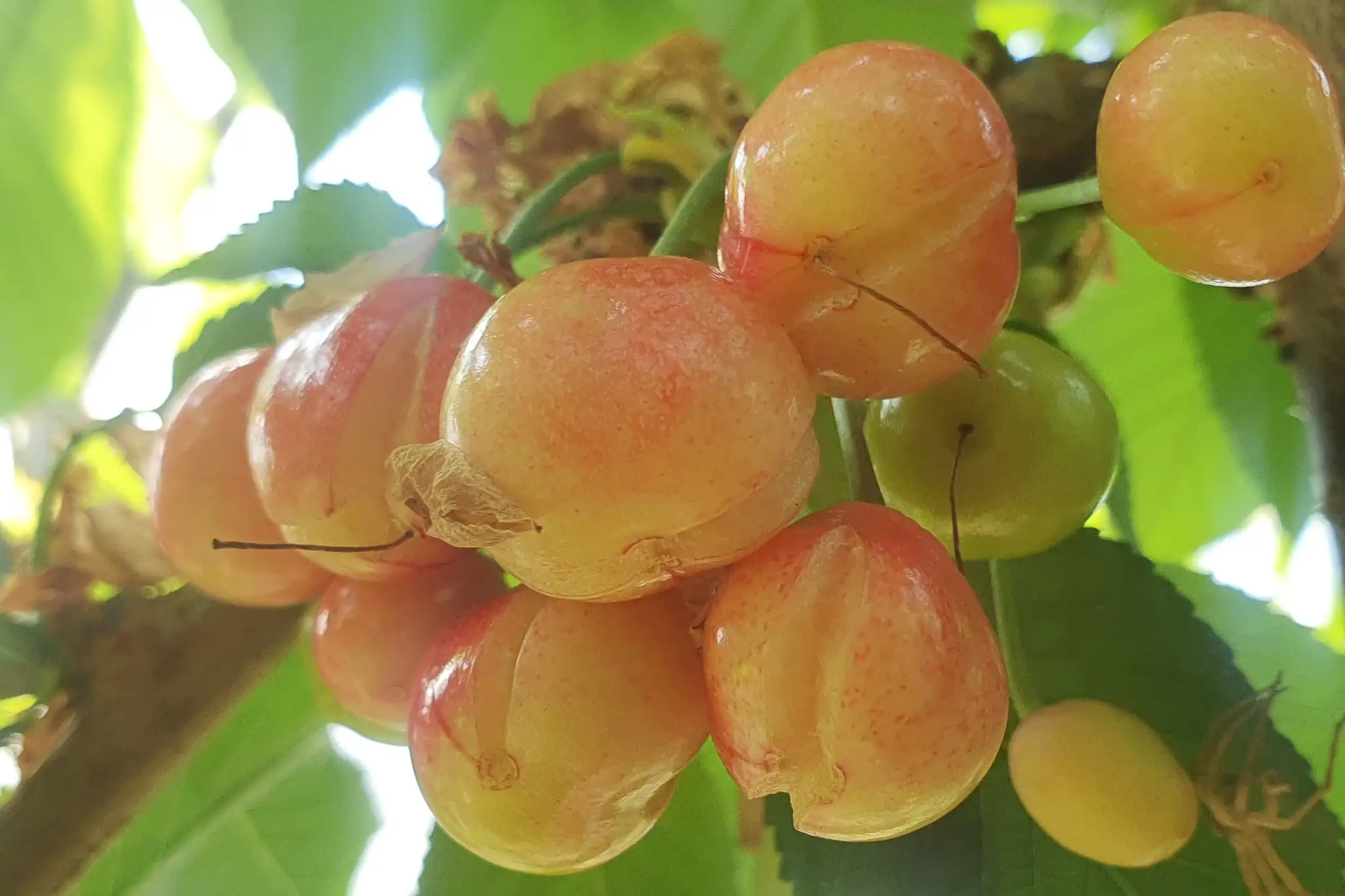
Similar mechanisms appear in sweet cherries and table grapes. In cherries, prolonged surface wetness from rainfall near harvest softens the fruit skin and causes splitting, often beginning at specific weak points; once microcracks form, they quickly spread.
In grapes, berries can suddenly take in too much water, causing them to expand until the skin splits. Cracking in both crops is influenced by factors such as shifts in humidity, temperature changes, and variations in soil moisture.
In cherries, for instance, if more than a quarter of the fruits in an orchard are cracked, harvesting becomes economically unviable.
Factors and detection technologies
Citrus fruits also suffer from cracking, particularly in certain cultivars prone to this disorder. The problem often shows up as deep splits on the peel during dry-to-wet transitions or periods of extreme heat.
The intensity of cracking depends on several factors: the plant’s genetic makeup, the thickness and flexibility of the peel, and environmental conditions such as soil type and local climate. Among all influences, irregular irrigation and temperature fluctuations are the main triggers.
While growers have long relied on visual inspection to assess cracking risk, such methods are subjective and often too late to prevent losses. Today, however, new research is exploring how plant physiological and spectral indicators can detect early signs of water stress and tissue strain.
Could precision sensing technologies finally offer growers a way to predict cracking before it happens?
Why tackling cracking matters
Fruit cracking is not just a matter of appearance and it directly affects income, sustainability, and food security. Each split fruit represents wasted resources: water, fertiliser, and labour invested throughout the season.
Moreover, cracked fruits become entry points for pathogens, leading to rot and further yield losses. For growers, this translates into unpredictable harvest outcomes and greater financial uncertainty.
Preventing cracking, therefore, is not simply about maintaining fruit appearance, but it is about stabilising yields, improving resource efficiency, and reducing food waste.
Sustainability also depends on how effectively technology can support decision-making in orchards. Integrated monitoring systems, combining satellite data, meteorological inputs, and on-site sensors, now allow researchers to collect agri-environmental parameters at multiple scales.
Yet, predicting cracking still requires one missing piece: accurate, high-resolution data about fruit-level changes. Gathering such information remains challenging, as each fruit responds differently to its microenvironment.
Advanced sensing and the CrackSense project
The CrackSense project is addressing this gap by upscaling sensing technologies to detect fruit cracking and yield loss at multiple levels, from individual fruit to entire regions.
CrackSense uses advanced tools such as TOMMY, a robotic system equipped with thermal and optical cameras that scans each fruit to detect early stress indicators that may lead to cracking.
In addition, drones collect hyperspectral, multispectral, and thermal data from the air, enabling detailed mapping of canopy variations and identifying zones exposed to temperature or water stress.
Combined with 3D point-cloud imaging, proximal sensors, and RGB-thermal assessments, these technologies merge with environmental data such as soil type, irrigation, and microclimate to build predictive models that estimate cracking risk.
With this integrated approach, the question emerges: could early detection and effective prevention of fruit cracking finally become a practical reality for growers worldwide?
If you are interested in this topic and want to follow our journey, you can connect with us on LinkedIn, and visit our Newsroom to see how close we are to realising the vision of crack-free fruit.
Source: Progetto Crack Sense, Progetto Horizon
Image source: SL Fruit Service
Cherry Times - Tutti i diritti riservati