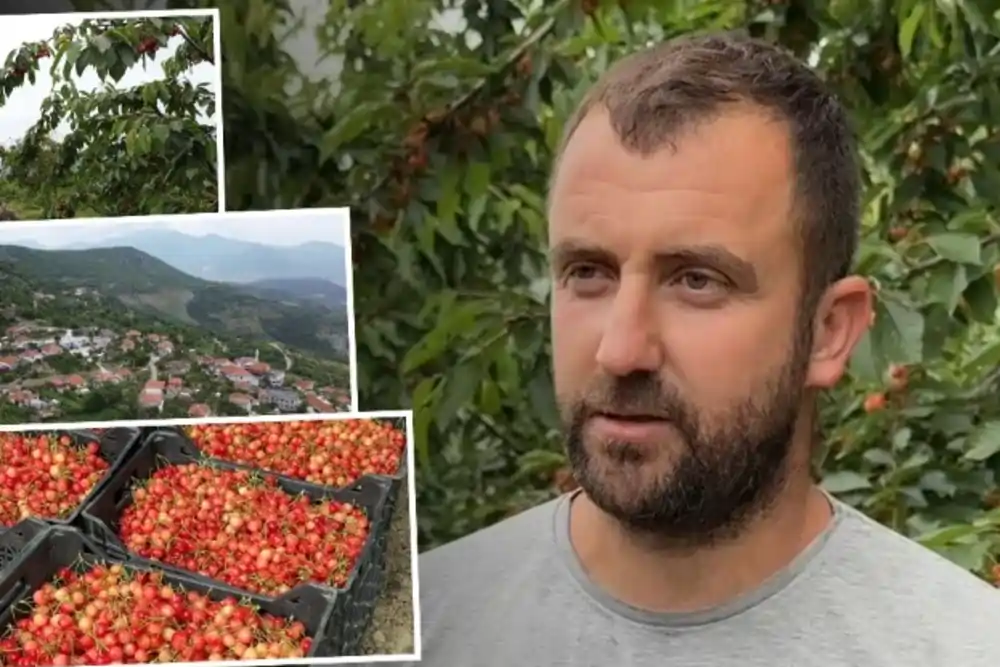
On the gentle hills of Elbasan, where fresh air and fertile soil come together in natural harmony, lies a small village with a big name: Godolesh.
Known as the “cherry village”, this small community produces around 700 tonnes of cherries every year, a fruit that has become a source of pride for the entire area and beyond.
During these warm days of May, the cherry harvest has begun in Godolesh, in the Elbasan district, and farmers are working tirelessly to gather the fruit of an entire year’s work.
Xhevahir Ademi, one of the best-known names in cherry growing, is a remarkable example of returning home after emigrating and achieving success in the production of this highly appreciated fruit.
Roots and success
With 1,500 cherry trees in his orchard, his is a success story that began with emigration but eventually put down strong roots in his homeland.
“This year, the situation is very positive,” Ademi says. “The cherries from the first harvest were sold for 5,000-6,000 lek (approximately €54.62-65.55) per kilogram thanks to their high quality, while those from the second harvest are selling for around 2,000-2,500 lek (approximately €21.85-27.31).
This is a native cherry variety: only Godolesh has this variety. This year, we are practically the only ones with production, because weather conditions have damaged other areas such as Dibër, Korçë and Berat.
This has affected both prices and demand, so we are very satisfied.”
Market and value
The Godolesh cherry is not simply a delicious fruit: it represents heritage, economic value and hope for the future.
This season has been the best in the past 30 years, with prices per kilogram reaching 250-500 lek (approximately €2.73-5.46), due to the shortage of production in the rest of the country.
“Every day, traders arrive from Tirana and from all over Albania. Their numbers have increased like never before, with as many as 20 vans or trucks arriving each day,” Ademi says.
Returning to his roots
Xhevahir’s story is also one of returning to his roots. In the past, he had left his village, Godolesh, and emigrated to Greece in search of a better life. However, it was his Greek employer who made him change his perspective: “He told me, ‘Go back to Albania, your cherries are worth more than the work you do here.’ And he was right.
Those words encouraged me to return. Emigration was not the solution. Here I work for myself, close to my family. It is the best thing,” he says with conviction.
Today, Godolesh has become a symbol of smart and sustainable agriculture. The village’s farmers have preserved a native variety, invested in their trees and in quality, and built a sustainable economy without any external support.
The growing demand on the domestic market, the undeniable quality of the product and the favourable prices recorded this year have made farmers more optimistic than ever. And as Albania seeks its own path towards agricultural development, Godolesh stands as an example to follow: a place where the fruits of hard work generate not only income, but also pride.
Image source: BalkanWeb
Fatmir Popja
BalkanWeb
Cherry Times - All rights reserved